Spanish (Catalan) · Surrealism
Salvador Dalí
b. 11 May 1904, Figueres, Catalonia, Spain — d. 23 January 1989, Figueres, Catalonia, Spain
Salvador Dalí (1904–1989) was a Catalan Surrealist painter famous for melting clocks, double images and meticulously painted dreamscapes, and for a flamboyant public persona. The Persistence of Memory (1931) is his best-known work.
1 work in the collection
Works by Salvador Dalí
Salvador Dalí was a Spanish painter, born in Figueres, Catalonia, in 1904, who became the most famous member of the Surrealist movement. His precise, almost photographic technique applied to impossible subjects, melting watches, burning giraffes, elephants on spindly legs, made the irrational look real, and his showmanship made him one of the best-known artists of the twentieth century.
Life in brief
Dalí studied at the Royal Academy of Fine Arts of San Fernando in Madrid, where he befriended the poet Federico García Lorca and the filmmaker Luis Buñuel, with whom he made the Surrealist film Un Chien Andalou (1929). That year he joined the Surrealists in Paris and met Gala, then married to the poet Paul Éluard, who became his wife, muse and manager. The Persistence of Memory (1931, Museum of Modern Art, New York) made him famous. His politics and commercialism led André Breton to expel him from the group in 1939. Dalí spent the 1940s in the United States, then returned to Catalonia, living at Portlligat near Cadaqués. In 1974 he opened the Dalí Theatre-Museum in Figueres, where he is buried.
Style and method
Dalí called his approach the "paranoiac-critical method": a deliberate cultivation of delusional associations so that one form could be seen as another. His double images, in which a landscape is also a face, or a group of figures also a skull, come from this. His technique was old-masterly, with smooth glazes and minute detail modeled on Vermeer and Velázquez, which is what makes his dreams so convincing.
The Endless Enigma
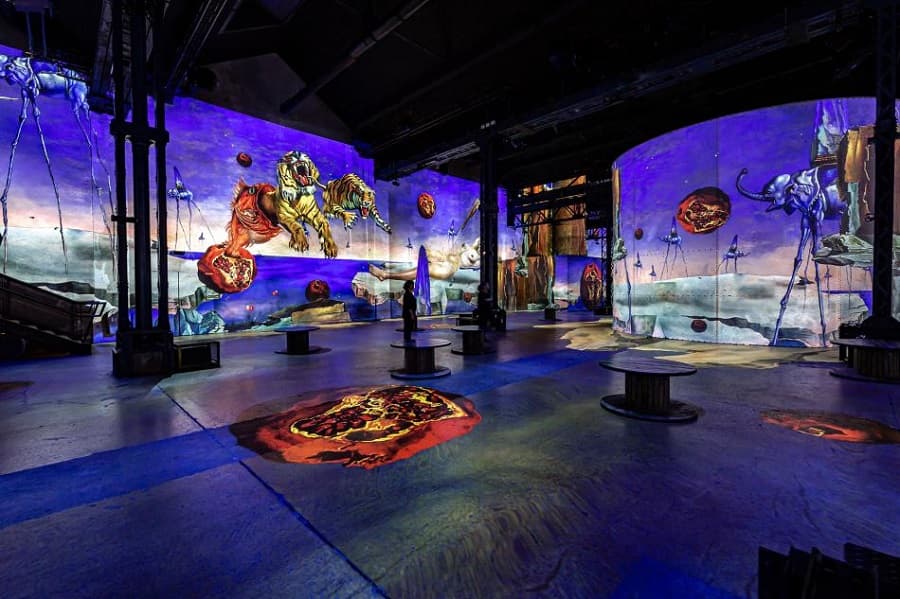
The Endless Enigma (1938, Museo Reina Sofía, Madrid) is one of his most complex double images, in which a beach scene contains several superimposed pictures at once: a reclining figure, a greyhound, a face, a mandolin. The title was borrowed for Dalí, l'énigme sans fin (The Endless Enigma), an immersive digital exhibition at the Atelier des Lumières in Paris from May 2021 to January 2022, which projected images from six decades of his work across the walls and floors of a former foundry, much as the same venue did for Van Gogh and Yves Klein.
Where to see his work
The Dalí Theatre-Museum in Figueres, the Salvador Dalí Museum in St. Petersburg, Florida, the Reina Sofía in Madrid and the Museum of Modern Art in New York hold the most important collections. See more in Famous Paintings.
Questions & answers
What is Salvador Dalí famous for?
Dalí is famous for Surrealist paintings such as The Persistence of Memory (1931), with its melting clocks, for double images that can be read two ways, and for an eccentric public persona with an upturned mustache.
What was The Endless Enigma exhibition?
Dalí, l'énigme sans fin (The Endless Enigma) was an immersive digital exhibition at the Atelier des Lumières in Paris, running from May 2021 to January 2022, that projected Dalí's paintings across the walls and floors of a former foundry, set to music.
Where is Dalí's painting The Endless Enigma?
Dalí's 1938 painting The Endless Enigma, a complex double image combining several hidden figures in a beach landscape, is in the Museo Nacional Centro de Arte Reina Sofía in Madrid.