Spanish · Baroque · Spanish Golden Age
Diego Velázquez
b. 1599 (baptized 6 June), Seville — d. 6 August 1660, Madrid
Diego Velázquez (1599–1660) was the leading painter of the Spanish Golden Age and court painter to Philip IV, whose Las Meninas (1656) in the Prado is often called the greatest painting ever made.
1 work in the collection
Works by Diego Velázquez
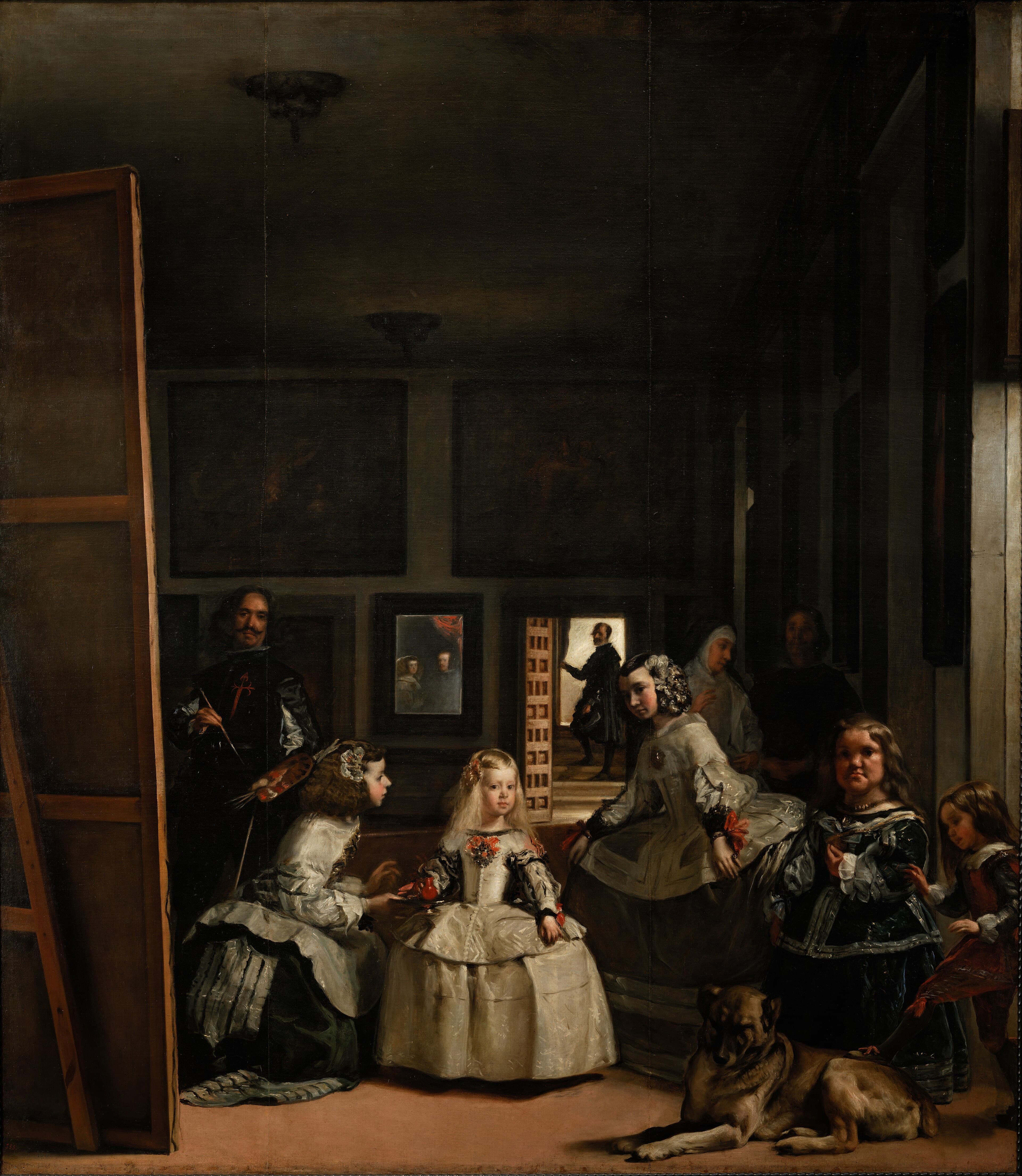
Diego Rodríguez de Silva y Velázquez was court painter to King Philip IV of Spain for nearly four decades and one of the most influential painters in European history. His masterpiece, Las Meninas (1656), hangs in the Museo del Prado in Madrid, which holds the largest collection of his paintings in the world.
Life in brief
Velázquez was baptized in Seville on 6 June 1599, the eldest son of a family of minor gentry. Seville was then the richest city in Spain, the port for the Americas, and at about eleven he was apprenticed to the painter and theorist Francisco Pacheco. In 1618 he married Pacheco's daughter, Juana.
His early Seville pictures are bodegones, kitchen and tavern scenes with still-life elements, painted with a hard, raking light that shows his debt to the naturalism of Caravaggio. An Old Woman Cooking Eggs (1618, Scottish National Gallery, Edinburgh) and The Waterseller of Seville (c. 1618–22, Apsley House, London) already show his gift: an egg whitening in hot oil, a drop of water running down a clay jar.
In 1623 he moved to Madrid, painted the eighteen-year-old Philip IV, and was appointed a royal painter. He would serve the king until his death. The visit of Peter Paul Rubens to Madrid in 1628–29 encouraged him to travel, and in 1629–31 he spent eighteen months in Italy, studying Titian in Venice and the antique and Raphael in Rome. A second Italian journey, in 1649–51, was partly to buy paintings and casts for the royal collection.
At court he rose beyond painting. He held a series of palace offices, culminating in 1652 as aposentador mayor, responsible for the king's lodgings and ceremonies. In 1659, after long investigations into his ancestry, he was made a knight of the Order of Santiago, the honor he had wanted most. In 1660 he organized the decoration for the meeting on the Isle of Pheasants at which the Infanta Maria Theresa was handed over to marry Louis XIV of France. He fell ill soon after returning to Madrid and died on 6 August 1660.
Style and technique
Velázquez began with a tight, sculptural naturalism and ended with something close to pure suggestion. In his mature work, especially after the first Italian trip, his brushwork loosens: a sleeve or a silver brocade dissolves, up close, into dashes and smears of paint that resolve into fabric only from a distance. He used a limited palette, often over a warm or gray ground, and he left changes of mind (pentimenti) visible, such as the ghostly extra legs of horses in his equestrian portraits.
He painted the whole court with the same attention. His portraits of the king's dwarfs and jesters, such as Francisco Lezcano and Sebastián de Morra, are among the most humane images of their time.
Key works
- The Surrender of Breda (1634–35, Prado), painted for the Hall of Realms in the Buen Retiro palace, where the victorious general lays a hand on the shoulder of his defeated opponent.
- The Rokeby Venus (c. 1647–51, National Gallery, London), his only surviving female nude, seen from behind gazing into a mirror held by Cupid.
- Portrait of Juan de Pareja (1650, Metropolitan Museum of Art), his enslaved assistant, whose deed of freedom Velázquez signed in Rome that year; Pareja became a painter in his own right.
- Portrait of Pope Innocent X (1650, Galleria Doria Pamphilj, Rome), a portrait so penetrating the pope is said to have called it troppo vero, “too true.”
- The Spinners (Las Hilanderas, c. 1655–60, Prado), which hides the myth of Arachne in the background of a tapestry workshop.
Las Meninas
Painted in 1656, Las Meninas (“The Ladies-in-Waiting”) shows the five-year-old Infanta Margarita Teresa surrounded by her maids of honor, a chaperone, a guard, two dwarfs and a dog, in a room of the Alcázar palace in Madrid. Velázquez painted himself at a huge canvas on the left, brush raised, looking out at us. In a mirror on the back wall appear the king and queen, standing, it seems, exactly where the viewer stands. The red cross of Santiago on the painter's chest was added after his knighthood in 1659. Who is being painted, and who is looking at whom, has been debated for centuries, most famously by Michel Foucault in The Order of Things (1966).
Influence
For a long time Velázquez's work was little seen outside Spain's royal palaces. When the Prado opened in 1819 and French and British travelers reached Madrid, he became a revelation. Édouard Manet, visiting in 1865, called him “the painter of painters,” and his loose handling fed directly into Impressionism. Pablo Picasso made 58 variations on Las Meninas in 1957, now in the Museu Picasso, Barcelona, and Francis Bacon spent decades reworking the portrait of Innocent X into his screaming popes. Salvador Dalí modeled his upturned moustache on Velázquez's.
Where to see his work
The Prado in Madrid is essential, with Las Meninas, The Surrender of Breda, The Spinners, the dwarf portraits and the royal equestrian portraits. Outside Spain, the National Gallery in London, the Metropolitan Museum of Art in New York, the Kunsthistorisches Museum in Vienna (portraits of the Infanta Margarita) and the Galleria Doria Pamphilj in Rome all hold major works. Explore the period in Baroque Art and Famous Paintings.
Questions & answers
What is Diego Velázquez most famous for?
Velázquez is most famous for Las Meninas (1656), his portrait of the Infanta Margarita Teresa and her attendants with the painter himself at work, now in the Prado, Madrid. He is also renowned for his portraits of Philip IV's court, The Surrender of Breda and the Rokeby Venus.
Where is Las Meninas?
Las Meninas is in the Museo del Prado in Madrid, where it hangs in a central gallery devoted to Velázquez. It is a large oil on canvas, about 318 by 276 cm, and has belonged to the Spanish royal collection since it was painted in 1656.
Why is Velázquez called the painter of painters?
Édouard Manet called Velázquez “the painter of painters” after seeing his work in the Prado in 1865. Painters admired his loose, economical brushwork, which creates convincing fabric, flesh and light from a few strokes, and his ability to make complex scenes seem effortless.
What does Las Meninas mean?
The title means “The Ladies-in-Waiting,” after the two maids of honor attending the Infanta. Its meaning is debated: the king and queen appear only in a mirror, suggesting they stand where the viewer stands. Many read it as a reflection on painting, royal power and the act of looking.
How many paintings did Velázquez make?
Velázquez was not prolific; scholars generally accept between about 110 and 120 surviving paintings, many of them portraits, since court duties took much of his time. The Prado in Madrid holds around fifty of them, by far the largest collection anywhere.