Finnish · Symbolism
Hugo Simberg
b. 24 June 1873, Hamina, Finland — d. 12 July 1917, Ähtäri, Finland
Hugo Simberg (1873–1917) was a Finnish Symbolist painter famous for gentle, eerie images of Death and devils, above all The Wounded Angel (1903) and The Garden of Death (1896), both in the Ateneum, Helsinki.
1 work in the collection
Works by Hugo Simberg
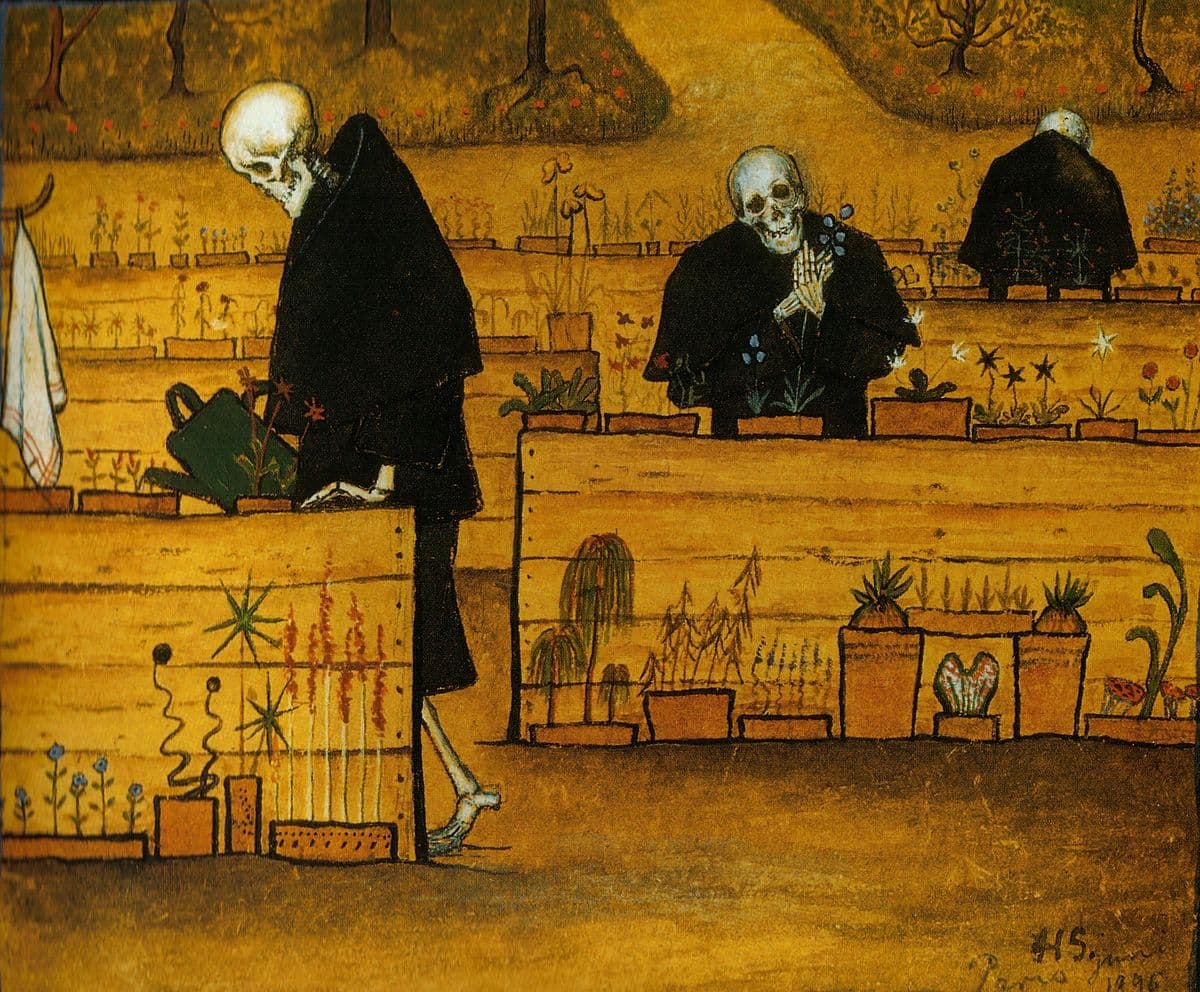
Hugo Simberg was a Finnish Symbolist painter and graphic artist whose small, strange pictures of Death, devils and angels are among the best-loved images in Finnish art. His The Garden of Death (1896), in which skeletal figures in black robes tend flowers with loving care, sums up his tone: macabre, but tender and faintly comic.
Life
Simberg was born on 24 June 1873 in Hamina, the son of an army colonel. His aunt Alexandra, who ran a school in the family home and painted as an amateur, encouraged him. He studied at the Viipuri Friends of Art drawing school from 1891 and at the Finnish Art Society's school in Helsinki from 1893 to 1895, where his teachers included Helene Schjerfbeck. In 1895, inspired by an article on Symbolism, he became the private pupil of Akseli Gallen-Kallela at his wilderness studio in Ruovesi, studying with him in three periods until 1897. Trips to London, Paris and Italy followed.
Between 1904 and 1906, with Magnus Enckell, he decorated St John's Church in Tampere, now Tampere Cathedral. His frescoes, including The Garden of Death motif, a serpent and naked garland-bearing boys, scandalized some, and the committee approved them by a single vote. He taught at the Ateneum drawing school from about 1907 to 1913, married Anni Bremer in 1910, and died at Ähtäri in 1917, aged 44.
Style and key works
Simberg painted small, often in watercolor and gouache, with a deliberately naive, folk-tale drawing style. His Death is not a terror but a worker, a gardener, a fiddler, a ferryman; his devils are mischievous rather than evil. That mix of melancholy and humor is unlike anything else in European Symbolism.
- The Garden of Death (1896), Ateneum, Helsinki; repeated in the Tampere Cathedral frescoes.
- The Wounded Angel (1903), Ateneum: two grim boys carry a blindfolded, injured angel on a stretcher through a bleak park. Voted Finland's "national painting" in a 2006 poll.
- Frost (1895) and The Devil by the Pot.
Where to see his work
The Ateneum in Helsinki holds his most important paintings, and Tampere Cathedral preserves his frescoes. See also our guides to Symbolism and death in art.
Questions & answers
What is Hugo Simberg's most famous painting?
His most famous painting is The Wounded Angel (1903) in the Ateneum, Helsinki, showing two boys carrying an injured, blindfolded angel. The Garden of Death (1896), with skeletal gardeners tending flowers, is almost as well known.
What does The Garden of Death by Simberg mean?
Simberg shows Death not as a destroyer but as a caring gardener tending the souls of the dead like plants. The image mixes melancholy with gentle humor, typical of his Symbolist vision.
Where can I see Hugo Simberg's paintings?
The Ateneum (Finnish National Gallery) in Helsinki holds his key works, including The Wounded Angel and The Garden of Death. His frescoes survive in Tampere Cathedral.