Contemporary public art
Modem Swamp
Daniel Popper, 2019
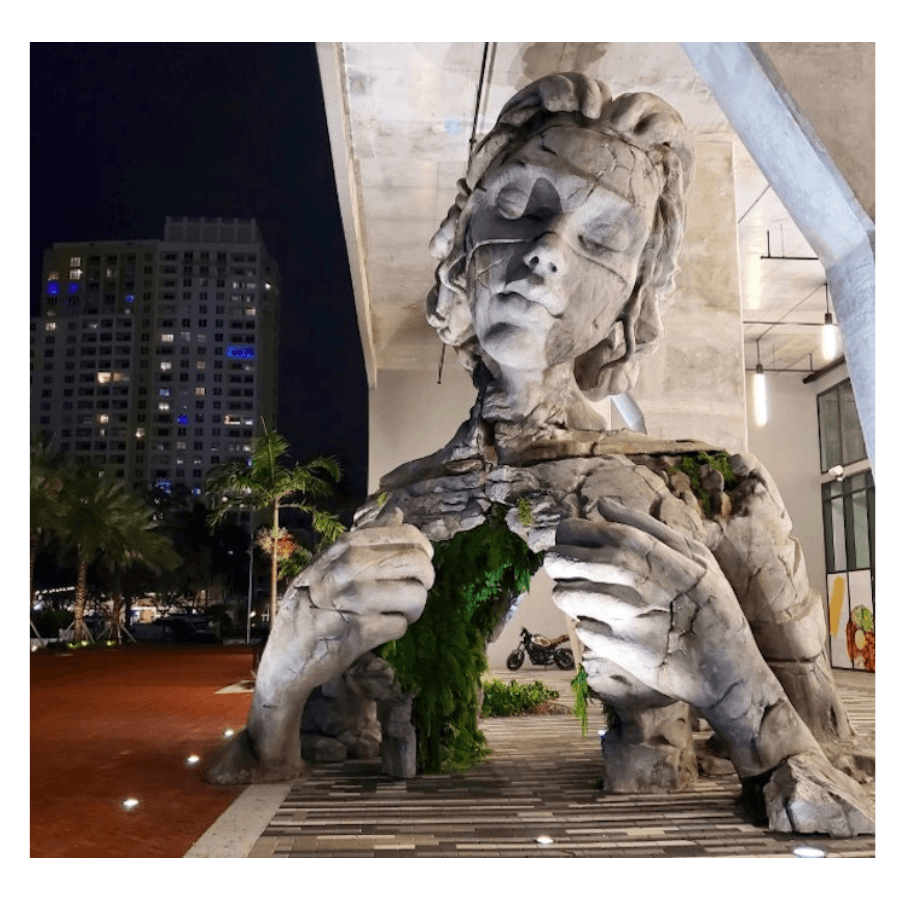
Modem Swamp is an 8-meter sculpture by South African artist Daniel Popper, made in 2019 for the Modem Festival in Croatia. A giant figure rising from rocks lifts its face away like a mask to reveal ferns growing inside its head.
- Artist
- Daniel Popper
- Date
- 2019
- Medium
- Steel, fiberglass and concrete (reported)
- Dimensions
- approx. 8 m high
- Collection
- Modem Festival (temporary installation), Primišlje, Croatia
- Movement
- Contemporary public art
What you are looking at
A colossal figure rises out of a heap of rough stones, shown from the chest up like a bust half-buried in the ground. Its hands are raised in front of it, and between thumb and fingers they hold a face, lifted away from the head like a mask. The face is serene, eyes closed, lips slightly parted. Where that face should be on the head, there is a ragged opening, and inside the hollow skull grows a mass of ferns and trailing greenery: a small jungle in place of features. The figure's smooth gray body and bald head make the green inside all the more vivid.
Published accounts give the height as about 8 meters (roughly 26 feet), and the photograph bears that out: the trees and the timber festival buildings behind it look small beside the hands.
Daniel Popper made the work in 2019 for the Modem Festival, an electronic music and arts festival held in the forested valley near Primišlje in central Croatia. The title joins the festival's name with the idea of a swamp, the dense, wet, vegetal world that seems to fill the figure.
How it was made
Popper builds at architectural scale. Published accounts of Modem Swamp describe a steel armature with fiberglass forms finished in concrete, and some add timber and glass; the sources do not agree on every material, which is common for festival works documented mostly through press images. What is consistent is the method that runs through his practice: a welded steel structure strong enough to stand in open ground, skinned in sculpted surfaces that read from far away as smooth, weathered stone.
At night the piece became something else. The sculpture was lit with projection mapping, a technique in which video is shaped precisely to the contours of a three-dimensional object. Images of the work after dark show its surface apparently shifting color and material, at moments looking almost like polished chrome. The sculpture was designed to be seen twice: as a quiet monument by day and as a moving, glowing screen by night, when the festival crowds were largest.
Close looking
Look at the hands first. They are the most carefully modeled part of the work: long fingers, visible knuckles, thumbs pinching the jaw and the cheek of the mask the way someone delicately lifts off a theater mask or a face covering. The gesture is not violent. Nothing is being torn away; something is being shown.
Then look at the two faces, because there are effectively two. The mask is detailed and individual, with heavy eyelids, a broad nose and a slightly open mouth. The head behind it is almost featureless, a smooth dome with an ear and a broken rim around the opening. Popper puts the personality on the mask and leaves the "real" head blank except for the plants. The ferns spill over the lower edge of the opening, so the growth seems to be pushing outward.
The base matters too. The figure does not stand on a plinth; it emerges from a pile of broken rock, as though the ground had cracked open and a buried giant were surfacing. Planting at its foot repeats the ferns inside the head, tying the figure to the forested hillside around it.
What does Modem Swamp mean?
Popper has not published a fixed program for the piece, and press accounts describe the figure as female, though the bald head and serene mask leave it open. It belongs to a clear family of images in his work. Again and again his giant figures open up, part, or split to reveal plant life inside: a tunnel of ferns, a bloom, a garden. The idea is that the human body and the living landscape are continuous, and that what we show the world, the face, is a surface over something wilder and more alive.
The mask has a long history in art as a sign of persona, the self we present. Here the persona is lifted away gently, and what is underneath is not darkness but growth. In the setting of a music festival, where people come to lose themselves for a few days, the reading is easy to feel: take off the face you wear for the world and find the swamp, the jungle, the unruly part of you.
Daniel Popper and festival sculpture
Popper, based in Cape Town, began by designing sets and installations for festivals and moved into monumental figurative sculpture. His works have appeared at events such as Boomtown in England and at the Morton Arboretum near Chicago, where his 2019 exhibition Human+Nature placed several giant figures among trees. Modem Swamp sits among his works of that year alongside other monumental figures. See his walk-through sculpture Thrive and the split figure of Chasm for the same idea of a body opening onto nature, and more of his work on his artist page.
Where is Modem Swamp now?
Modem Swamp was made as a festival installation, and there is no public record of where it is today or whether it survives. If you want to see Popper's work in person, his permanent and touring pieces, and festival programs that commission him, are the best leads. For other large-scale contemporary works in the catalogue, compare Lorenzo Quinn's monumental hands in Building Bridges and Jason deCaires Taylor's underwater giant Ocean Atlas.
Questions & answers
Who made Modem Swamp?
Modem Swamp was made by Daniel Popper, a Cape Town-based South African artist known for giant figurative sculptures. He created it in 2019 for the Modem Festival, an electronic music and arts festival held near Primišlje in Croatia.
How tall is Modem Swamp?
The sculpture stands about 8 meters, or roughly 26 feet, tall. The figure rises from a pile of rocks, so visitors looked up at its raised hands and into the hollow head, where ferns grow in place of a face.
What is Modem Swamp made of?
Accounts describe a steel structure with fiberglass forms finished in concrete; some sources also mention timber and glass. At night the surface was lit with projection mapping, which made it appear to change color and even to look like chrome.
Where is Modem Swamp now?
It was created as a temporary installation for the 2019 Modem Festival in Croatia. There is no published record of its current location or whether it is still standing, so its present whereabouts should be treated as unknown.
More by the artist
Daniel Popper

Kindred works
You may also study

Building Bridges
Lorenzo Quinn · 2019

Ocean Atlas
Jason deCaires Taylor · 2014

Support
Lorenzo Quinn · 2017

Bridge over a Pond of Water Lilies
Claude Monet · 1899

Venus de Milo
Alexandros of Antioch · c. 150–125 BC

The Scream
Edvard Munch · 1893

Ophelia
John Everett Millais · 1851–52

Woman with a Parasol – Madame Monet and Her Son
Claude Monet · 1875