British · Pre-Raphaelite · Arts and Crafts · Birmingham Group
Sidney Harold Meteyard
b. 2 November 1868, Stourbridge, Worcestershire — d. 4 April 1947, Cookhill, Worcestershire
Sidney Harold Meteyard (1868–1947) was an English painter, stained-glass designer and teacher of the Birmingham Group, working in a late Pre-Raphaelite style shaped by Burne-Jones, as in Hope Comforting Love in Bondage.
1 work in the collection
Works by Sidney Harold Meteyard
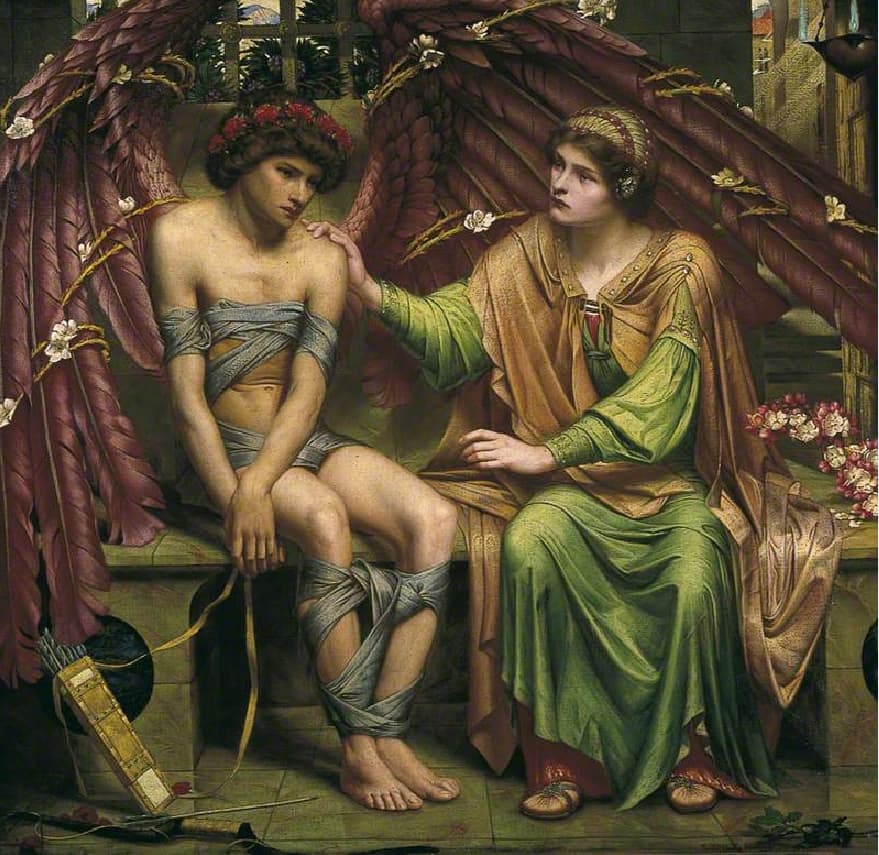
Sidney Harold Meteyard was a Birmingham artist who carried the dreamy, jewel-colored manner of Edward Burne-Jones into the twentieth century. Painter, illustrator, enameller and stained-glass designer, he spent his whole career around the Birmingham School of Art. His best-known painting, Hope Comforting Love in Bondage (1901), belongs to Birmingham Museums Trust.
Life in brief
Meteyard was born in 1868 in Stourbridge and studied at the Birmingham School of Art under its headmaster Edward R. Taylor. He began teaching there in 1886 and stayed for some forty-five years, becoming one of the core members of the Birmingham Group, the circle of painters and craftsmen around the school who looked to Burne-Jones, himself Birmingham-born, and to William Morris. In 1890 he was among the School of Art artists who painted murals for Birmingham Town Hall. He was elected to the Royal Birmingham Society of Artists (RBSA).
He married Lizzie Muckley in 1892; after her death he married, in 1940, the jeweller and enameller Kate Eadie, a former student who had also been his model. They settled at Cookhill in Worcestershire, where he died in 1947.
Style and work
Meteyard's paintings are mostly allegories and legends, peopled by personifications such as Love and Hope. They share the Arts and Crafts love of pattern and surface. Wings, robes and flowers are worked into flat, rich designs of crimson, green and gold, and the figures, long-limbed and grave, owe much to Burne-Jones. Besides oils he worked in tempera, a revival medium prized in Birmingham, and his decorative skills extended to book illustration, including an edition of Longfellow's The Golden Legend.
In Hope Comforting Love in Bondage a winged boy, Love, sits slumped on a bench, his legs bound in gray bands and his bow and arrows abandoned at his feet, while Hope, dressed in her traditional green, lays a hand on his shoulder.
His applied art includes a large enamel of The Angel of the Resurrection (1907) at Holy Trinity Church, Wordsley, and stained glass, among it a memorial window at St Paul's, Cookhill, probably made with Kate Eadie.
Where to see his work
Birmingham Museum and Art Gallery holds the largest group, with others in the British Museum and the National Gallery of Canada. Compare the earlier Pre-Raphaelite vision of John Everett Millais, and explore The Pre-Raphaelites and Symbolism.
Questions & answers
Who was Sidney Harold Meteyard?
Sidney Harold Meteyard (1868–1947) was an English painter, stained-glass designer and enameller, a long-serving teacher at the Birmingham School of Art and a member of the Birmingham Group. He worked in a late Pre-Raphaelite style strongly influenced by Edward Burne-Jones and the Arts and Crafts movement.
Where is Hope Comforting Love in Bondage?
Hope Comforting Love in Bondage (1901) belongs to Birmingham Museums Trust and is part of the collection of Birmingham Museum and Art Gallery, which holds one of the world's largest collections of Pre-Raphaelite art. It is not always on display, so check the museum before visiting.
What was the Birmingham Group?
The Birmingham Group was a circle of artists and craftspeople linked to the Birmingham School of Art from the 1890s, including Meteyard, Joseph Southall, Arthur Gaskin and Kate Bunce. Inspired by Burne-Jones and William Morris, they revived tempera painting and practiced crafts such as enamel, metalwork and illustration.