Dutch · Dutch Golden Age · Baroque
Johannes Vermeer
b. 1632 (baptized 31 October), Delft — d. December 1675 (buried 15 December), Delft
Johannes Vermeer (1632–1675) was the Dutch Golden Age painter of Delft whose quiet interiors and Girl with a Pearl Earring, in the Mauritshuis, made him one of the most loved artists in the world, from only about 35 known paintings.
1 work in the collection
Works by Johannes Vermeer
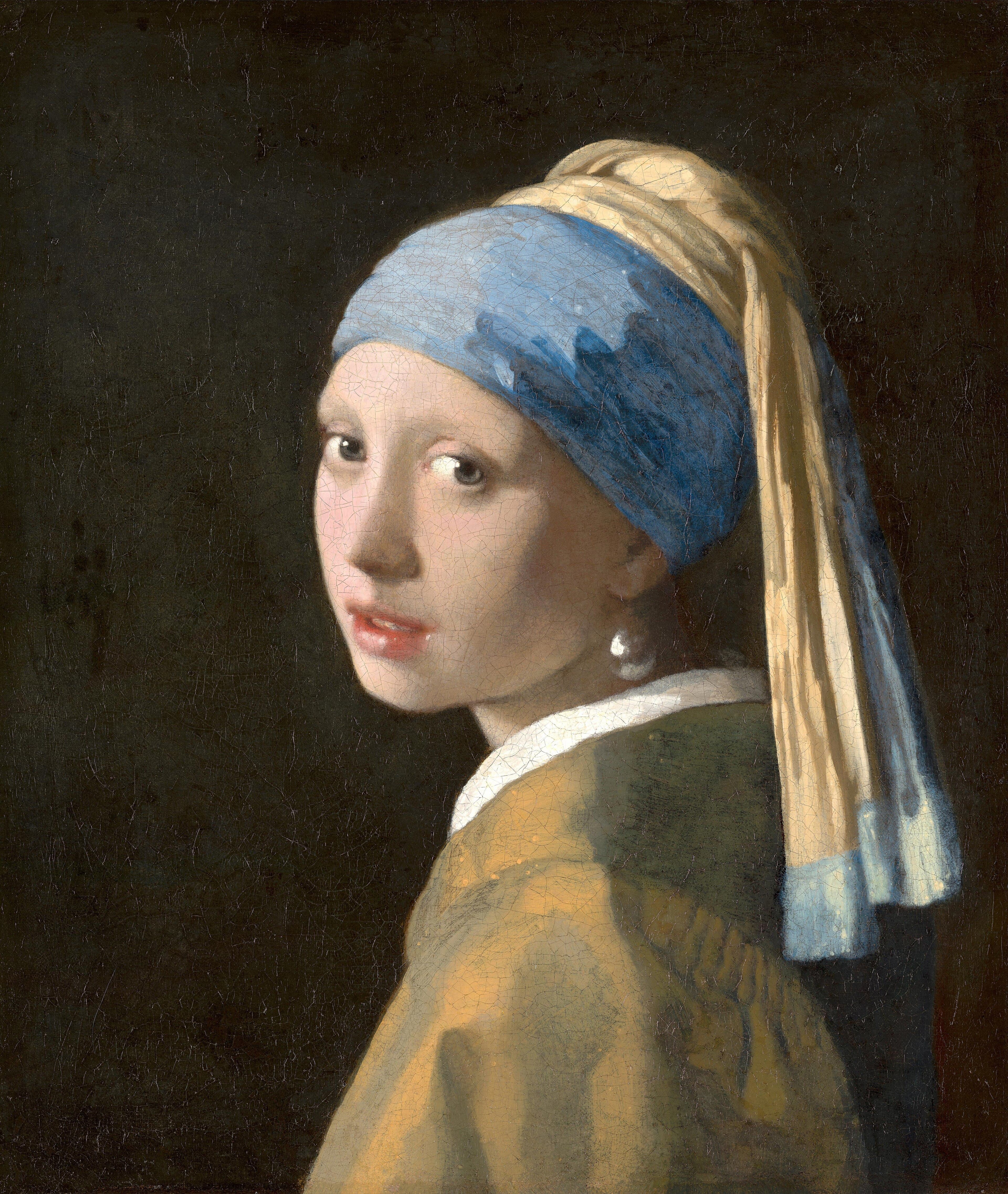
Johannes Vermeer was a painter from Delft in the Dutch Republic, active from the mid-1650s until his death in 1675. He painted slowly and little, and only about 35 to 37 works are now attributed to him, yet his calm scenes of women reading, writing, pouring milk or making music, and his tronie Girl with a Pearl Earring (c. 1665) in the Mauritshuis, The Hague, have made him one of the most celebrated painters in history.
Life in brief
Vermeer was baptized in Delft on 31 October 1632. His father, Reynier Jansz, was a silk weaver who also ran an inn and dealt in paintings, a trade his son inherited. Nothing certain is known of Vermeer's training. In April 1653 he married Catharina Bolnes, a Catholic from a wealthier family, and probably converted to Catholicism; in December of the same year he joined Delft's Guild of Saint Luke as a master painter. He was later elected one of its headmen.
The couple lived with Catharina's mother, Maria Thins, in a house on the Oude Langendijk in Delft's Catholic quarter, and had fifteen children, eleven of whom were alive when he died. A local collector, Pieter van Ruijven, seems to have bought much of Vermeer's output, which helps explain why he could work so slowly.
In 1672, the Dutch “year of disaster,” French troops invaded the Republic and the art market collapsed. Vermeer could sell neither his own paintings nor the ones he dealt in. He died in December 1675, aged 43, leaving his family deep in debt; Catharina said that the strain had driven him into a frenzy that killed him within a day or two.
Style and technique
Vermeer's early paintings were history subjects, such as Diana and Her Nymphs (Mauritshuis) and Christ in the House of Martha and Mary (Scottish National Gallery), and the large Procuress (1656, Dresden). From about 1657 he turned to the domestic interior, a specialty of Delft painters such as Pieter de Hooch, and made it his own.
His rooms are lit by a window on the left. Light falls across a white wall, a map, a tablecloth, a face, and Vermeer recorded precisely how it softens, reflects and colors everything it touches. He built up his surfaces in thin layers and placed tiny dots of thick, pale paint, sometimes called pointillés, to make highlights sparkle on bread, brass or pearls. He used natural ultramarine, ground from lapis lazuli and more costly than gold, lavishly, even in shadows. Some scholars believe he used a camera obscura to study optical effects such as blurred highlights; the question remains open.
The mood is stillness. Figures are absorbed in a single task or caught in a passing glance, and objects are arranged with geometric care. Rather than telling a story, the pictures invite the viewer to look slowly.
Key works
- The Milkmaid (c. 1657–58, Rijksmuseum, Amsterdam), a kitchen maid pouring milk in a thin white stream.
- The Little Street (c. 1658, Rijksmuseum), a sliver of Delft brickwork and courtyard.
- View of Delft (c. 1660–61, Mauritshuis), the city's skyline across the water under moving clouds.
- Girl Reading a Letter at an Open Window (c. 1657–59, Gemäldegalerie Alte Meister, Dresden), where restoration completed in 2021 uncovered a painting of Cupid on the back wall.
- Woman Holding a Balance (c. 1662–63, National Gallery of Art, Washington).
- The Art of Painting (c. 1666–68, Kunsthistorisches Museum, Vienna), an allegory in which a painter, seen from behind, portrays a model dressed as Clio, Muse of History.
- The Astronomer (1668, Louvre) and The Lacemaker (c. 1669–70, Louvre).
Girl with a Pearl Earring
The painting in our catalogue is not a portrait but a tronie, a study of a face in exotic costume. A young woman turns over her shoulder toward us, lips parted, wearing a blue and yellow turban and a large, glowing drop earring. The pearl is little more than two strokes of paint: a soft reflection below and a bright highlight above, with no hook to attach it. A technical study by the Mauritshuis in 2018, Girl in the Spotlight, found that the dark background was originally a green curtain and that Vermeer painted tiny eyelashes, now invisible to the naked eye. The identity of the model is unknown; Tracy Chevalier's 1999 novel and the 2003 film are fiction.
Influence and rediscovery
After his death Vermeer was almost forgotten, his works often attributed to others. In the 1860s the French critic Théophile Thoré-Bürger published studies that restored him to fame and called him “the Sphinx of Delft.” His rarity later tempted forgers, most notoriously Han van Meegeren, whose fake Vermeers fooled experts in the 1930s and 1940s. In 2023 the Rijksmuseum brought together 28 of his paintings in the largest Vermeer exhibition ever held. Compare the drama of his older contemporary Rembrandt, whose The Night Watch shows a very different Dutch Golden Age.
Where to see his work
The Rijksmuseum in Amsterdam (four paintings) and the Mauritshuis in The Hague (three, including Girl with a Pearl Earring and View of Delft) are essential. The Metropolitan Museum of Art has five, the Frick Collection three, and others are in Washington, London, Paris, Dresden, Berlin, Vienna and Edinburgh. Explore Famous Paintings, Famous Paintings of Women and Light Academia.
Questions & answers
How many paintings did Vermeer paint?
Only about 34 to 37 paintings are attributed to Vermeer today, a few of them disputed. He worked slowly, perhaps two or three paintings a year, over a career of about twenty years. Some works mentioned in old sale records are lost.
Where is Girl with a Pearl Earring?
Girl with a Pearl Earring (c. 1665) is in the Mauritshuis in The Hague, the Netherlands, where it has been since 1902. The collector Arnoldus Andries des Tombe bought it at auction in 1881 for a few guilders and bequeathed it to the museum. It rarely travels.
What is Vermeer famous for?
Vermeer is famous for luminous, quiet interiors of everyday life in Delft, such as The Milkmaid and Woman Holding a Balance, for his mastery of natural light and color, and for Girl with a Pearl Earring. He is one of the greatest painters of the Dutch Golden Age.
Did Vermeer use a camera obscura?
Possibly, but there is no documentary proof. Optical effects in his paintings, such as soft, blurred highlights and exaggerated perspective, led scholars including Philip Steadman to argue he used one. Others think his effects came from careful observation and skill.
Where can I see Vermeer paintings?
The Rijksmuseum in Amsterdam and the Mauritshuis in The Hague hold the most celebrated works. The Metropolitan Museum of Art and the Frick Collection in New York, the National Gallery of Art in Washington, the Louvre, Dresden and Vienna also own Vermeers.