British · Academic art · Aesthetic Movement · Classicism
Frederic Leighton
b. 3 December 1830, Scarborough, Yorkshire — d. 25 January 1896, London
Frederic Leighton (1830–1896) was a British painter and sculptor of classical subjects, President of the Royal Academy, best known for Flaming June, his radiant sleeping woman in orange, now in Puerto Rico.
1 work in the collection
Works by Frederic Leighton
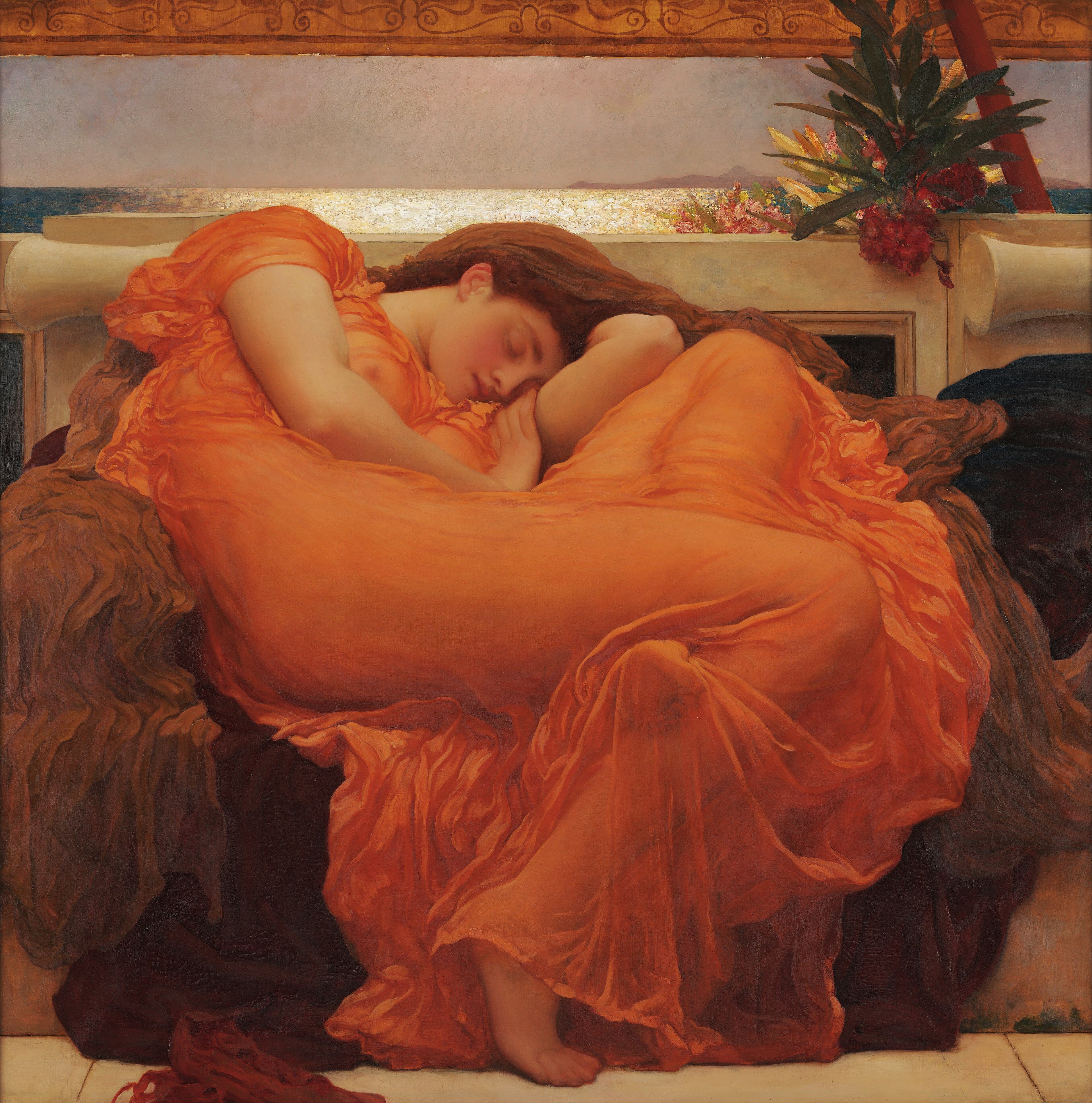
Frederic Leighton was the most honored British artist of the Victorian age, a painter of idealized classical figures and the President of the Royal Academy from 1878 until his death. His most famous painting, Flaming June (1895), is in the Museo de Arte de Ponce, Puerto Rico.
Life in brief
Born in Scarborough in 1830 to a doctor's family, Leighton grew up largely on the Continent and trained in Florence, Brussels, Paris and, above all, Frankfurt, under the Nazarene painter Edward von Steinle. He was multilingual and cosmopolitan in a way few English artists were. His breakthrough came in 1855, when Cimabue's Celebrated Madonna is Carried in Procession through the Streets of Florence was shown at the Royal Academy and bought by Queen Victoria.
He settled in London and built a house in Holland Park, with a domed Arab Hall lined with Islamic tiles he had collected in the Middle East. He was knighted in 1878, made a baronet in 1886, and in January 1896 became Baron Leighton of Stretton, the first painter raised to the peerage. He died the next day, so the title lasted barely a day. He was buried in St Paul's Cathedral and succeeded at the Academy by John Everett Millais.
Style
Leighton drew constantly, building each figure from nude studies before adding drapery, and his surfaces are smooth and finished. He loved Greek sculpture and Michelangelo, and his pictures aim at beauty rather than story: languid women, heroic nudes and warm Mediterranean light. He was also a fine sculptor; his bronze An Athlete Wrestling with a Python (1877, Tate) helped launch the New Sculpture movement in Britain.
Key works
Flaming June shows a woman asleep on a marble bench, curled in a transparent orange robe, with a sprig of poisonous oleander above her and the sea behind. Other major works include The Bath of Psyche (c. 1890, Tate), The Garden of the Hesperides (c. 1892, Lady Lever Art Gallery) and Perseus and Andromeda (1891, Walker Art Gallery, Liverpool).
Where to see his work
Leighton House in Holland Park, London, is a museum of his life and work. Tate Britain, the Royal Academy and Liverpool's galleries hold key paintings. Explore more in Academic Art and Famous Paintings of Women.
Questions & answers
Where is Flaming June?
Flaming June (1895) is in the Museo de Arte de Ponce in Ponce, Puerto Rico. Long out of fashion, it found no buyer in London in the early 1960s and was bought in 1963 by the museum's founder, Luis A. Ferré. It has been lent abroad for exhibitions, including at the Frick and Leighton House.
Why was Frederic Leighton a lord for only one day?
Leighton was created Baron Leighton of Stretton in January 1896, the first painter to receive a peerage, and died of heart failure the following day. Because he had no heir, the title became extinct with him, making it one of the shortest-lived peerages in British history.
Can you visit Leighton House?
Yes. Leighton House in Holland Park, London, the home and studio Leighton built from 1864, is a museum run by the Royal Borough of Kensington and Chelsea. Its Arab Hall, lined with Islamic tiles and a fountain, is its most famous room.