Italian · Romanticism
Francesco Hayez
b. 10 February 1791, Venice — d. 21 December 1882, Milan
Francesco Hayez (1791–1882) was the leading painter of Italian Romanticism, a Venetian who worked in Milan and painted The Kiss (1859, Pinacoteca di Brera), the emblem of Italy's Risorgimento.
1 work in the collection
Works by Francesco Hayez
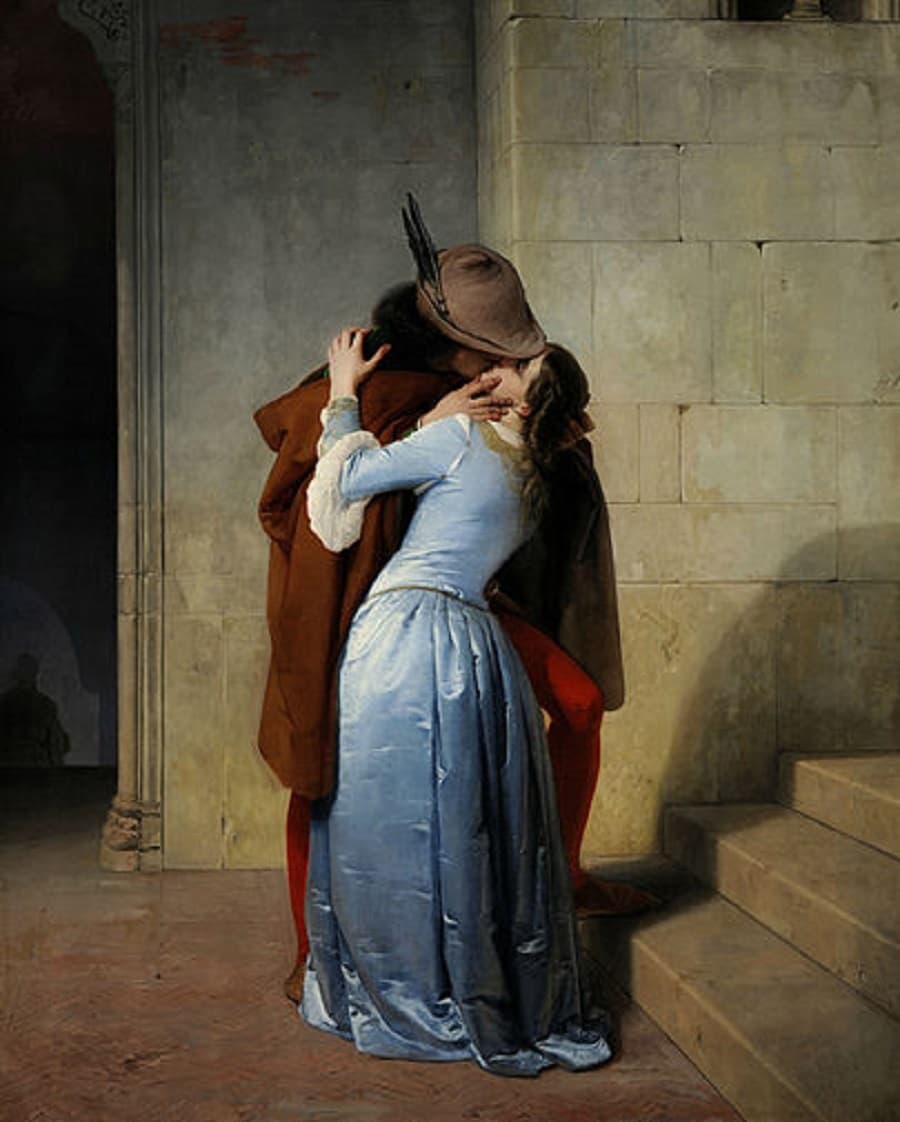
Francesco Hayez (1791–1882) was a Venetian-born painter who became the leading figure of Romantic painting in Italy. Working in Milan for most of his long life, he painted history scenes, portraits of the great figures of his time and, most famously, The Kiss (1859), which hangs in the Pinacoteca di Brera.
Life in brief
Hayez was born in Venice, the youngest son of a poor family; his father came from Valenciennes in France. He was raised by an aunt and her husband, the art dealer and collector Giovanni Binasco, who put him to work learning restoration before he trained at the Venice Academy. In 1809 he won a scholarship to Rome, where he worked under the protection of Antonio Canova. In the early 1820s he settled in Milan, and his Pietro Rossi (1820) is often called the first manifesto of Italian Romantic painting. He taught at the Brera Academy for decades, eventually as its president, and painted portraits of Alessandro Manzoni, Count Cavour and Gioachino Rossini among others.
Style
Hayez combined the clear drawing of Neoclassicism with Romantic subjects from medieval and Venetian history, scenes of conspiracy, exile and doomed love. Under Austrian rule in Lombardy, such stories could carry coded patriotic meaning, and audiences read them that way.
The Kiss
The Kiss shows a young couple in medieval dress at the foot of a stone staircase, the man's face hidden under his hat, the woman's head thrown back. His foot rests on the step as if he is about to leave. It was commissioned by Count Alfonso Maria Visconti di Saliceto and shown at Brera in 1859, months after Franco-Piedmontese victories over Austria, and was read at once as an image of farewell and of the alliance between Italy and France. Hayez painted further versions, one of which sets the woman's blue dress against white and red.
The painting is often confused with Klimt's The Kiss; for another nineteenth-century embrace, see Romanticism.
Where to see his work
The Pinacoteca di Brera and the Galleria d'Arte Moderna in Milan hold his major works, and the Gallerie dell'Accademia in Venice has early paintings.
Questions & answers
Where is Hayez's The Kiss?
The original 1859 version of Francesco Hayez's The Kiss (Il bacio) is in the Pinacoteca di Brera in Milan. Hayez painted later versions with small changes, including one with a white dress, which are in other collections.
What does Hayez's The Kiss mean?
On the surface it is a romantic farewell between a medieval couple. Shown in 1859, during Italy's war of independence against Austria, it was read as a patriotic allegory of the Risorgimento and of the alliance between Italy and France.
Who was Francesco Hayez?
Francesco Hayez (1791–1882) was a Venetian painter who worked in Milan and led Italian Romantic painting. He painted history scenes, portraits of figures like Manzoni and Cavour, and The Kiss, and taught for decades at the Brera Academy.