Italian (Milanese) · Late Renaissance · Lombard Mannerism · Still life
Fede Galizia
b. c. 1578, Milan — d. c. 1630, Milan
Fede Galizia (c. 1578–c. 1630) was a Milanese painter of portraits, religious works and still lifes, one of the first Europeans to specialize in fruit still life. Her Judith with the Head of Holofernes (1596) is in the Ringling Museum, Sarasota.
1 work in the collection
Works by Fede Galizia
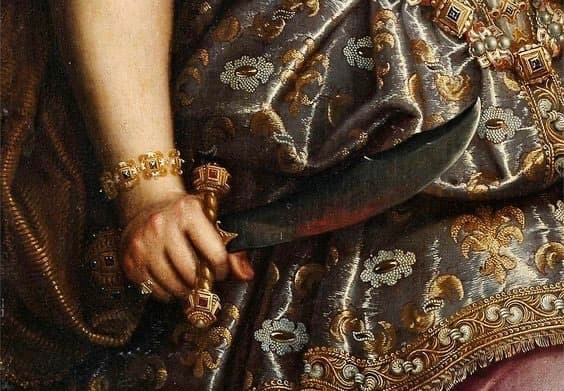
Fede Galizia was a Milanese painter of portraits, altarpieces and, above all, still lifes of fruit, a genre she helped to found in Italy. Her Judith with the Head of Holofernes (1596), signed and dated on Judith's blade, is in the John and Mable Ringling Museum of Art in Sarasota, Florida.
Life
Galizia was born in Milan, probably in 1578. Her father, Nunzio Galizia, a miniaturist from Trento, trained her. By the age of twelve she was already praised by the painter and theorist Gian Paolo Lomazzo, and by her late teens she had an international reputation as a portraitist. Her Portrait of Paolo Morigia (1596), painted at about eighteen, shows the Jesuati scholar writing a poem about the painter herself.
She received public commissions for Milanese churches, including a Noli me tangere (1616). She never married. She made her will on 21 June 1630 and is thought to have died of plague in Milan shortly afterward.
Still life
Of about sixty-three works catalogued as hers, forty-four are still lifes. Her one signed still life, of 1602, is the earliest known dated still life by an Italian artist. The compositions are simple and frontal: a basket or a bowl of a single fruit, peaches or pears, with a few pieces and a flower or two on the ledge. Their severity recalls the later still lifes of Zurbarán.
Judith
Galizia painted the story of Judith and Holofernes several times. The 1596 Ringling picture shows Judith richly dressed, calm and composed, holding the general's head while her maid holds a bag ready. The care given to jewels and brocade reflects her skill as a portraitist; some writers have suggested the face may be a self-portrait, a reading that remains unproven. Compare more violent versions by Artemisia Gentileschi and Caravaggio.
See also famous paintings of women.
Questions & answers
Where is Fede Galizia's Judith with the Head of Holofernes?
Her 1596 Judith with the Head of Holofernes, signed and dated on the sword blade, is in the John and Mable Ringling Museum of Art in Sarasota, Florida. Several other versions of the subject by her survive, mostly in private collections.
Why is Fede Galizia important?
Galizia was one of the first European painters to specialize in fruit still life. Her signed still life of 1602 is the earliest known dated still life by an Italian, and she was a sought-after portraitist as a teenager.
When did Fede Galizia live?
She was born in Milan around 1578 and died there around 1630, probably of the plague, shortly after making her will on 21 June 1630.