French · Romanticism
Eugène Delacroix
b. 26 April 1798, Charenton-Saint-Maurice, France — d. 13 August 1863, Paris
Eugène Delacroix (1798–1863) was the leading painter of French Romanticism, known for Liberty Leading the People and for violent, richly colored scenes from history, literature and North Africa.
1 work in the collection
Works by Eugène Delacroix
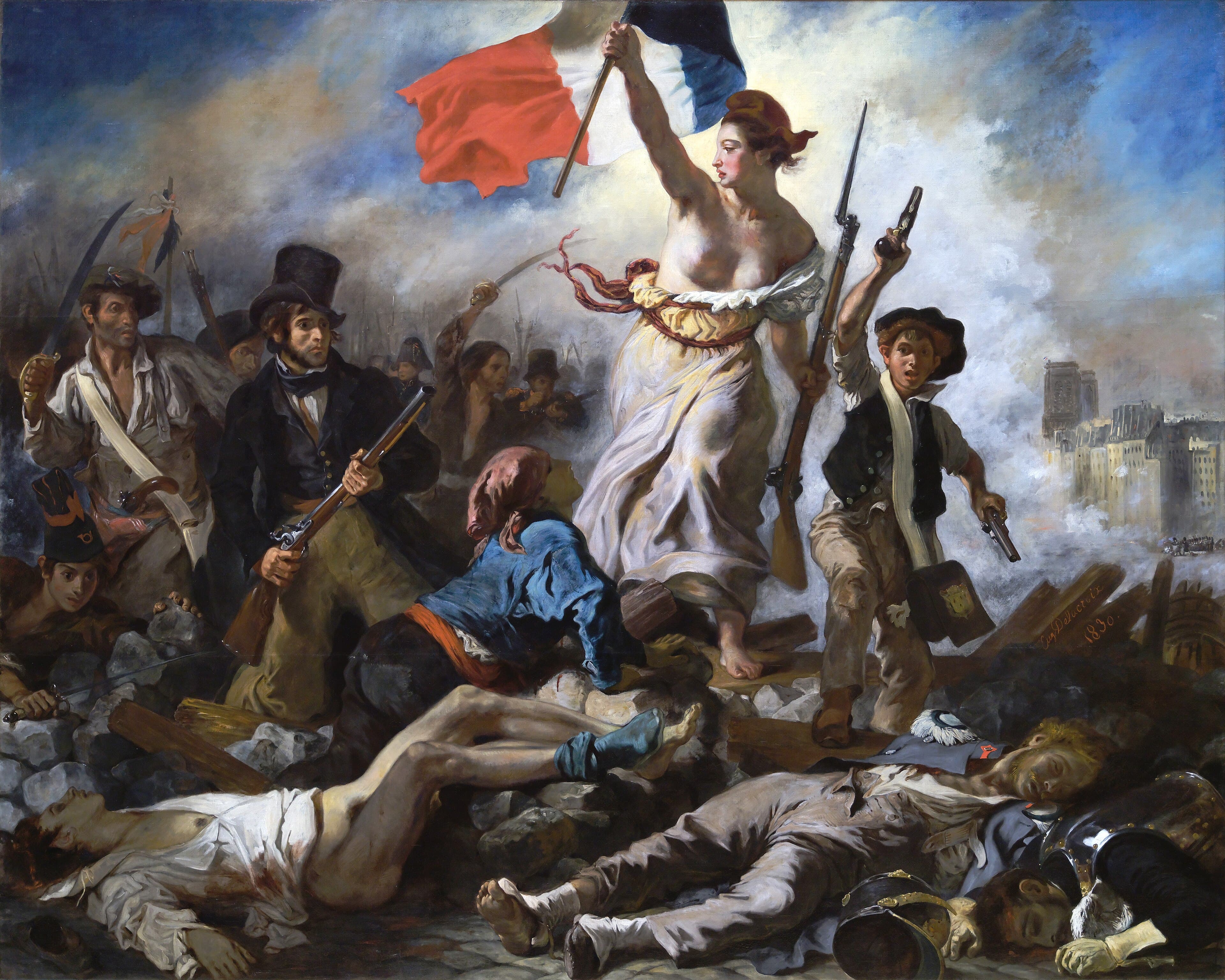
Eugène Delacroix was the central figure of Romantic painting in France. Against the cool line of Neoclassicism he set color, movement and passion, and his best-known painting, Liberty Leading the People (1830), hangs in the Louvre in Paris.
Life in brief
Delacroix was born in 1798 near Paris into a family of high officials; rumors that his real father was the statesman Talleyrand have never been proved. He trained in the studio of Pierre-Narcisse Guérin, where he met Théodore Géricault, whose The Raft of the Medusa he watched take shape and even posed for. He made his Salon debut in 1822 with The Barque of Dante and became famous, and controversial, two years later with The Massacre at Chios, a scene from the Greek War of Independence.
In 1832 he traveled with a French diplomatic mission to Morocco and Algeria. The light, costume and animals he saw there fed his art for the rest of his life. From the 1830s the state gave him large mural commissions, in the Palais Bourbon, the Luxembourg Palace, the Louvre's Galerie d'Apollon and the Chapel of the Holy Angels at Saint-Sulpice, which he finished in 1861. He died in Paris in 1863.
Style
Delacroix built pictures from color. He placed complementary hues side by side so that they vibrate, modeled flesh with greens and reds, and let brushwork stay visible. His subjects came from Dante, Shakespeare, Byron and Walter Scott, from current events and from North Africa. The Death of Sardanapalus (1827, Louvre), a whirl of slaughter around an indifferent king, scandalized the Salon. His Journal is one of the great artist's diaries.
Liberty Leading the People
Painted in the autumn of 1830 to commemorate the July Revolution in Paris, Liberty shows a bare-breasted allegorical woman carrying the tricolor over a barricade, with workers, a top-hatted bourgeois and a boy with pistols around her. The French state bought it in 1831.
Influence
Baudelaire championed him, and his color theory passed directly to the Impressionists, to Seurat and to Van Gogh. Cézanne copied him, and Picasso painted a series of variations on his Women of Algiers (1834).
Where to see his work
The Louvre has his major canvases; his last apartment and studio on Place de Furstenberg is now the Musée national Eugène Delacroix. See also Romanticism.
Questions & answers
What is Eugène Delacroix famous for?
Delacroix is famous as the leader of French Romantic painting and above all for Liberty Leading the People (1830), which commemorates the July Revolution. His other key works include The Massacre at Chios (1824) and The Death of Sardanapalus (1827), both in the Louvre.
Where is Liberty Leading the People?
Liberty Leading the People is in the Musée du Louvre in Paris. The French state bought it in 1831, the year after it was painted. It was cleaned and restored in 2023–24, revealing much brighter color, including the blue, white and red of the flag.
Where can I see Delacroix's work in Paris?
The Louvre holds his great Salon paintings and his ceiling in the Galerie d'Apollon. His murals decorate the Chapel of the Holy Angels in Saint-Sulpice, and his last home and studio is now the Musée national Eugène Delacroix on Place de Furstenberg.