Greek (Rhodian) · Hellenistic sculpture
Agesander of Rhodes
b. active 1st century BC (possibly into the 1st century AD), Rhodes
Agesander of Rhodes was a Hellenistic Greek sculptor named by Pliny the Elder, with Athenodoros and Polydorus, as maker of the Laocoön group now in the Vatican Museums. He probably worked in the 1st century BC.
1 work in the collection
Works by Agesander of Rhodes
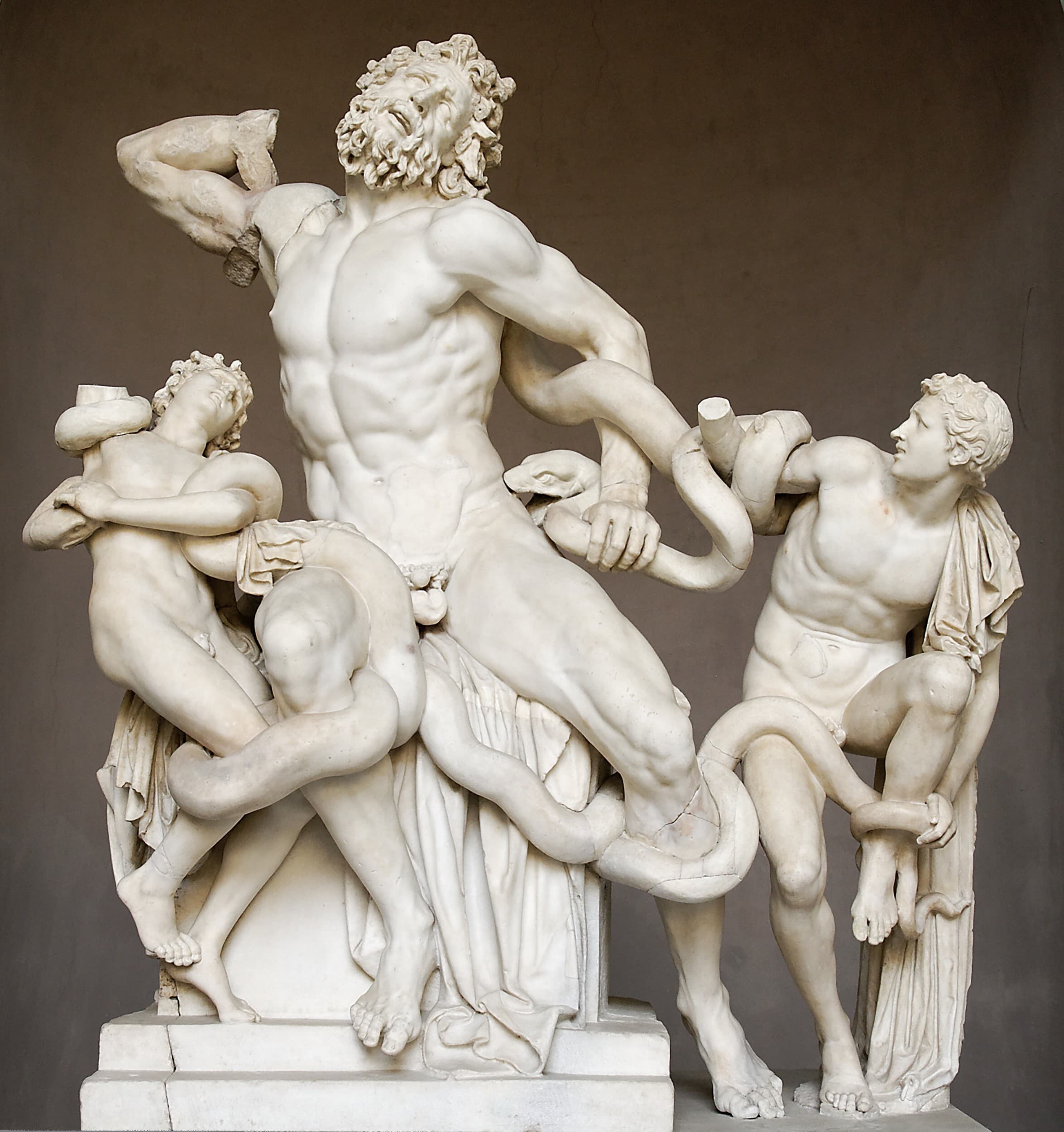
Agesander (Greek Hagesandros) was a sculptor from the island of Rhodes, and almost everything we know about him comes from a single sentence. Writing in his Natural History in the 70s AD, Pliny the Elder described a marble group of Laocoön and his sons in the palace of the emperor Titus and named its makers as Hagesander, Polydorus and Athenodorus of Rhodes, listing Agesander first. When a marble group matching that description was dug up in Rome in 1506, it was identified at once as the work Pliny had praised: Laocoön and His Sons, now in the Vatican Museums.
One sculptor or several?
The name ran in families on Rhodes, and scholars think there may have been more than one sculptor called Agesander. In the late 1950s fragments of colossal sculpture were found in a seaside grotto at Sperlonga, south of Rome, including a group of the monster Scylla attacking Odysseus' ship. An inscription on the ship names three sculptors: Athanodoros son of Hagesandros, Hagesandros son of Paionios, and Polydoros son of Polydoros. The order differs from Pliny's, and since such lists often ran by seniority, some historians doubt that the Sperlonga Agesander is the same man. Inscriptions from Lindos on Rhodes add an Athenodoros son of Agesander on a statue base securely dated to 42 BC, which suggests a family workshop in which fathers, sons and perhaps brothers worked together.
Style and dating
The Laocoön belongs to the theatrical late Hellenistic manner sometimes called Hellenistic baroque: twisting bodies, straining muscles, faces open in pain, a composition built to be read from the front like a relief. Its date is one of the long-running problems of ancient art. Winckelmann placed it in the 4th century BC; others have pushed it as late as the reign of Vespasian. Most scholars now put the Laocoön and the Sperlonga groups between about 50 BC and AD 70. Whether the Vatican marble is an original or a Roman-period version of a bronze is also still argued.
Influence
Few ancient works have had a stronger afterlife. Michelangelo is said to have been present when the Laocoön was uncovered, and its contorted anatomy shaped Renaissance and Baroque sculpture, from Michelangelo to Bernini. In 1766 Lessing used it as the starting point of his essay Laocoön on the limits of painting and poetry.
Where to see the work
The Laocoön stands in the Octagonal Court of the Museo Pio-Clementino, Vatican Museums. The Sperlonga sculptures are in the Museo Archeologico Nazionale at Sperlonga. See also Greek Statues and Famous Sculptures.
Questions & answers
Who made the Laocoön statue?
Pliny the Elder credits the Laocoön group to three sculptors from Rhodes: Agesander (Hagesander), Athenodoros and Polydorus. He names Agesander first, which may mean he was the senior member, perhaps the father, of a family workshop. Pliny is the only ancient author who names them.
When did Agesander live?
No birth or death dates survive. Related inscriptions from Lindos on Rhodes date to 42 and 22 BC, and most scholars place the Laocoön and the signed Sperlonga sculptures between about 50 BC and AD 70. There may have been more than one sculptor named Agesander.
Where is the Laocoön today?
The Laocoön and His Sons is in the Vatican Museums in Vatican City, in the Octagonal Court of the Museo Pio-Clementino. It was excavated in Rome in January 1506 and acquired by Pope Julius II soon after its discovery.