Polish · Academic art · Symbolism
Wilhelm Kotarbiński
b. 30 November 1848, Nieborów, Poland — d. 4 September 1921, Kyiv
Wilhelm Kotarbiński (1848–1921) was a Polish painter who worked mostly in Kyiv, known for misty Symbolist visions of ghosts, nymphs and night, such as Grave of a Suicide Victim, and for murals in St Volodymyr's Cathedral.
1 work in the collection
Works by Wilhelm Kotarbiński
Wilhelm Kotarbiński was a Polish painter, born in 1848 at Nieborów, near Łowicz, who spent most of his working life in the Russian Empire, especially in Kyiv. He painted large academic history pictures and church murals, but he is loved today for small, dreamlike Symbolist canvases of twilight and moonlight, inhabited by phantoms, sleeping women, angels and lonely graves.
Life in brief
Kotarbiński studied drawing in Warsaw and then went to Rome, where he trained at the Accademia di San Luca and spent several lean years establishing himself. From 1888 he settled in Kyiv, where, with Viktor Vasnetsov, Mikhail Nesterov and Pavel Svedomsky, he worked on the murals of St Volodymyr's Cathedral. He lived in Kyiv through the Revolution and civil war and died there, impoverished, in 1921.
Style
Kotarbiński's history paintings follow the polished academic manner of Rome and Saint Petersburg. His Symbolist works are different: broadly brushed, with soft edges and a limited palette of blue-grays, mauves and greens, lit by moonlight or by a single glowing form. Recurring subjects include the dead returning, nymphs and spirits over water, and solitary figures at night. These sepia-toned dream pictures were widely reproduced as postcards in his lifetime.
Grave of a Suicide Victim
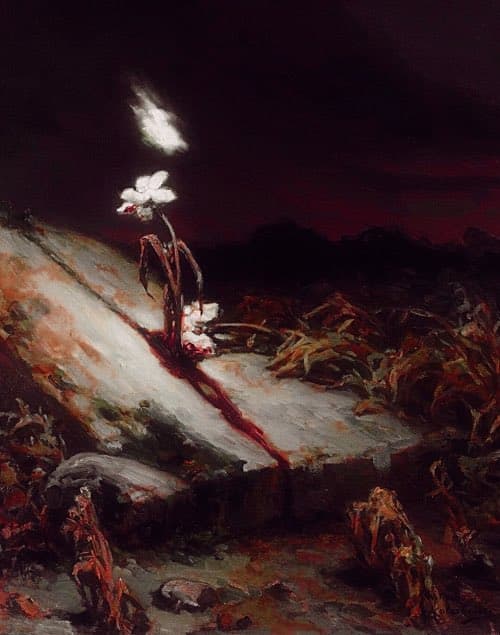
Grave of a Suicide Victim (Mogiła samobójcy, about 1900) shows a lone grave slab in an empty landscape at night, with a white lily rising beside it whose flower seems to bleed. In Christian tradition suicides were often refused burial in consecrated ground, and the solitary grave, outside the churchyard, carries that history. The lily, a symbol of purity, turns the picture from condemnation to mourning. A version is in the National Museum in Warsaw, and a larger one is in Kraków.
Where to see his work
The National Art Museum of Ukraine and the Kyiv Art Gallery hold major collections, and his murals survive in St Volodymyr's Cathedral in Kyiv. The National Museum in Warsaw and collections in Kraków also hold his work. See more in Symbolism, Death in Art and Dark Academia.
Questions & answers
Who was Wilhelm Kotarbiński?
Wilhelm Kotarbiński (1848–1921) was a Polish painter trained in Warsaw and Rome who worked mainly in Kyiv. He painted murals in St Volodymyr's Cathedral and is best known for moonlit Symbolist scenes of ghosts, nymphs and graves.
What does Grave of a Suicide Victim mean?
It shows a solitary grave at night with a bleeding white lily. Suicides were historically buried outside consecrated ground, so the lonely grave recalls that exclusion, while the lily, a symbol of purity, turns the scene into an image of pity and mourning.
Where is Grave of a Suicide Victim?
A version of Kotarbiński's Grave of a Suicide Victim, painted around 1900, is in the National Museum in Warsaw; a larger version is in Kraków.