English · Gothic Revival
Sir George Gilbert Scott
b. 13 July 1811, Gawcott, Buckinghamshire — d. 27 March 1878, London
Sir George Gilbert Scott (1811–1878) was the most prolific architect of the English Gothic Revival, designing or altering more than 800 buildings, among them St Pancras's Midland Grand Hotel, the Albert Memorial and the Foreign Office in London.
1 work in the collection
Works by Sir George Gilbert Scott
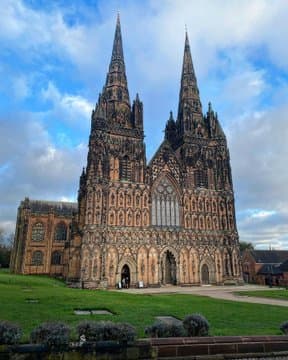
Sir George Gilbert Scott was an English architect who, more than anyone, made Gothic the official style of Victorian Britain. Between the 1830s and his death in 1878 his office designed, built or restored more than 800 buildings: churches, cathedrals, workhouses, colleges, memorials, a government ministry and one of the most famous railway hotels in the world.
Life in brief
Scott was born on 13 July 1811 at Gawcott in Buckinghamshire, where his father was the parson. He trained with the London architect James Edmeston and then worked under Henry Roberts. In the late 1830s he went into partnership with William Bonython Moffatt, and their early bread and butter was workhouses, built in quantity after the New Poor Law of 1834.
His conversion to Gothic came through the writings of Augustus Welby Pugin, who argued that pointed architecture was the only true Christian style. Scott's first major success in that spirit was the Martyrs' Memorial in Oxford (1841–43). In 1844 he won the competition for the Nikolaikirche in Hamburg, a huge Gothic church whose spire, at the time of completion, was among the tallest in the world.
He was appointed surveyor of the fabric of Westminster Abbey in 1849, elected a Royal Academician in 1861 and knighted in 1872. He died in London on 27 March 1878 and was buried in Westminster Abbey. His Personal and Professional Recollections appeared the following year.
Style: "Victorian Gothic" on every scale
Scott's Gothic was learned, eclectic and practical. He drew on English Decorated work of the 13th and 14th centuries, but also on Italian and Flemish Gothic, with polychrome stone and brick, carved capitals of natural foliage, and heavy use of metalwork, tile and stained glass. In his book Remarks on Secular and Domestic Architecture (1857) he argued that Gothic was not only for churches but suited town halls, offices and hotels.
He ran the largest architectural practice in Britain, and his buildings are uneven. The best, though, have a confidence and a love of craftsmanship that is hard to match, and many of his teams of carvers, metalworkers and glaziers went on to shape the Arts and Crafts movement.
George Gilbert Scott's most famous buildings
- Midland Grand Hotel, St Pancras, London (1868–76). The red-brick Gothic hotel in front of St Pancras station, now the St Pancras Renaissance Hotel, with its grand staircase and clock tower.
- Albert Memorial, Kensington Gardens, London (1864–76). Queen Victoria's memorial to her husband: a gilded figure of Prince Albert under a Gothic canopy like a giant medieval shrine, ringed with sculpture of the arts and the continents.
- Foreign Office, Whitehall (1861–68). Scott wanted Gothic; Lord Palmerston insisted on Italianate classical, and Scott, reluctantly, complied. The result is one of the great Victorian government buildings.
- University of Glasgow, Gilmorehill (from 1870). The main building with its tall central tower, completed by his son John Oldrid Scott.
- St Mary's Episcopal Cathedral, Edinburgh (1874–79) and St Mary's Episcopal Cathedral, Glasgow.
- Exeter College Chapel, Oxford (1856–59), St John's College Chapel, Cambridge (1866–69) and King's College Chapel, London.
- University of Mumbai, where his designs include the Rajabai Clock Tower.
The restorer of cathedrals
Scott was also the leading church restorer of his day. He worked on Ely, Hereford, Salisbury, Worcester, Westminster Abbey and many others. At Lichfield Cathedral, restored from the later 1850s, his team renewed much of the decayed sandstone, and he designed the metal choir screen made by Francis Skidmore with the sculptor John Birnie Philip, often called a triumph of High Victorian art and the only one of Skidmore's three great cathedral screens still in place. Work on Lichfield's west front statuary continued under his son John Oldrid Scott after his death.
Restoration made him enemies. Critics accused him of replacing genuine medieval fabric with his own idea of what it should have been. When Scott's office proposed work at Tewkesbury Abbey in 1877, William Morris founded the Society for the Protection of Ancient Buildings, whose principle of "repair, not restoration" was largely a reaction against Scott's methods.
Influence and the Scott dynasty
Scott trained a generation of architects, including G. E. Street, G. F. Bodley and Thomas Garner. His sons George Gilbert Scott Jr. and John Oldrid Scott were architects, and his grandson Sir Giles Gilbert Scott designed Liverpool Cathedral, Battersea Power Station and the red K2 telephone box. When people search "Gilbert Scott," they may mean either man; the Victorian Gothic is George, the 20th-century work is Giles.
Where to see his work
London holds the essentials: St Pancras, the Albert Memorial and the Foreign Office are a short journey apart. Beyond London, visit Lichfield, Ely and Salisbury cathedrals, the University of Glasgow and Edinburgh's St Mary's. For the medieval buildings he restored and admired, see our guide to Gothic art and Siena Cathedral, whose striped Italian Gothic influenced Victorian architects.
Questions & answers
What buildings did George Gilbert Scott design?
His most famous buildings include the Midland Grand Hotel at St Pancras, the Albert Memorial and the Foreign Office in London, the University of Glasgow's main building, St Mary's Episcopal Cathedral in Edinburgh, and chapels at Exeter College, Oxford, and St John's College, Cambridge. In all he designed or altered over 800 buildings.
Is Sir Gilbert Scott the same as Giles Gilbert Scott?
No. Sir George Gilbert Scott (1811–1878) was the Victorian Gothic Revival architect. His grandson Sir Giles Gilbert Scott (1880–1960) designed Liverpool Cathedral, Battersea Power Station and the red K2 telephone box.
What did George Gilbert Scott do at Lichfield Cathedral?
Scott led a major restoration of Lichfield Cathedral from the later 1850s, renewing decayed stonework and designing the metal choir screen made by Francis Skidmore and John Birnie Philip. His son John Oldrid Scott continued the work on the west front after 1878.
Why was George Gilbert Scott criticized?
His restorations of medieval churches often replaced original fabric with new work. In 1877 William Morris founded the Society for the Protection of Ancient Buildings partly in protest against Scott's proposed restoration of Tewkesbury Abbey.
Where is George Gilbert Scott buried?
Scott died in London on 27 March 1878 and was buried in Westminster Abbey, where he had served as surveyor of the fabric since 1849.