Greek (Rhodian) · Hellenistic sculpture
Polydorus of Rhodes
b. active 1st century BC, Rhodes
Polydorus of Rhodes was a Hellenistic Greek sculptor, named by Pliny the Elder with Agesander and Athenodoros as one of the three makers of the Laocoön group in the Vatican Museums.
1 work in the collection
Works by Polydorus of Rhodes
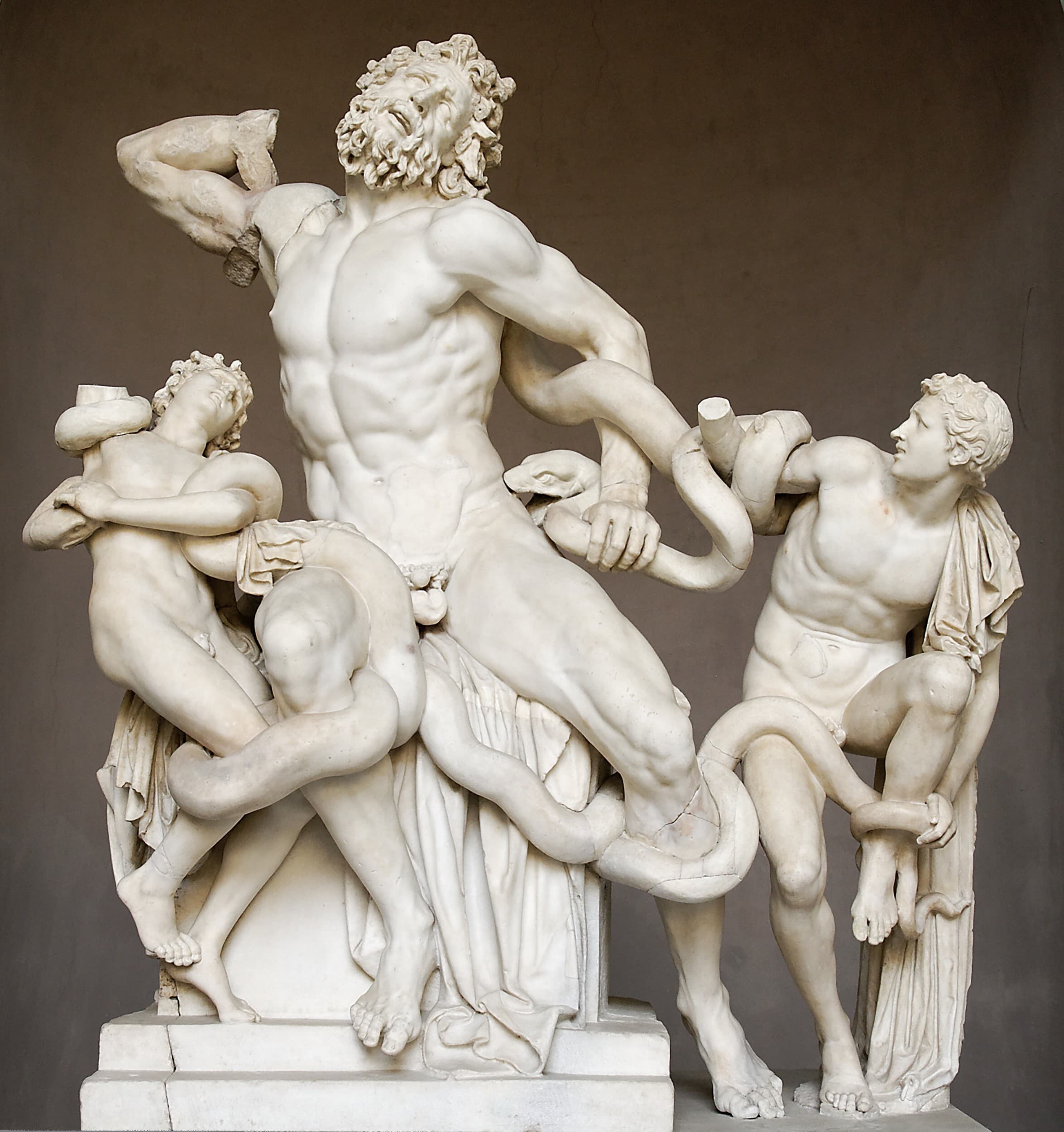
Polydorus (Greek Polydoros) was a sculptor from the island of Rhodes, known to us only as one of a team. Pliny the Elder, writing in the 70s AD, named him with Agesander and Athenodoros as the creators of Laocoön and His Sons, the marble group of the Trojan priest and his two sons crushed by sea serpents, now in the Vatican Museums.
What we know
Outside Pliny's sentence, Polydorus survives in a single inscription. In the late 1950s, excavations in a seaside grotto at Sperlonga, south of Rome, uncovered fragments of colossal marble groups illustrating the Odyssey. The ship in the Scylla group carries the signatures of three Rhodian sculptors, the last of them Polydoros son of Polydoros. Nothing else is recorded about him: no birth or death dates, no independent works, no family beyond his father's name. Like the other members of the workshop, he probably worked in the 1st century BC, and possibly into the 1st century AD, though the dating of both the Laocoön and the Sperlonga groups is still argued.
The group he helped make
What survives of his art is a shared one. The Laocoön was found in a Roman vineyard in January 1506 and acquired by Pope Julius II. Laocoön's right arm was missing, and in the 1530s Giovanni Angelo Montorsoli added a restoration with the arm stretched heroically upward. In 1906 the archaeologist Ludwig Pollak found the original arm in a Roman builder's yard: bent sharply back behind the head. It was reattached in the late 1950s, and the restored group now shows the priest's struggle as more desperate and less triumphant.
How the work was divided among the three sculptors is unknown. Scholars have tried to distinguish hands in the father and the two sons, but the group reads as a single design.
Why it matters
The Laocoön shaped how the Renaissance saw ancient art. Michelangelo studied it, and for centuries it set the standard for depicting extreme pain in stone.
Where to see the work
The Laocoön is in the Octagonal Court of the Museo Pio-Clementino, Vatican Museums. See also Greek Statues and Famous Sculptures.
Questions & answers
Who was Polydorus of Rhodes?
Polydorus was a Greek sculptor from Rhodes, active around the 1st century BC. Pliny the Elder names him with Agesander and Athenodoros as a maker of the Laocoön group, and a Polydoros son of Polydoros signed the Sperlonga sculptures. No other facts about his life survive.
Why does the Laocoön's arm look different in old pictures?
For centuries the Laocoön displayed a 16th-century restoration by Montorsoli, with the priest's right arm stretched straight up. In 1906 Ludwig Pollak found the original bent arm in Rome, and it was reattached in the late 1950s, replacing the earlier restoration.
Where is the Laocoön and His Sons?
The Laocoön and His Sons is in the Vatican Museums, Vatican City, in the Octagonal Court of the Museo Pio-Clementino. It has belonged to the papal collections since Pope Julius II acquired it shortly after its discovery in Rome in 1506.