British · Fantastic art · Contemporary drawing
Paul Rumsey
b. 1956, Essex, England
Paul Rumsey (born 1956) is an English artist whose dark, grotesque charcoal and ink drawings, in the tradition of Goya and Alfred Kubin, include a Danse Macabre series. He trained at Chelsea School of Art and works in Essex.
1 work in the collection
Works by Paul Rumsey
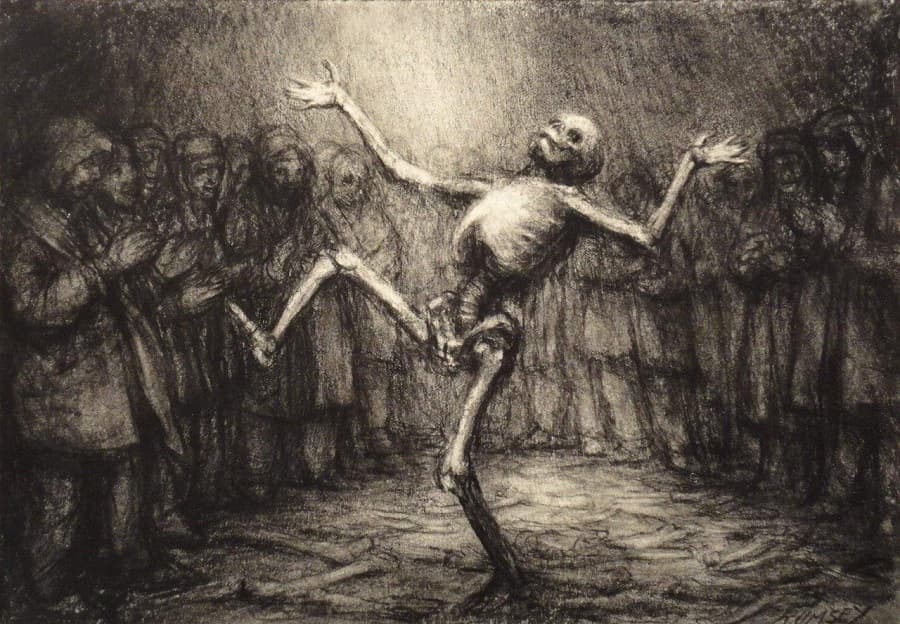
Paul Rumsey is an English draughtsman, born in Essex in 1956, who makes meticulous charcoal and ink drawings of grotesque and fantastic subjects: people with buildings growing from their heads, faces on bellies, human-animal hybrids and skeletons dancing among the living. His charcoal Danse Macabre drawings, on the medieval theme of the Dance of Death, are among his best-known images online.
Life and training
Rumsey took the foundation course at Colchester School of Art and Design from 1972 to 1974. In 1974 he won the Munnings Travel Scholarship and spent three months traveling in Italy and Austria. From 1974 to 1977 he studied for a BA at Chelsea School of Art in London.
His taste was out of step with art school in the 1970s. His Colchester tutors disapproved of what he admired: Alfred Kubin's Dance of Death drawings and Goya's print series, the Caprichos, the Disasters of War and the Disparates. He kept to them anyway.
After leaving Chelsea he spent about ten years in Fulham, painting large figure compositions and developing his imagery in sketchbooks, encouraged by his wife, the artist Terry Curling. In 1989, after the birth of their twin daughters, the family moved to Wivenhoe, near Colchester. In 1995 he first visited Chappel Galleries in Essex, which has shown his work regularly since 1999.
Style: tone, not line
Rumsey works in charcoal or ink on paper or card. His dealers note that he thinks in tones rather than lines: forms emerge from soft gradations of gray and black rather than from contour. He corrects and reworks constantly, using erasers and sandpaper to lift, bleach out or hide details, so that the finished drawings have a smoky depth that is hard to reproduce in photographs.
His sources are eclectic: news stories, history books, folktales, mythology, dreams and invention. He distorts reality through the classic devices of the grotesque, mixing forms, changing scale, elongating bodies and reversing expectations. The curator Mark Curteis has described the work as dark, grotesque, fantastic and macabre, sometimes erotic, but always with great attention to detail. Recurring motifs include heads made of libraries or museums, bodies carrying architecture, and animals with human faces.
The Danse Macabre drawings
Rumsey's Danse Macabre drawings return to one of the oldest subjects in European art. In the late Middle Ages, painted cycles on church and cemetery walls showed skeletons leading pope, emperor, merchant and child alike in a dance to the grave: a reminder that death levels everyone. The theme was revived by printmakers from Holbein to Kubin.
In the drawing in our catalogue, a skeleton dances with flung-out arms before a hushed crowd. The power comes from the contrast of the bony, energetic dancer and the soft, dark mass of watchers who do not yet know they are next. The series' exact dates and number of drawings have not been published in sources we could check.
Recognition and collections
Rumsey won prizes at the South Bank Picture Show, the Spectator Art Award, Drawings For All and the Eastern Open between 1988 and 1996, and showed at the Royal Academy Summer Exhibition in 1999. In 2010 Chelmsford Borough Museum acquired his drawing Museum Head, and three works entered the collection of the Abbaye d'Auberive in France.
His selected solo shows include the East West Gallery, London (1996–98), Dreams & Mythologies at Piers Feetham Gallery, London (2007), Fusains at Galerie Béatrice Soulié, Paris (2010), a joint show with Władysław Mirecki at Chelmsford Museum (2013) and Two Decades at Chappel Galleries (2015). Group shows include Alfred Kubin et vingt créateurs contemporains du dessin at the Abbaye d'Auberive (2010) and Beautiful Grotesque in Pueblo, Colorado (2015). His popularity online has brought particular interest from France.
Where to see his work
The most reliable places are Chappel Galleries in Essex, which holds regular exhibitions, Chelmsford Museum and the Abbaye d'Auberive collection in France. For the tradition he works in, see our guides to the danse macabre, memento mori and death in art, and Hugo Simberg's The Garden of Death.
Questions & answers
Who is Paul Rumsey?
Paul Rumsey is an English artist born in Essex in 1956. He studied at Colchester School of Art and Chelsea School of Art and makes highly detailed charcoal and ink drawings of grotesque, fantastic and macabre subjects, influenced by Goya and Alfred Kubin.
What media does Paul Rumsey use?
Rumsey draws in charcoal or ink on paper or card. He builds images in tone rather than line and reworks them with erasers and sandpaper, lifting and bleaching out details.
What is Paul Rumsey's Danse Macabre?
It is a group of charcoal drawings on the medieval Dance of Death theme, in which skeletons dance among the living as a reminder that death comes to everyone. The exact dates and size of the series are not published.
Where can I see Paul Rumsey's art?
Chappel Galleries in Essex has shown his work regularly since 1999. Chelmsford Museum owns his drawing Museum Head, and the Abbaye d'Auberive in France holds three of his works.