Italian · Late Baroque
Nicola Salvi
b. 6 August 1697, Rome — d. 8 February 1751, Rome
Nicola Salvi (1697–1751) was the Roman architect who designed the Trevi Fountain. He won the commission from Pope Clement XII around 1730–32, but died in 1751; Giuseppe Pannini finished the fountain in 1762.
1 work in the collection
Works by Nicola Salvi
Nicola Salvi was a Roman architect of the late Baroque, born in 1697, whose fame rests almost entirely on one work: the Trevi Fountain, the most celebrated fountain in Rome. He spent the last two decades of his life on it and did not live to see it finished.
Life in brief
Salvi studied philosophy, mathematics and anatomy as well as drawing, and trained in architecture under Antonio Canevari. He was a member of the Arcadian Academy, the literary society that shaped taste in eighteenth-century Rome. Before the fountain his built work was modest; he collaborated with Luigi Vanvitelli, including on a chapel for the church of São Roque in Lisbon commissioned by the king of Portugal, and on the enlargement of the Palazzo Chigi-Odescalchi in Rome. Work on the Trevi absorbed him from the 1730s; his health declined, and he died in Rome in 1751.
The Trevi Fountain
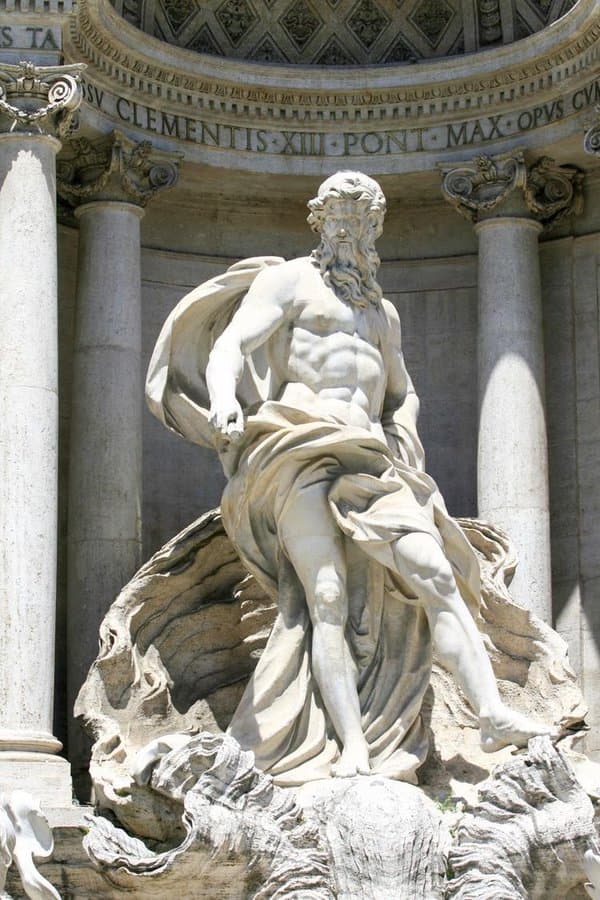
Pope Clement XII held a competition to rebuild the fountain at the end of the Acqua Vergine, the ancient aqueduct, and Salvi's design was chosen in 1732. His idea was to treat the whole back wall of the Palazzo Poli as a triumphal arch and to let the sea pour out of it over a mass of artificial rocks. At the center, in a niche, stands Oceanus on a shell-shaped chariot drawn by sea horses and tritons, carved by Pietro Bracci; in the side niches are Abundance and Health by Filippo della Valle, with reliefs above telling the story of the aqueduct. Work continued under several popes and was completed in 1762 by Giuseppe Pannini, who made some changes to Salvi's plan. The catalogue's Statue on the Trevi Fountain looks at Oceanus and his attendants.
Style
Salvi's fountain joins architecture, sculpture and water into one scene, in the tradition of Bernini, while its strict classical palace front looks ahead to Neoclassicism. The rocks seem to grow out of the building, and the water seems both natural and staged.
Where to see his work
The Trevi Fountain stands in the Piazza di Trevi in central Rome and is visible at all hours. See more in Baroque Art and Famous Sculptures.
Questions & answers
Who designed the Trevi Fountain?
The Trevi Fountain was designed by the Roman architect Nicola Salvi, whose plan won a competition held by Pope Clement XII in 1732. Salvi died in 1751, and Giuseppe Pannini completed the fountain in 1762.
Who made the statue of Oceanus on the Trevi Fountain?
The central figure of Oceanus, standing on a shell chariot pulled by sea horses and tritons, was carved by Pietro Bracci within Salvi's design. The flanking statues of Abundance and Health are by Filippo della Valle.
Did Nicola Salvi finish the Trevi Fountain?
No. Salvi worked on the fountain from the 1730s until his death in 1751. It was finished in 1762 under Giuseppe Pannini, who modified some details of Salvi's plan.