Italian · Late Baroque · Neoclassicism
Giuseppe Pannini
b. c. 1718–20, Rome — d. c. 1805–12, Rome
Giuseppe Pannini (c. 1718–c. 1805) was a Roman architect, stage designer and archaeologist, son of the painter Giovanni Paolo Panini. He is remembered above all for completing the Trevi Fountain in 1762 after Nicola Salvi's death.
1 work in the collection
Works by Giuseppe Pannini
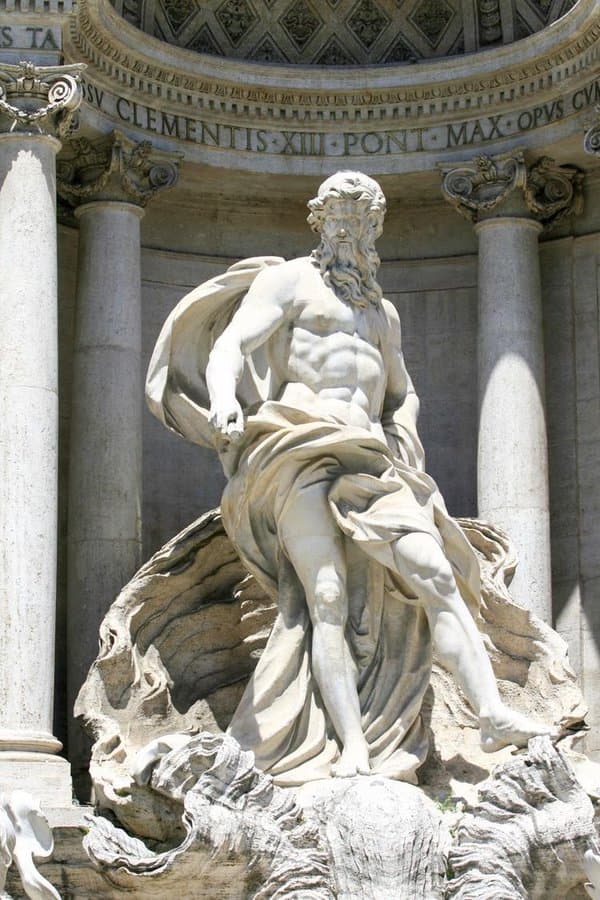
Giuseppe Pannini was an architect working in Rome in the middle and later decades of the 18th century, in the years when the city's Late Baroque was giving way to Neoclassicism. His name survives chiefly because he finished the Trevi Fountain: when its designer, Nicola Salvi, died in 1751 with the work half done, Pannini was appointed architect, and the fountain was inaugurated under his direction in 1762.
Who was Giuseppe Pannini?
He was one of two sons of Giovanni Paolo Panini, the most famous painter of Roman views (vedute) of his age. Both sons followed their father, but into different trades. Giuseppe became an architect and archaeologist; his brother Francesco Panini (1745–1812) was a painter, draughtsman and print publisher who worked in their father's studio.
The two brothers have been confused for a long time, and that confusion runs through much of what is written about Giuseppe online. The dates 1745–1812, a career as a landscape painter and engraver, and famous prints of St. Peter's, the Forum and the Pantheon belong to Francesco, not Giuseppe. Even Bryan's Dictionary of Painters and Engravers, a standard reference in 1904, printed a biography under Giuseppe's name that can only describe his brother. Giuseppe's own dates are uncertain: sources give birth in 1718 or 1720 and death in 1805, 1810 or 1812. On his prints he sometimes signed himself "Joseph Pannini, Architectus."
Completing the Trevi Fountain
The Trevi had a long birth. Pope Clement XII held a competition in 1730; Salvi's design was chosen and work began in 1732, built against the back of the palace now called Palazzo Poli. By Salvi's death the architecture stood, but much of the sculpture did not. Four sculptors were engaged to finish it: Pietro Bracci, who carved the central Oceanus riding his shell chariot, Filippo della Valle, Giovanni Grossi and Andrea Bergondi.
Pannini's role was to bring the project to an end, and he did not simply follow Salvi's drawings. In the side niches, where Salvi had planned statues of Agrippa (the Roman general who built the aqueduct, the Aqua Virgo, that feeds the fountain) and Trivia, the virgin who in legend showed thirsty soldiers the spring, Pannini substituted the present allegorical figures of Abundance and Health. Agrippa and the virgin moved up into reliefs above them. Pope Clement XIII inaugurated the fountain on 22 May 1762.
That is why the Britannica-style shorthand "designed by Nicola Salvi, completed by Giuseppe Pannini" appears in nearly every guide to the fountain. It is also why visitors sometimes credit him with the Oceanus. The statue is Bracci's; the overall finish, and the decision about what filled the niches, was Pannini's.
Churches, palaces and festival architecture
Little is documented about the rest of his career, but enough survives to show a working Roman architect of real standing. For Pope Benedict XIV he built the small church of Sant'Isidoro alle Terme (1754–55) against the ruins of the Baths of Diocletian. Only its pretty, simple Baroque facade and a gutted interior survived archaeological demolition in 1940.
He supplied designs for the Palazzo Corsini (1751), built the ornate cantoria, the musicians' gallery over the entrance of Santa Maria della Scala (around 1756), and in 1775 worked on rebuilding and redecorating the vault of Santissima Trinità dei Monti, the church at the top of the Spanish Steps. Between 1781 and 1794 he painted illusionistic architectural perspectives in trompe l'oeil inside the Palazzo Sforza Cesarini.
Much of his work was ephemeral. Like many Roman architects of the period, he designed celebratory and funerary displays, often with Ferdinando Fuga. The best documented is the temporary funeral architecture he built in Santa Maria in Monserrato for the death of Charles III of Spain in 1788; the engraver Giovanni Volpato published prints of it in 1789, and those prints are now the only record of what it looked like.
Pannini the archaeologist
Pannini also worked in the field. In 1753 Cardinal Silvio Valenti Gonzaga sent him to the Odeum at Hadrian's Villa near Tivoli to check reports that the landowners were stripping the ancient theater of its last marble. His survey was published as three large copper engravings by Carlo Fidanza.
From 1775 he took part in the papal excavations at Otricoli in Umbria. Around 1781–82, under his direction and Vincenzo Cecchi's, the colossal marble head known as the Jupiter of Otricoli was found in the octagonal hall of the Roman baths; it now stands in the Sala Rotonda of the Vatican's Museo Pio-Clementino. In 1779 he was commissioned to reproduce the great octagonal floor mosaic from the same site, with Lapiths fighting centaurs, now laid in that same room. His brother Francesco engraved it in color, one of the few moments where the two brothers' work meets on the same object.
Legacy and where to see his work
Pannini was not an innovator on the scale of Salvi, and he lived in the shadow of his famous father. But he is a good example of how Roman monuments were actually made: by teams, over decades, with designs adjusted by whoever was left to finish them. The most-visited fountain in the world carries his decisions in every niche.
To see his work, stand in the Piazza di Trevi and look at the side niches; visit the facade of Sant'Isidoro alle Terme and the vault of Trinità dei Monti; and look for his and Fidanza's engravings of the Hadrian's Villa Odeum, which survive in collections including the McNay Art Museum and the Royal Collection. For more Roman fountains and statues, see our guide to famous sculptures and the Baroque.
Questions & answers
Who was Giuseppe Pannini?
Giuseppe Pannini (c. 1718–c. 1805) was a Roman architect, stage designer and archaeologist, the son of the view painter Giovanni Paolo Panini. He is best known for completing the Trevi Fountain in 1762 after its designer, Nicola Salvi, died in 1751.
What did Giuseppe Pannini do at the Trevi Fountain?
He was appointed architect after Nicola Salvi's death in 1751 and brought the fountain to completion in 1762. He changed Salvi's plan for the side niches, replacing intended statues of Agrippa and the virgin Trivia with allegories of Abundance and Health. Pope Clement XIII inaugurated it on 22 May 1762.
Did Pannini carve the Oceanus statue on the Trevi Fountain?
No. The central Oceanus in his shell chariot was carved by the sculptor Pietro Bracci. Pannini was the architect who completed the fountain; the sculpture was shared among Bracci, Filippo della Valle, Giovanni Grossi and Andrea Bergondi.
Is Giuseppe Pannini the same as Francesco Panini?
No, they were brothers, both sons of Giovanni Paolo Panini. Francesco (1745–1812) was a painter and print publisher of Roman views. Many online biographies of Giuseppe, including the 1745–1812 dates and the famous view prints, actually describe Francesco.