Swiss-born French · Neoclassicism · Romanticism
James Pradier
b. 23 May 1790, Geneva — d. 4 June 1852, Bougival, France
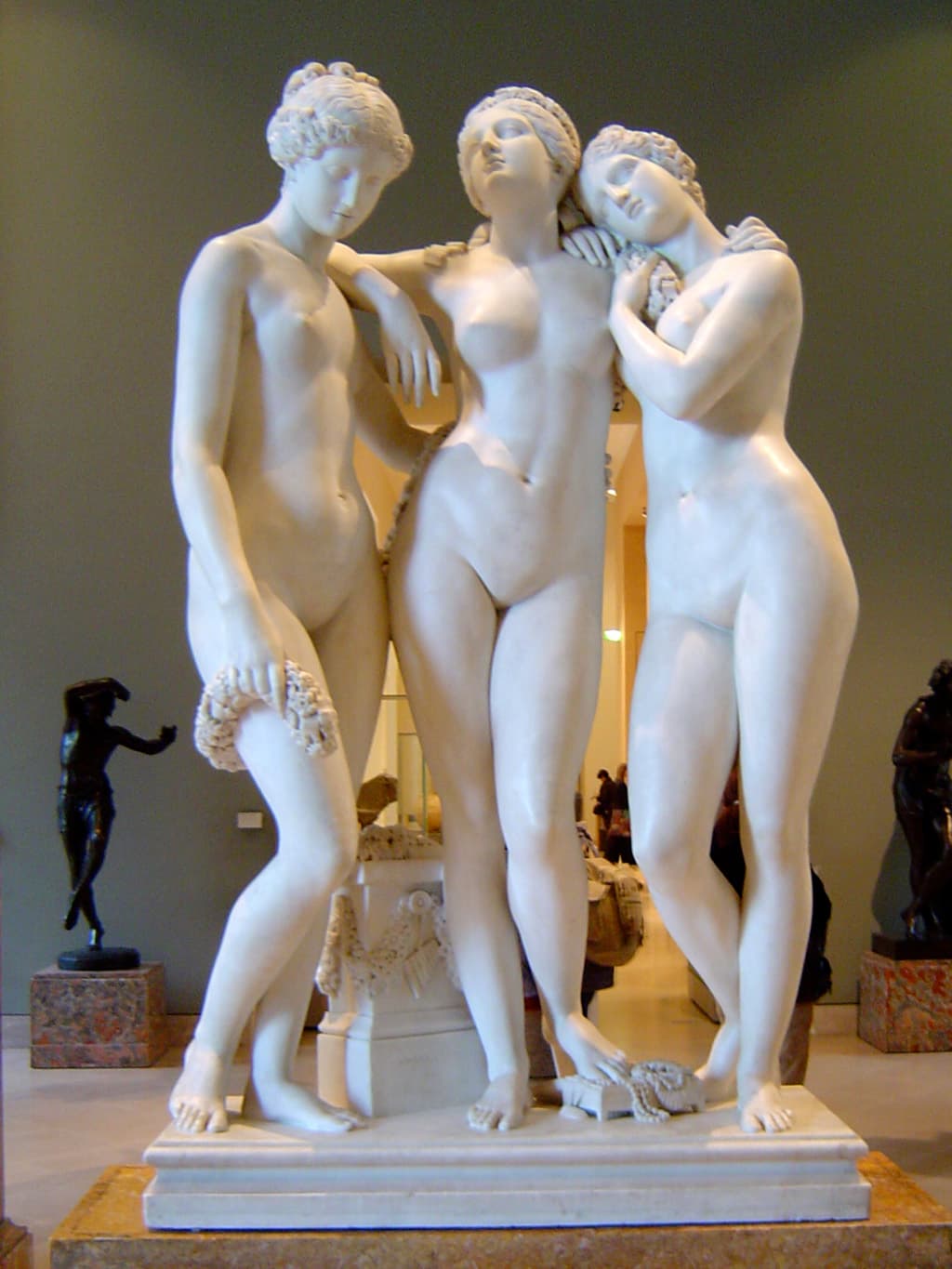
Jean-Jacques (James) Pradier (1790–1852) was a Geneva-born French sculptor, the most fashionable maker of marble nudes in Romantic Paris, known for The Three Graces in the Louvre and the Victories around Napoleon's tomb.
1 work in the collection
Works by James Pradier
Jean-Jacques Pradier, who signed himself James Pradier, was born in Geneva in 1790 and became one of the most successful sculptors in Paris between the Restoration and the Second Republic. He kept the polished marble and classical subjects of Neoclassicism but gave them a softer, more sensual surface, and critics in his own lifetime both admired and scolded him for it.
Life in brief
Pradier came to Paris as a young man, trained under the sculptor François-Frédéric Lemot, and won the Prix de Rome in 1813, which sent him to the French Academy in Rome for several years. He returned to make his name at the Salon with mythological nudes, became a member of the Académie des Beaux-Arts in 1827 and taught at the École des Beaux-Arts. His private life was lively: the actress Juliette Drouet, later Victor Hugo's companion, was his mistress and the mother of his daughter Claire. He died suddenly in 1852 at Bougival, near Paris.
Style
Pradier's figures are smooth, rounded and closely observed from life, with an attention to skin and softness that pushed classical marble toward the erotic. Satyr and Bacchante (1834) caused a scandal at the Salon; his late Sappho (1852, Musée d'Orsay) shows the poet sitting in melancholy. Alongside these he produced official monuments in great number.
Key works
Les Trois Grâces (The Three Graces), shown at the Salon of 1831 and bought for the French crown, is a life-size marble group of the three daughters of Zeus, now in the Louvre. It invites comparison with Antonio Canova's The Three Graces, whose cooler idealism Pradier knew well. In Paris his public work includes the twelve Victories around Napoleon's tomb at Les Invalides, the seated cities of Lille and Strasbourg on the Place de la Concorde, and the Muses of the Fontaine Molière.
Where to see his work
The Louvre and the Musée d'Orsay hold his finest marbles; his monuments can be seen across Paris, and the Musée d'art et d'histoire in Geneva keeps work by its native son. See more in Famous Sculptures.
Questions & answers
Who was James Pradier?
James Pradier, born Jean-Jacques Pradier in Geneva in 1790, was a French sculptor who won the Prix de Rome in 1813 and became the leading maker of marble nudes in Romantic Paris. He died in 1852.
Where is Pradier's Three Graces?
Pradier's Les Trois Grâces, a life-size marble shown at the Salon of 1831 and bought for the French crown that year, is in the Musée du Louvre in Paris.
What are Pradier's most famous works?
Besides The Three Graces, his best-known works are Sappho (1852, Musée d'Orsay), Satyr and Bacchante (1834), the Victories around Napoleon's tomb at Les Invalides, and the statues of Lille and Strasbourg on the Place de la Concorde.