French · Academic art
Gustave Courtois
b. 18 May 1852, Pusey, Haute-Saône — d. 25 November 1923, Paris
Gustave Courtois (1852–1923) was a French academic painter, pupil of Gérôme, best known for Dante and Virgil in Hell (1879), now in the Musée des Beaux-Arts et d'Archéologie de Besançon.
1 work in the collection
Works by Gustave Courtois
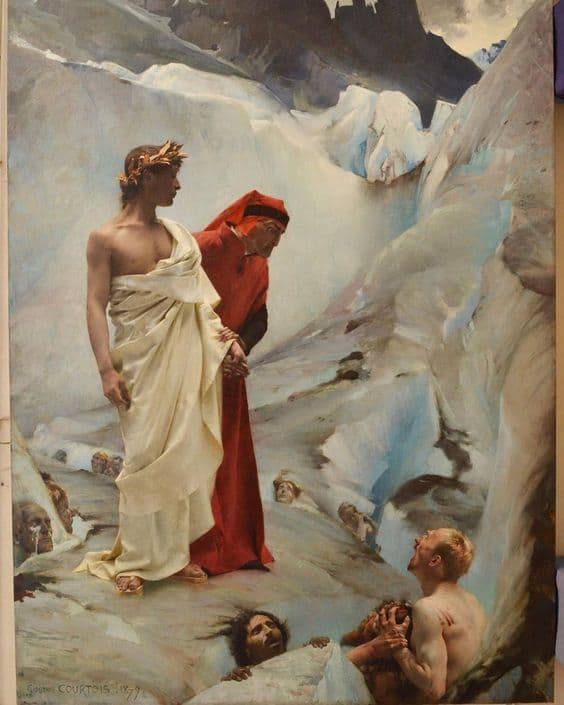
Gustave Courtois (1852–1923) was a French academic painter of portraits, mythological and religious subjects. He is best known today for Dante and Virgil in Hell (1879), a disturbing scene from Dante's Inferno that hangs in the Musée des Beaux-Arts et d'Archéologie in Besançon.
Life in brief
Courtois was born in Pusey, in the Haute-Saône region of eastern France, and raised by his mother, who was unmarried. He showed talent early at the municipal drawing school in Vesoul, and his drawings were shown to the celebrated academic painter Jean-Léon Gérôme, who encouraged him to enter the École des Beaux-Arts in Paris, where he became Gérôme's pupil. There he formed a lifelong friendship with his fellow student Pascal Dagnan-Bouveret. He exhibited regularly at the Salon from the late 1870s, taught at the Académie Colarossi, where his pupils included many American and British women artists, and was made a Chevalier of the Legion of Honor.
Style
Courtois painted in the polished, closely observed manner of the Gérôme school, with smooth surfaces and precise drawing. His portraits of fashionable sitters are elegant and cool; his literary and religious works are more charged.
Dante and Virgil in Hell
Painted in 1879 and shown at the Salon of 1880, this canvas illustrates Canto 32–33 of the Inferno, the frozen lake of Cocytus in the ninth circle, where traitors are trapped in ice. Dante and Virgil, wrapped in robes, look down at Count Ugolino gnawing the skull of Archbishop Ruggieri, who betrayed him and left him to starve in a tower with his children. Courtois contrasts the poets' clothed, upright figures with the pale, naked tangle of the damned, and sets the scene in a cold, colorless light that makes it more unsettling than a fiery hell would be. Compare Gustave Doré's famous engravings of the Inferno and the many treatments in Dark Academia and Death in Art.
Where to see his work
The museums of Besançon and Bordeaux, among other French regional museums, hold his paintings, and some portraits are in museums abroad.
Questions & answers
Who painted Dante and Virgil in Hell (1879)?
Dante and Virgil in Hell was painted in 1879 by the French academic painter Gustave Courtois, a pupil of Jean-Léon Gérôme. Shown at the 1880 Salon, it is now in the Musée des Beaux-Arts et d'Archéologie in Besançon, France.
What does Courtois's Dante and Virgil in Hell show?
It shows Dante and Virgil on the frozen lake of Cocytus in the ninth circle of Hell, from Inferno cantos 32–33, looking at Count Ugolino gnawing the head of Archbishop Ruggieri, the traitor who imprisoned and starved him.
Who was Gustave Courtois?
Gustave Courtois (1852–1923) was a French academic painter from the Haute-Saône who trained under Gérôme at the École des Beaux-Arts. He painted portraits and religious and literary subjects, taught at the Académie Colarossi and received the Legion of Honor.