Austrian · Vienna Secession · Symbolism · Art Nouveau
Gustav Klimt
b. 14 July 1862, Baumgarten, near Vienna — d. 6 February 1918, Vienna
Gustav Klimt (1862–1918) was the Austrian Symbolist painter and co-founder of the Vienna Secession, famous for gold-leaf paintings such as The Kiss and Portrait of Adele Bloch-Bauer I.
2 works in the collection
Works by Gustav Klimt
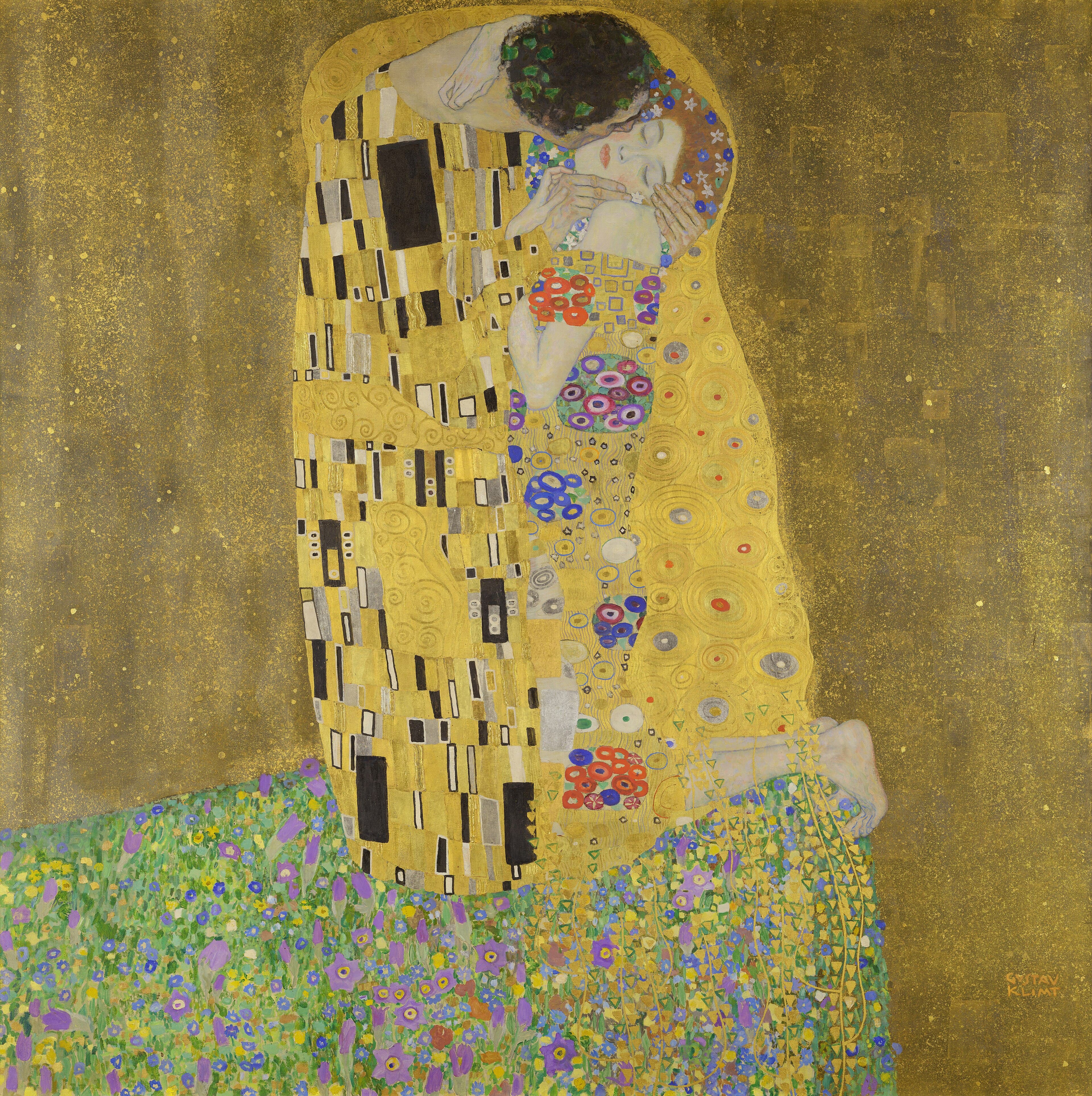
Gustav Klimt (1862–1918) was an Austrian painter, the leading artist of the Vienna Secession and of turn-of-the-century Viennese art. His "golden phase," in which he combined oil paint with real gold and silver leaf, produced The Kiss (1907–08) and Portrait of Adele Bloch-Bauer I (1907), two of the most recognized paintings of the twentieth century.
Life in brief
The son of a gold engraver, Klimt studied at Vienna's School of Arts and Crafts and began his career as a decorator, painting ceilings and staircases for the Burgtheater and the Kunsthistorisches Museum with his brother Ernst and Franz Matsch. In 1897 he co-founded the Vienna Secession, a breakaway group of artists, and became its first president. His paintings for the ceiling of the University of Vienna, Philosophy, Medicine and Jurisprudence, caused a public scandal over their nudity and pessimism; he withdrew from the commission, and the canvases were destroyed by fire in 1945. He died in 1918 after a stroke, complicated by the influenza pandemic.
Style and the golden phase
Klimt's mature style sets realistically painted faces and hands within flat fields of ornament: spirals, eyes, rectangles and circles, often in gold. A visit to the Byzantine mosaics of Ravenna in 1903 confirmed his use of gold as a sacred, timeless background. In The Kiss, the man's robe is patterned with black and white rectangles and the woman's with colored circles, a contrast of male and female that dissolves where the two figures meet.
Gold in London
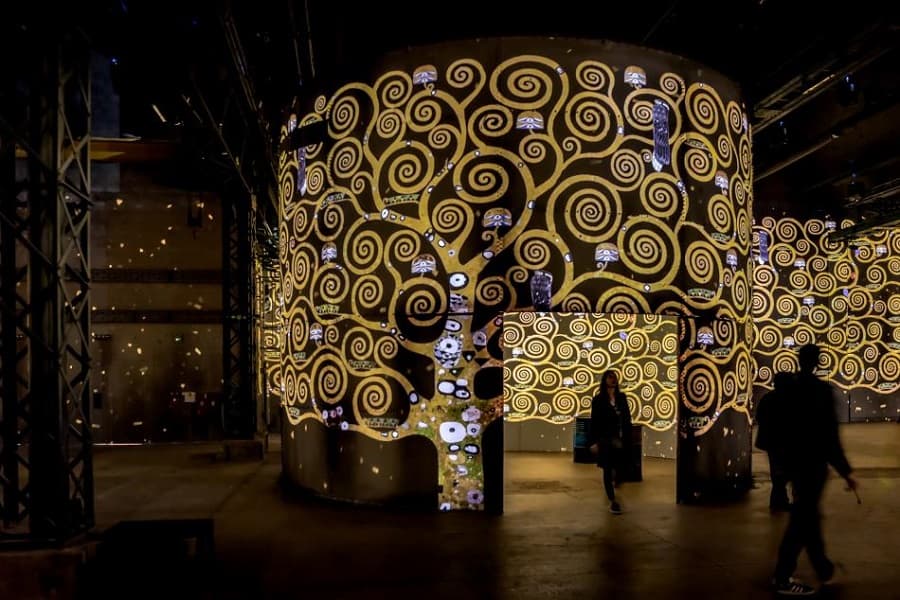
The catalogue entry Gold in London records an immersive exhibition devoted to Klimt's gold, in which his paintings, including the Tree of Life spirals of the Stoclet Frieze, were projected across the walls and floor of a dark hall. The image shows that kind of projection show, a format pioneered by Culturespaces' Gustav Klimt at the Atelier des Lumières in Paris in 2018 and since toured internationally. Such shows are not exhibitions of original works, but they have introduced Klimt's patterns to very large audiences. Compare Destination Cosmos, an immersive show in the same format.
Where to see his work
The Belvedere in Vienna holds The Kiss and the largest group of his paintings; the Secession building displays the Beethoven Frieze (1902), and the Leopold Museum has many works. Adele Bloch-Bauer I is at the Neue Galerie in New York. See also Symbolism.
Questions & answers
Why did Klimt use gold in his paintings?
Klimt's father was a gold engraver, and his own training was in decorative arts. After seeing Byzantine mosaics in Ravenna in 1903, he used gold leaf to give his figures a sacred, timeless setting, most famously in The Kiss and Adele Bloch-Bauer I.
Where is Klimt's The Kiss?
The Kiss (1907–08) is in the Upper Belvedere in Vienna, which bought it from the artist in 1908 before he had even finished it. It is painted in oil with applied layers of gold and silver leaf.
What was the Gold in London Klimt exhibition?
Our catalogue records Gold in London as an immersive digital show about Klimt's gold, projecting his works across a darkened hall. The format began with Culturespaces' Klimt show at the Atelier des Lumières in Paris in 2018; we have not confirmed details of a London run.