Czech · Academic art
František Bohumil Doubek
b. 20 March 1865, České Budějovice — d. 26 October 1952, Nový Jičín
František Bohumil (Franz) Doubek (1865–1952) was a Czech painter and illustrator from České Budějovice who trained in Prague and Munich. Allegory of Summer, a harvest nude with a hidden sickle, is attributed to him.
1 work in the collection
Works by František Bohumil Doubek
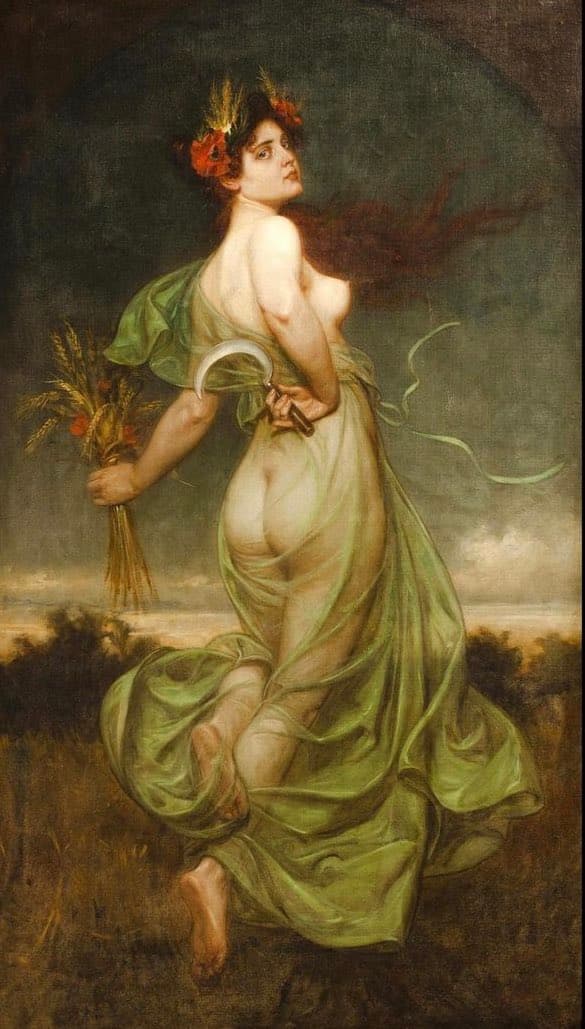
František Bohumil Doubek, often listed under the German form Franz Bohumil Doubek, was a Czech painter and illustrator who spent much of his career in Bavaria. Online he is best known for Allegory of Summer, a painting attributed to him and usually dated around 1905, in which a red-haired woman crowned with wheat and poppies walks through a harvest field, a sickle hidden behind her back.
Life
Doubek was born in České Budějovice (Budweis) on 20 March 1865, the son of a shoemaker. At fifteen he went to Prague, attending a private drawing school in 1879–80, and from 1880 studied at the Prague Academy under Antonín Lhota, František Sequens and František Čermák. In 1885 he moved to Munich, where he studied painting with Otto Seitz and composition with Alexander von Liezen-Mayer, and married there.
He served in the Austro-Hungarian army during the First World War and remained in Bavaria for about five years afterward. In 1924 he returned to České Budějovice, and in 1933 he moved to Prague, where he exhibited and worked as an illustrator. He died in a care home in Nový Jičín on 26 October 1952.
Work
Doubek painted portraits, religious works and allegories in the polished academic manner taught in Munich. In České Budějovice he portrayed the mayor Otakar Svoboda and the industrialist August Zátka, and he made the high altar painting and Stations of the Cross for the church of St Nicholas. He also portrayed President T. G. Masaryk. He was a member of the Jednota umělců výtvarných and, from 1898 to 1900, of the Mánes Union of Fine Arts.
Allegory of Summer
The painting shows summer as a young woman seen from behind, glancing back at the viewer, with a sheaf of grain in one hand and a sickle half hidden in the other. Wheat and poppies are traditional emblems of harvest; the sickle adds a reminder that ripeness is also the moment of cutting down. We have not found an independent museum record for the picture, so its date and present owner remain unconfirmed.
For related allegorical figures, see Academic art and famous paintings of women.
Questions & answers
Who painted Allegory of Summer?
Allegory of Summer is attributed to the Czech painter František Bohumil Doubek, also known as Franz Doubek, and is usually dated around 1905. It shows a woman crowned with wheat and poppies, with a sickle hidden behind her back.
Is Franz Doubek the same as František Bohumil Doubek?
Yes. Franz is the German form of František. Doubek trained in Prague and Munich and worked for years in Bavaria, so his name appears in both Czech and German forms.
Where did František Bohumil Doubek study?
He studied at the Prague Academy under Antonín Lhota, František Sequens and František Čermák, then from 1885 in Munich with Otto Seitz and Alexander von Liezen-Mayer.