Swiss (German-born) · Symbolism
Carlos Schwabe
b. 21 July 1866, Altona, Holstein — d. 22 January 1926, Avon, Seine-et-Marne
Carlos Schwabe (1866–1926) was a Swiss Symbolist painter and illustrator who designed the poster for the first Salon de la Rose + Croix (1892), illustrated Baudelaire's Les Fleurs du mal, and painted Spleen et Idéal (1907).
1 work in the collection
Works by Carlos Schwabe
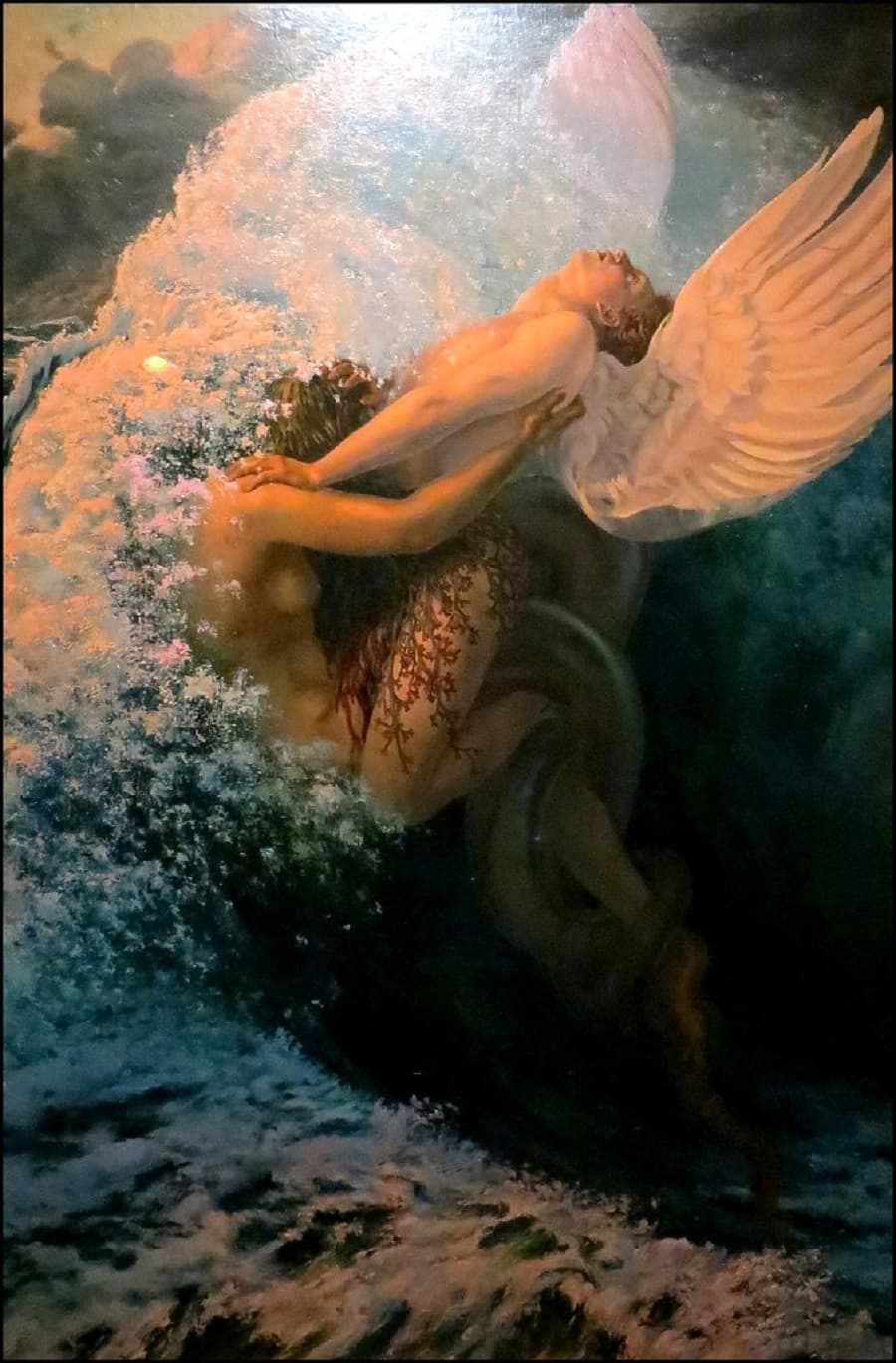
Carlos Schwabe, born Émile Martin Charles Schwabe, was a Swiss Symbolist painter, printmaker and one of the most important book illustrators of the movement. Searches for him most often concern Spleen et Idéal (1907), his painting of a winged figure and a serpent-wound woman embracing inside a breaking wave, titled after the first section of Baudelaire's Les Fleurs du mal.
Life
Schwabe was born on 21 July 1866 in Altona, near Hamburg, into a merchant family that moved to Switzerland in 1870; he became a Swiss citizen in 1888. He studied at the École des arts industriels in Geneva (1882–84), then moved to Paris, where he worked as a wallpaper designer and met Symbolist writers and musicians, including the composer Guillaume Lekeu. Lekeu's death in 1894 deepened his preoccupation with death and the ideal.
In 1892 he took part in the first Salon de la Rose + Croix, organized by Joséphin Péladan, and designed its poster: three women ascending toward spiritual light, printed in shades of blue. He won a gold medal at the Exposition Universelle of 1900 and the Legion of Honor in 1902. He lived in France for the rest of his life and died at Avon on 22 January 1926.
Style
Schwabe drew with a hard, precise line indebted to Dürer and Mantegna, and his compositions are tightly packed with lilies, thorns, wings and flowing hair. Women carry most of his meanings, appearing as Death, as suffering, or as the muse. In Death and the Gravedigger (1895), Death is a winged woman with a green light in her hand, said to resemble his first wife.
Spleen et Idéal and Baudelaire
Schwabe illustrated Les Fleurs du mal in an edition of 1900, and Baudelaire's opposition of spleen (melancholy, disgust) and idéal (spiritual aspiration) runs through his work. The 1907 painting turns that title into a single image. Its present owner is not confirmed in sources we could check. He also illustrated Zola's Le Rêve and Maeterlinck's Pelléas et Mélisande.
Where to see his work
The Musée d'Orsay in Paris and the Musée d'Art et d'Histoire in Geneva hold key works. See also our guides to Symbolism and death in art.
Questions & answers
What is Spleen et Idéal by Carlos Schwabe?
Spleen et Idéal is a 1907 oil painting by Carlos Schwabe, named after the first section of Baudelaire's Les Fleurs du mal. A winged figure and a woman encircled by a serpent embrace within a breaking wave, joining melancholy and spiritual longing.
Did Carlos Schwabe illustrate Les Fleurs du mal?
Yes. Schwabe produced illustrations for an edition of Baudelaire's Les Fleurs du mal published in 1900, one of the best-known Symbolist illustrated books. He also illustrated Zola's Le Rêve and Maeterlinck's Pelléas et Mélisande.
Where can I see Carlos Schwabe's work?
The Musée d'Orsay in Paris, which holds Death and the Gravedigger, and the Musée d'Art et d'Histoire in Geneva have important works. Others are in Brussels, Amsterdam's Van Gogh Museum and Rio de Janeiro.