American · American Renaissance · Academic art
Edwin Howland Blashfield
b. 15 December 1848, Brooklyn, New York — d. 12 October 1936, South Dennis, Massachusetts
Edwin Howland Blashfield (1848–1936) was a leading American muralist of the American Renaissance, best known for the dome murals of the Library of Congress Main Reading Room.
1 work in the collection
Works by Edwin Howland Blashfield
Edwin Howland Blashfield (1848–1936) was an American painter and the most prolific muralist of the American Renaissance, the movement that filled late nineteenth- and early twentieth-century public buildings with classical allegory. His best-known work is the painted dome of the Main Reading Room of the Library of Congress in Washington, D.C.
Life in brief
Born in Brooklyn, Blashfield began studying engineering at the Massachusetts Institute of Technology before turning to art. In 1867 he went to Paris to train with the portrait painter Léon Bonnat, and he stayed in Europe, with intervals, until 1881, exhibiting genre and historical scenes at the Paris Salon and studying Italian fresco painting. Back in New York, he made his reputation as a decorator with a dome for the Manufactures and Liberal Arts Building at the World's Columbian Exposition in Chicago in 1893.
Two years later he painted the Library of Congress dome: in the crowning circle, a female figure of Human Understanding lifting a veil, and in the collar below, twelve seated figures representing the countries and eras that contributed to civilization, from Egypt to America. Commissions followed for state capitols, courthouses, churches and universities across the country. He served as president of the National Academy of Design, and with his wife, the writer Evangeline Wilbour Blashfield, published books on Italian art.
Style
Blashfield's figures are idealized women in flowing robes, set against blue skies or gold, drawn with academic precision and colored with the light, chalky harmony he admired in Italian fresco.
Spring Scattering Stars
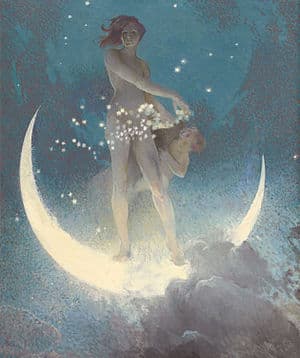
Spring Scattering Stars (1927) shows a nude young woman standing on the upturned crescent of the moon, flinging stars across a twilight sky, with a small child behind her. It is an easel painting, but its single allegorical figure in a cosmic setting reads like a fragment of one of his ceilings. Compare the floating allegories in Academic Art and the work of William-Adolphe Bouguereau, whose generation he trained alongside in Paris.
Where to see his work
The Library of Congress in Washington holds his most famous mural. Others survive in the state capitols of Wisconsin, Minnesota and Iowa, among other public buildings.
Questions & answers
Who painted the dome of the Library of Congress?
Edwin Howland Blashfield painted the murals in the dome of the Main Reading Room of the Library of Congress in 1895–96: Human Understanding in the central circle and twelve figures representing the contributors to civilization in the collar around it.
What does Spring Scattering Stars show?
Blashfield's Spring Scattering Stars (1927) shows a nude female personification of spring standing on an upturned crescent moon and scattering stars across a twilight sky, with a small child behind her. It is an allegory of renewal in his mural style.
What was the American Renaissance?
The American Renaissance (roughly 1876–1917) was a movement in American architecture, painting and sculpture that borrowed from the Italian Renaissance and classical art to decorate public buildings, with muralists like Blashfield, Kenyon Cox and John La Farge.