British · Academic art · Classicism · Aestheticism
Edward John Poynter
b. 20 March 1836, Paris — d. 26 July 1919, London
Sir Edward John Poynter (1836–1919) was an English classical painter, President of the Royal Academy from 1896 and Director of the National Gallery from 1894 to 1904, known for Israel in Egypt and Psyche in the Temple of Love.
1 work in the collection
Works by Edward John Poynter
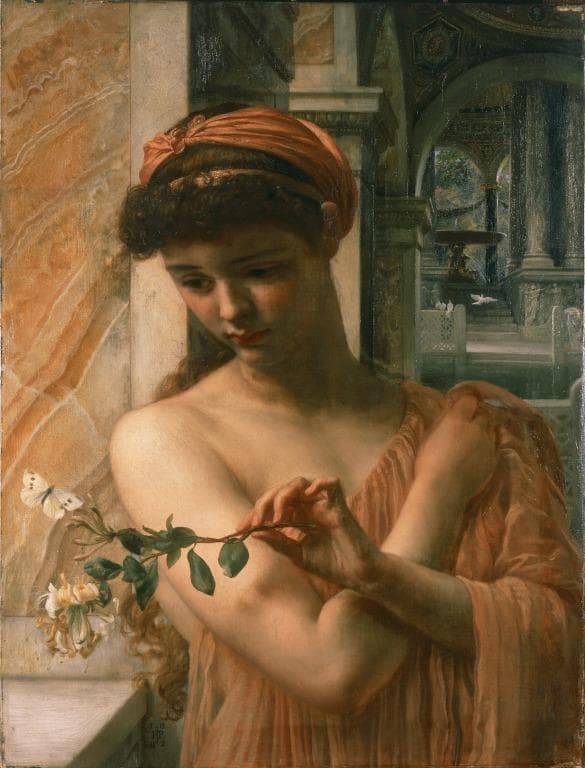
Sir Edward John Poynter was a painter, designer and draftsman of grand classical and biblical subjects who rose to the very top of the British art establishment. In the catalogue he is represented by Psyche in the Temple of Love (1882), in the Walker Art Gallery, Liverpool.
Life
Poynter was born in Paris on 20 March 1836, the son of the architect Ambrose Poynter; the family returned to Britain soon after. Ill health took him to Madeira and Rome, where in 1853 he met Frederic Leighton, a decisive influence. He studied at Leigh's Academy and the Royal Academy Schools in London, then in Paris in the studio of Charles Gleyre, alongside James McNeill Whistler and George du Maurier.
In 1866 he married Agnes Macdonald, one of the famous Macdonald sisters: her sisters married Edward Burne-Jones and became the mothers of Rudyard Kipling and Stanley Baldwin. Poynter was the first Slade Professor at University College London (1871–75), Director of the National Gallery (1894–1904), and President of the Royal Academy from 1896, succeeding Millais. He was knighted in 1896, made a baronet in 1902, and died in London on 26 July 1919.
Style
Poynter's art rests on drawing: firm contours, carefully studied figures and archaeologically detailed settings in marble and bronze. His early fame came from huge narrative canvases such as Israel in Egypt (1867, Guildhall Art Gallery) and The Visit of the Queen of Sheba to King Solomon (1884–90, Art Gallery of New South Wales). Later he favored smaller, cooler pictures of single women in classical interiors, such as Psyche in the Temple of Love, where Cupid's mortal beloved contemplates a butterfly, symbol of the soul.
He also designed tiles, stained glass and the mosaic St George in the Central Lobby of the Palace of Westminster.
Where to see his work
The Walker Art Gallery, Guildhall Art Gallery, Tate and the Art Gallery of New South Wales hold major works. See also Academic art and Greek mythology in art.
Questions & answers
What is Edward Poynter famous for?
Poynter is known for grand classical and biblical paintings such as Israel in Egypt (1867) and The Visit of the Queen of Sheba to King Solomon (1884–90), and for leading the Royal Academy as President from 1896 to 1918.
Where is Psyche in the Temple of Love by Poynter?
Psyche in the Temple of Love (1882) is in the Walker Art Gallery in Liverpool. It shows Psyche, beloved of Cupid, gazing at a butterfly on a sprig of honeysuckle.
Was Edward Poynter related to Rudyard Kipling?
By marriage, yes. Poynter's wife Agnes Macdonald was the sister of Kipling's mother, Alice, so Poynter was Kipling's uncle. Another sister, Georgiana, married Edward Burne-Jones.