German · Neoclassicism · Academic art
Eduard Müller
b. 9 August 1828, Hildburghausen — d. 29 December 1895, Rome
Eduard Müller (1828–1895) was a German sculptor who trained late, after working as a cook, and spent most of his career in Rome. His masterpiece is the marble group Prometheus Bound and the Oceanids (1872–79) in the Alte Nationalgalerie, Berlin.
1 work in the collection
Works by Eduard Müller
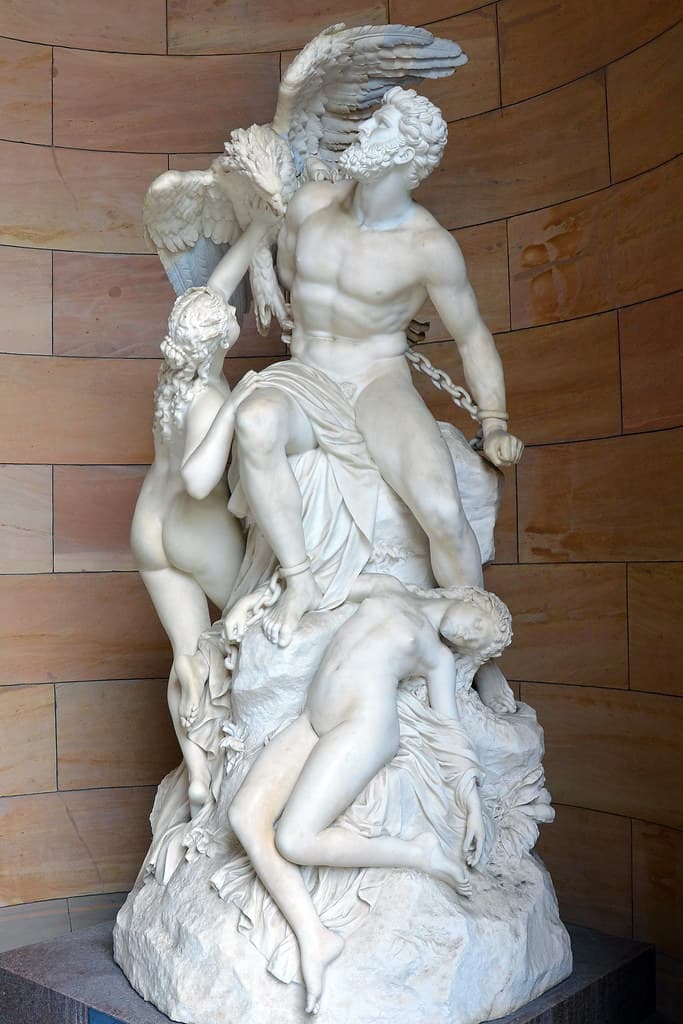
Eduard Müller was a German sculptor of mythological and ideal figures who made his career in Rome. He is remembered above all for Prometheus Bound and the Oceanids (1872–79), a heroic-scale marble group carved from a single block and now in the Alte Nationalgalerie in Berlin.
An unusual path into sculpture
Müller was born on 9 August 1828 in Hildburghausen, in Thuringia. His first trade was not art at all: he worked as a cook in the ducal kitchen at Coburg, and followed that trade in Munich and Paris before reaching Antwerp. There, on the advice of the Belgian sculptor Joseph Geefs, he enrolled at the Academy in 1850, already in his twenties. Two years later he moved on to Brussels, and in 1857 he settled permanently in Rome, where he would live and work until his death on 29 December 1895. Among his pupils there was the Italian sculptor Cesare Aureli.
Style and subjects
Rome in the second half of the nineteenth century was full of foreign sculptors carving marble for northern European patrons, and Müller belongs to that world. His subjects are nymphs, satyrs, fauns and Cupids, treated with smooth finish and lively, readable poses. Contemporary reference works praised his careful composition, truthfulness to life and technical polish. Titles include Nymph Kissing Cupid (1862, acquired for the British royal collection), Satyr with the Mask (1870) and its companion The Terrified Nymph, The Faun's Secret (1874), The Neapolitan Fisherman and His Son (1875) and Eve with Her Children (1880). He also made a group of Faith, Love and Hope (1869) for the Schröder mausoleum in Hamburg.
Prometheus Bound and the Oceanids
The Prometheus group is his most ambitious work and the one that secured his reputation in Germany. It shows the Titan chained to his rock as punishment for giving fire to humanity, with the sea nymphs, the Oceanids, gathered around him in grief, a scene taken from Aeschylus's tragedy Prometheus Bound. Carving such a crowded, larger-than-life composition from one block of marble was a technical statement as much as an artistic one. The work entered the Nationalgalerie in Berlin, where it can still be seen; it sits well beside Berlin's other ambitious marble of the period, Louis Sussmann-Hellborn's Sleeping Beauty.
Where to see his work
The Alte Nationalgalerie on Berlin's Museum Island holds the Prometheus group. Other pieces are scattered through private and royal collections. For the wider tradition he worked in, see our guides to Greek mythology in art and famous sculptures.
Questions & answers
What is Eduard Müller's most famous sculpture?
His best-known work is Prometheus Bound and the Oceanids (1872–79), a heroic-scale marble group carved from a single block. It shows the chained Titan Prometheus mourned by the sea nymphs and is in the Alte Nationalgalerie, Berlin.
Where did Eduard Müller train?
After working as a cook, Müller studied at the Academy in Antwerp from 1850, on the advice of the sculptor Joseph Geefs, then in Brussels from 1852. In 1857 he settled in Rome, where he spent the rest of his career.
Where can I see Eduard Müller's work?
The Alte Nationalgalerie in Berlin displays Prometheus Bound and the Oceanids. Most of his other ideal figures, such as Nymph Kissing Cupid and Satyr with the Mask, are in royal or private collections.