Danish · Neoclassicism
Bertel Thorvaldsen
b. 19 November 1770, Copenhagen — d. 24 March 1844, Copenhagen
Bertel Thorvaldsen (1770–1844) was a Danish Neoclassical sculptor who worked in Rome for four decades, Canova's great rival, and designed the Lion of Lucerne monument in Switzerland.
1 work in the collection
Works by Bertel Thorvaldsen
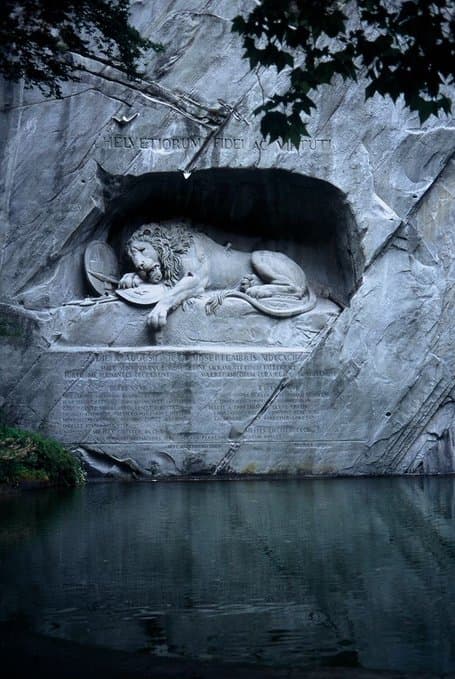
Bertel Thorvaldsen (1770–1844) was a Danish sculptor and, with Antonio Canova, the leading Neoclassical sculptor in Europe. He spent most of his working life in Rome, and one of his designs, The Lion of Lucerne, is among the most visited monuments in Switzerland.
Life in brief
The son of an Icelandic woodcarver in Copenhagen, Thorvaldsen entered the Royal Danish Academy of Fine Arts as a boy, studying under Nicolai Abildgaard among others, and won the travel scholarship that took him to Rome. He arrived on 8 March 1797, a date he later celebrated as his "Roman birthday." His breakthrough came with Jason with the Golden Fleece, ordered in marble by the English collector Thomas Hope in 1803. Commissions followed from across Europe, including a frieze of Alexander the Great prepared for Napoleon's expected visit to the Quirinal Palace in 1812. He returned to Copenhagen in 1838 a national hero.
Style
Thorvaldsen's work is stricter and cooler than Canova's: frontal poses, clear outlines, surfaces closer to Greek originals than to living skin. His relief work, especially the roundels Night and Day, was endlessly copied.
The Lion of Lucerne
The Lion of Lucerne commemorates the Swiss Guards killed on 10 August 1792 when revolutionaries stormed the Tuileries Palace in Paris. Thorvaldsen designed the dying lion in 1819; the stonemason Lukas Ahorn carved it in 1820–21 into the sandstone face of a former quarry. A broken spear sticks in the lion's side, and its paw rests on a shield with the French fleur-de-lis. Mark Twain called it "the saddest and most moving piece of stone in the world."
Where to see his work
The Thorvaldsens Museum in Copenhagen, opened in 1848, holds his models and marbles and his tomb. His Christ and Twelve Apostles stand in the Church of Our Lady, Copenhagen.
Questions & answers
Who made the Lion of Lucerne?
The Lion of Lucerne was designed by the Danish sculptor Bertel Thorvaldsen in 1819 and carved into the rock in 1820–21 by the stonemason Lukas Ahorn. It commemorates the Swiss Guards killed at the Tuileries Palace in Paris in 1792.
Where can I see Thorvaldsen's sculpture?
The Thorvaldsens Museum in Copenhagen holds most of his plaster models and many marbles, and his Christ and the Twelve Apostles are in Copenhagen's Church of Our Lady. The Lion of Lucerne is in Lucerne, Switzerland.
Were Thorvaldsen and Canova rivals?
Yes, in the sense that they were the two most sought-after sculptors in Rome in the early nineteenth century. Thorvaldsen's style was more severe and Greek, Canova's softer and more sensuous, and patrons often compared them directly.