Flemish · Baroque · Flemish Baroque
Artus Quellinus
b. August 1609, Antwerp — d. 23 August 1668, Antwerp
Artus Quellinus the Elder (1609–1668) was the leading Flemish Baroque sculptor, who spent some fifteen years covering Amsterdam's new town hall, now the Royal Palace, with sculpture, including its great figure of Atlas.
1 work in the collection
Works by Artus Quellinus
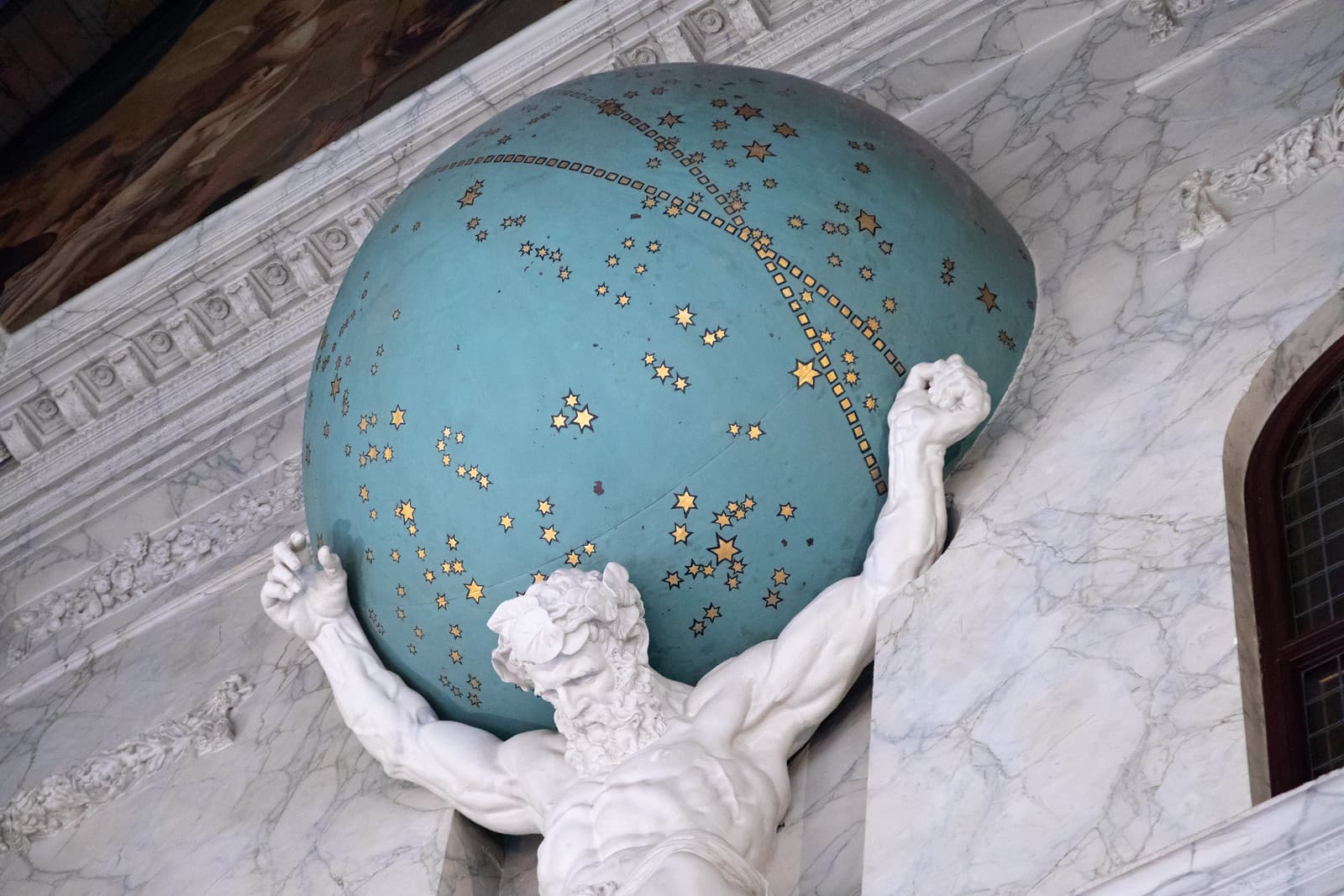
Artus Quellinus the Elder was a sculptor from Antwerp, regarded as the most important Baroque sculptor of the Southern Netherlands. His largest project was the sculptural decoration of Amsterdam's new town hall on Dam Square, today the Royal Palace, where his workshop created the Atlas who carries a celestial globe above the Burgerzaal and, in bronze, on the roof.
Life in brief
Quellinus was born in Antwerp in August 1609, the son of the sculptor Erasmus Quellinus I, who trained him; his brother Erasmus II became a well-known painter. From 1635 to 1639 he worked in Rome in the studio of the Flemish sculptor François Duquesnoy, whose restrained, classicizing Baroque shaped his own style.
Back in Antwerp he became a master in the Guild of Saint Luke and ran a busy workshop. In 1650 he moved to Amsterdam to work on the city's new town hall, designed by Jacob van Campen. For about fifteen years he and a large team, including his cousin Artus Quellinus II, Rombout Verhulst, Bartholomeus Eggers, Gabriël Grupello and probably the young Grinling Gibbons, produced pediments, friezes, caryatids, reliefs and statues. In 1665 a book of engravings by his brother Hubertus published the sculpture with Van Campen's architectural drawings. He returned to Antwerp, where he died in 1668.
Style
Quellinus combined the full, fleshy figures of Rubens's Antwerp with the classical calm he had learned in Rome. His marble is softly modeled, his allegorical women dignified and heavy, his children plump and lively. At Amsterdam the sculpture serves an elaborate program celebrating the city as the center of the world: justice and punishment in the marble tribunal, the four elements, the planets and the seas.
The Atlas
The Titan Atlas, punished by the gods, holds up not the Earth but the heavens, shown as a starry blue-green celestial globe. The palace describes the indoor figure in the Burgerzaal as the full-size model, about 7 meters high, from which the bronze was cast in 1663 by the bell founders François and Pieter Hemony; the bronze still crowns the rear pediment of the palace.
Other works
Quellinus also made portrait busts, including those of Andries de Graeff (1661) and Johan de Witt (1665), and tombs in Berlin and Schleswig.
Where to see his work
The Royal Palace Amsterdam, open to visitors when not in royal use; the Rijksmuseum, which holds many of his terracotta models; and churches and museums in Antwerp. Explore Baroque Art and Famous Sculptures.
Questions & answers
Who made the Atlas statue in Amsterdam?
The Atlas statues at the Royal Palace on Dam Square, Amsterdam, were designed by the Flemish sculptor Artus Quellinus the Elder. The bronze on the roof was cast in 1663 by François and Pieter Hemony after his full-size model, which stands inside above the Burgerzaal.
What is Artus Quellinus known for?
Artus Quellinus the Elder is known for the sculpture of Amsterdam's town hall, now the Royal Palace, carried out with a large workshop from 1650 to about 1665, and for portrait busts and tombs. He was the leading Baroque sculptor of the Southern Netherlands.
Why does Atlas hold a sky globe instead of the Earth?
In Greek myth Atlas was condemned to hold up the heavens, not the Earth. Quellinus followed the original myth, giving him a celestial globe painted with stars. The image of Atlas carrying the Earth is a later confusion, partly due to his use on the covers of map books.