Italian (Florentine) · Early Renaissance
Andrea del Verrocchio
b. c. 1435, Florence — d. 1488, Venice
Andrea del Verrocchio (c. 1435–1488) was a Florentine sculptor, painter and goldsmith whose busy workshop trained Leonardo da Vinci. His Baptism of Christ in the Uffizi contains an angel painted by the young Leonardo.
1 work in the collection
Works by Andrea del Verrocchio
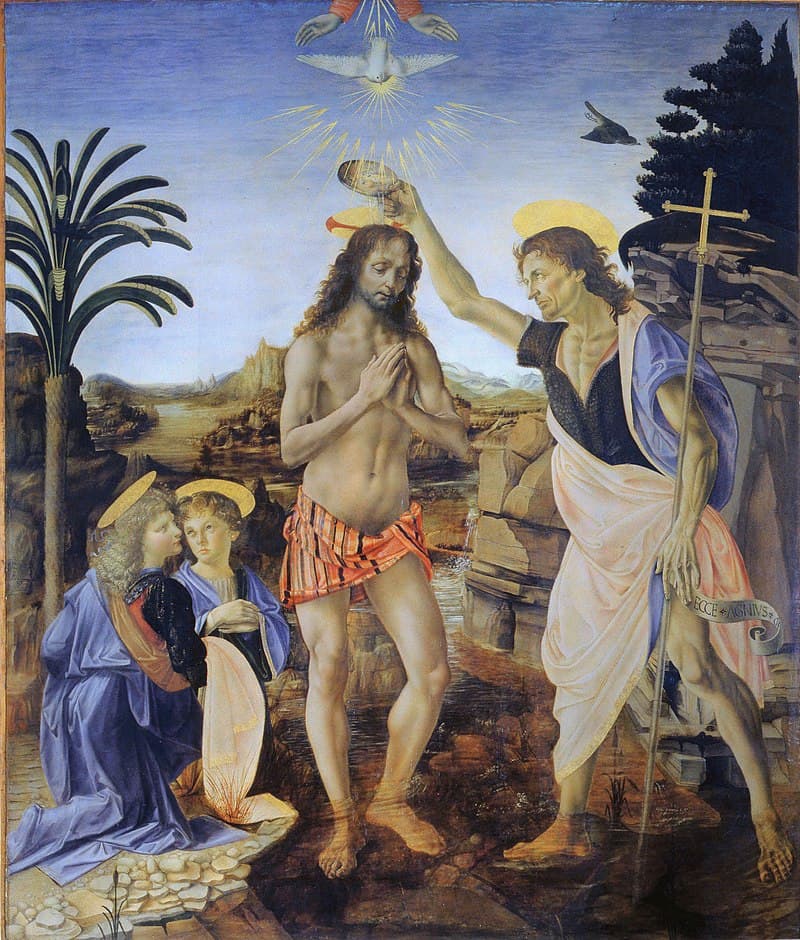
Andrea del Verrocchio ran the most versatile artistic workshop in fifteenth-century Florence, producing bronzes, marbles, paintings, goldsmith's work and festival decorations, often for the Medici. He is remembered today both for his sculpture and as the master of Leonardo da Vinci, who worked beside him on The Baptism of Christ (c. 1470–75), now in the Uffizi Gallery.
Life in brief
Born Andrea di Michele di Francesco de' Cione around 1435, the son of a kiln worker, he trained first as a goldsmith; his professional name probably comes from the goldsmith Giuliano Verrocchi. By the late 1460s he was a leading sculptor in bronze and marble, working for Piero and Lorenzo de' Medici. His workshop drew a remarkable generation of pupils and assistants: Leonardo, Pietro Perugino and Lorenzo di Credi among them. Around 1483 he moved to Venice to model the equestrian statue of the condottiere Bartolomeo Colleoni, and he died there in 1488 before it was cast.
Key works
Verrocchio's bronze David (c. 1466–70s, Bargello, Florence) is a slight, confident youth standing over Goliath's head, a deliberate answer to the Donatello bronze of the same subject. His group Christ and Saint Thomas (1467–83) for a niche at Orsanmichele shows Thomas stepping half out of the frame toward Christ's wound. He made the tomb of Giovanni and Piero de' Medici in San Lorenzo (1472), set the great gilt copper ball on the lantern of Florence Cathedral (1471), and designed the Colleoni monument in Venice, cast by Alessandro Leopardi and unveiled in 1496, one of the finest equestrian statues of the Renaissance.
The Baptism of Christ
The panel shows John the Baptist pouring water over Christ in the Jordan, with two kneeling angels at left. Giorgio Vasari tells that the young Leonardo painted the angel in profile so beautifully that Verrocchio resolved never to touch paint again. The story is embroidered, but technical study confirms that Leonardo, working in oil, painted that angel and parts of the landscape over Verrocchio's tempera.
Where to see his work
Florence holds most of it: the Bargello, Orsanmichele, San Lorenzo, the Palazzo Vecchio (Putto with a Dolphin) and the Uffizi. The Colleoni stands in Campo Santi Giovanni e Paolo, Venice. See also Renaissance Paintings and Famous Sculptures.
Questions & answers
Was Verrocchio Leonardo da Vinci's teacher?
Yes. Leonardo trained in Verrocchio's Florentine workshop from about the mid-1460s and remained associated with it into the late 1470s. He painted the left angel and parts of the landscape in Verrocchio's Baptism of Christ, now in the Uffizi.
What is Andrea del Verrocchio famous for?
Verrocchio is famous for bronze sculpture, especially his David in the Bargello, Christ and Saint Thomas at Orsanmichele and the equestrian Colleoni monument in Venice, and for The Baptism of Christ, painted with the young Leonardo. His workshop trained several leading Renaissance artists.
Where is The Baptism of Christ by Verrocchio?
The Baptism of Christ (c. 1470–75) is in the Uffizi Gallery in Florence. It was painted for the church of San Salvi outside the city and is executed in tempera and oil on panel, the oil passages generally given to Leonardo.