Italian · Verismo · Academic art
Ambrogio Borghi
b. 1848 (some sources 1849), Lombardy — d. 1887
Ambrogio Borghi (1848–1887) was a Milanese sculptor trained at the Brera Academy, best known for La Chioma di Berenice (Berenice's Tresses), a life-size marble nude shown at the 1878 Paris Exposition Universelle.
1 work in the collection
Works by Ambrogio Borghi
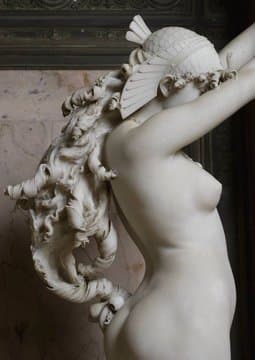
Ambrogio Borghi was an Italian sculptor of the generation that brought a new softness and realism to Milanese marble in the 1870s. Trained at the Brera Academy and active in Milan, he died young, at about 38, in 1887. His best-known work is La Chioma di Berenice (Berenice's Tresses), a life-size marble nude of the Egyptian queen Berenice II exhibited at the Paris Exposition Universelle of 1878.
Life and training
Borghi was born in Lombardy in 1848; some sources give 1849. Our earlier notes place his birth at Nova Milanese, north of Milan, but we have not been able to confirm this. He studied sculpture at the Brera Academy of Fine Arts in Milan under Giovanni Strazza, the sculptor of the famous Veiled Virgin, a marble whose transparent veil was a showpiece of Milanese technique. Strazza's interest in virtuoso surfaces left a clear mark on his pupil.
He won prizes as a student, and in 1871 a scholarship from the Oggioni Foundation allowed him to study for three years in Rome, where he could look closely at ancient and Baroque sculpture. He also worked in Turin, at the Accademia Albertina, under Odoardo Tabacchi, before returning to Milan around 1876 to set up as an independent sculptor.
Style: grace and realism
During the 1870s Borghi's style became more supple and realistic, moving away from the cool Neoclassicism that still dominated Italian academies toward the naturalism, sometimes called verismo, that Milanese sculptors were developing. His surfaces are smooth and finely finished, but the bodies are those of real models rather than ideal types, and he liked subjects that allowed a graceful, slightly playful pose.
A good example is Mascherina (Girl with a Mask), dated 1876, a young woman holding a carnival mask, a theme that combined charm with a hint of theater. It was reportedly shown at the 1876 Centennial Exhibition in Philadelphia. In 1877 he won a major prize at the national sculpture competition in Florence.
Berenice's Tresses
His best-known work takes its subject from a story told by the poets Callimachus and Catullus. Queen Berenice II of Egypt vowed to dedicate her hair to the gods if her husband, Ptolemy III, returned safely from war. When he did, she cut off her tresses and laid them in the temple of Aphrodite; the hair vanished overnight, and the court astronomer Conon declared it had been placed in the sky as a constellation, still called Coma Berenices.
Borghi shows the queen nude, life-size, at the moment of offering her long hair. The marble was exhibited at the Exposition Universelle in Paris in 1878, mounted on a revolving column of veined marble so that viewers could see the figure from every side. The marble is now in a private collection. In 1937 Borghi's daughter gave the full-size plaster model, with other plasters, to the city of Monza, and it is in the Musei Civici di Monza.
Legacy and where to see his work
Borghi's early death cut short a promising career, and he is little known outside Lombardy. His work is a good example of how Milanese sculptors of the 1870s used academic skill to make sensual, modern-feeling marbles for international exhibitions and private collectors. The Musei Civici in Monza hold the Berenice plaster; other works appear at auction. For context, see our guide to academic art and the Neoclassical marbles of Antonio Canova, whose Psyche Revived by Cupid's Kiss set the standard Borghi's generation worked against.
Questions & answers
Who was Ambrogio Borghi?
Ambrogio Borghi (1848–1887) was an Italian sculptor trained at the Brera Academy in Milan under Giovanni Strazza. He is known for graceful, realistic marbles, above all La Chioma di Berenice (Berenice's Tresses), shown at the 1878 Paris Exposition Universelle.
What is La Chioma di Berenice by Ambrogio Borghi?
It is a life-size marble nude of Queen Berenice II of Egypt offering her hair to the gods, the legend behind the constellation Coma Berenices. Borghi exhibited it in Paris in 1878; the marble is privately owned and the plaster model is in the Musei Civici di Monza.
Where can I see Ambrogio Borghi's sculpture?
The full-size plaster of Berenice's Tresses, given by his daughter in 1937, is in the Musei Civici di Monza near Milan. The marble version and other works are in private collections and occasionally appear at auction.
Who taught Ambrogio Borghi?
He studied at Milan's Brera Academy under Giovanni Strazza, sculptor of the Veiled Virgin, and later worked under Odoardo Tabacchi at the Accademia Albertina in Turin. An Oggioni Foundation scholarship took him to Rome for three years from 1871.