German · Baroque
Adam Elsheimer
b. 18 March 1578, Frankfurt am Main — d. 11 December 1610, Rome
Adam Elsheimer (1578–1610) was a German painter in Rome whose tiny, jewel-like paintings on copper, above all The Flight into Egypt (1609), transformed the painting of landscape and night light and influenced Rubens and Rembrandt.
1 work in the collection
Works by Adam Elsheimer
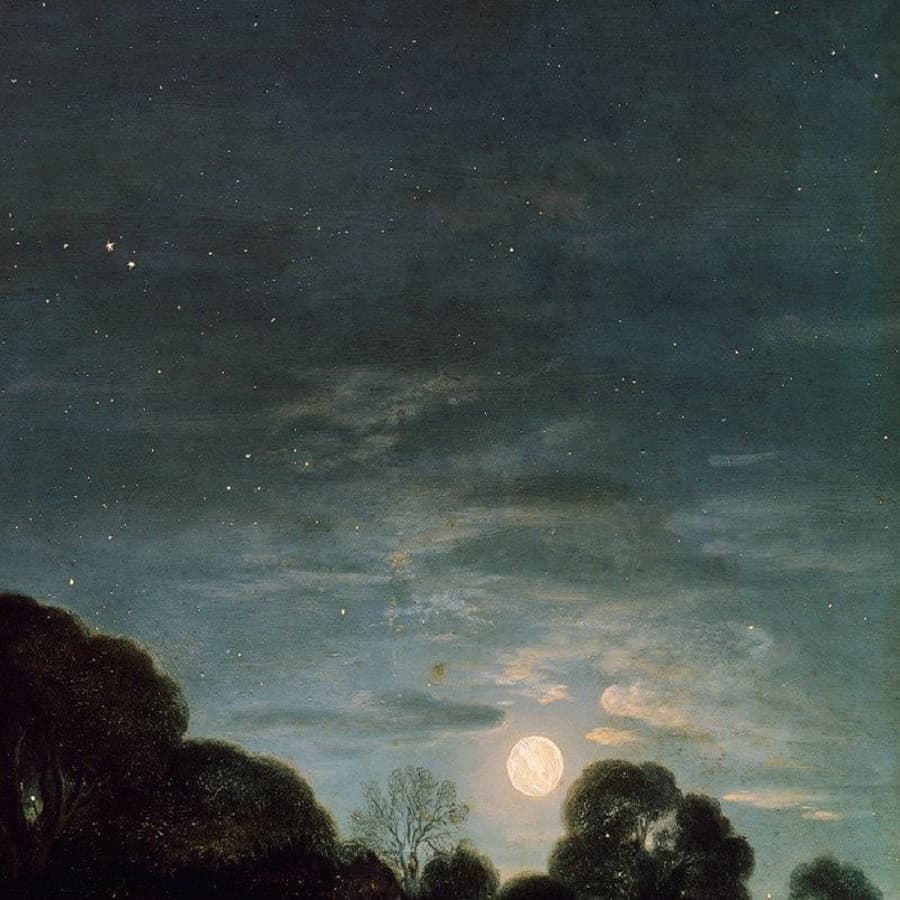
Adam Elsheimer was a German painter who worked in Rome in the first decade of the 17th century and died there at 32. His surviving output is small, perhaps around forty paintings, most of them no bigger than a sheet of paper and painted on copper. Yet those pictures changed European painting: his landscapes, his moonlit and firelit night scenes and his small, intensely observed figures were studied by Rubens, Rembrandt and Claude Lorrain. His best-known work is The Flight into Egypt of 1609, in the Alte Pinakothek, Munich.
Life
Elsheimer was born in Frankfurt am Main on 18 March 1578, one of ten children of a master tailor. His father's house stood a few meters from the Dominican church where Albrecht Dürer's Heller Altarpiece was then on display. He was apprenticed to the Frankfurt painter Philipp Uffenbach, visited Strasbourg in 1596, and around the age of twenty set out for Italy, passing through Munich, where he is documented in 1598.
In Venice he worked with the German painter Hans Rottenhammer and absorbed the color of Tintoretto and the Venetian tradition of small cabinet pictures on copper. By 1600 he was in Rome, where he spent the rest of his life. He joined a circle of northern artists and scholars around the physician and botanist Johann Faber, met the young Rubens, who became a friend, and converted to Catholicism. In 1606 he married, and his Dutch pupil and patron Hendrick Goudt lived in his household and made engravings after his paintings.
He worked slowly and earned little. Debts mounted, and he was briefly imprisoned for them in 1610. He died in Rome that December. Rubens, hearing the news in Antwerp, wrote that he had never known anyone his equal in small figures, landscapes and many other subjects, and lamented that he had died before his harvest.
Style: small pictures, enormous space
Elsheimer painted mostly on copper plates, a smooth, non-absorbent support that allows extraordinarily fine detail and glowing color. His pictures are cabinet paintings, meant to be held and studied up close by collectors. Within them he did two new things.
First, he gave landscape equal weight with the story. In his scenes the figures are small, and the woods, rivers and skies around them carry much of the emotional meaning. Second, he made light itself a subject: moonlight, starlight, torchlight, firelight and the glow of a lantern, often several sources in one picture, each casting its own colored shadows. He took the dramatic contrasts of Caravaggio, whose work was transforming Rome at the same moment, and applied them to the night outdoors.
Key works
- The Flight into Egypt (1609), Alte Pinakothek, Munich. Joseph, Mary and the Christ Child cross a dark landscape under a full moon reflected in a still lake, while shepherds tend a fire at the edge of the woods. The sky shows the Milky Way as a band of countless stars and recognizable constellations, one of the first naturalistic night skies in Western painting. Some scholars link it to the new telescopic astronomy of Galileo, whose Sidereus Nuncius appeared in 1610; others think Elsheimer worked from the naked eye.
- The Frankfurt Altarpiece (Exaltation of the True Cross), c. 1603–05, Städel Museum, Frankfurt. A small portable altarpiece in several panels, painted for a private patron.
- Il Contento, c. 1607, Scottish National Gallery, Edinburgh, a crowded allegorical scene from a Spanish tale, and The Stoning of Saint Stephen in the same collection.
- The Mocking of Ceres, Museo del Prado, Madrid, a night scene lit by a candle and the moon.
- Jupiter and Mercury in the House of Philemon and Baucis, Gemäldegalerie Alte Meister, Dresden, an intimate interior lit by a lamp.
- Tobias and the Angel, in versions engraved by Goudt, a subject his landscapes made popular.
Influence
Elsheimer's influence ran far beyond his tiny output. Rubens owned his work and borrowed his night effects. Goudt's engravings spread his compositions across northern Europe, where they reached Rembrandt, whose own night landscapes and Rest on the Flight into Egypt owe him a clear debt, partly via Rembrandt's teacher Pieter Lastman, who had known Elsheimer in Rome. Claude Lorrain's ideal landscapes, and the Dutch Italianate landscape painters, grew from the same source. Night painters such as Aert van der Neer worked in a tradition he did much to start.
Where to see his work
The Alte Pinakothek in Munich holds The Flight into Egypt and other works. The Städel in Frankfurt, the Scottish National Gallery in Edinburgh, the National Gallery in London, the Prado in Madrid and the Gemäldegalerie in Dresden all hold paintings. Because they are so small, they reward close looking. For the wider movement, see our guide to Baroque art and Caravaggio's paintings.
Questions & answers
Who was Adam Elsheimer?
Adam Elsheimer (1578–1610) was a German painter born in Frankfurt who worked in Rome from 1600 until his death at 32. His small paintings on copper, with innovative landscapes and night lighting, influenced Rubens, Rembrandt and Claude Lorrain.
What is Adam Elsheimer's most famous painting?
His most famous work is The Flight into Egypt (1609), an oil on copper in the Alte Pinakothek, Munich. It shows the Holy Family crossing a moonlit landscape under a naturalistic starry sky with the Milky Way, one of the first of its kind in Western art.
Why did Elsheimer paint on copper?
Copper is smooth and non-absorbent, so it allows very fine detail and luminous color, ideal for the small cabinet pictures collectors examined up close. Elsheimer learned the practice in Venice, where painting on copper was common among northern artists.
How did Adam Elsheimer influence Rembrandt?
Engravings after his paintings by Hendrick Goudt circulated widely in the Netherlands, and Rembrandt's teacher Pieter Lastman had known Elsheimer in Rome. Rembrandt's night scenes and landscapes, such as his Rest on the Flight into Egypt, show that debt.
Where can I see Adam Elsheimer's paintings?
Major holdings are in the Alte Pinakothek, Munich; the Städel Museum, Frankfurt; the Scottish National Gallery, Edinburgh; the National Gallery, London; the Prado, Madrid; and the Gemäldegalerie Alte Meister, Dresden.