American · American Impressionism
Abbott Fuller Graves
b. 15 April 1859, Weymouth, Massachusetts — d. 15 July 1936, Kennebunkport, Maine
Abbott Fuller Graves (1859–1936) was an American Impressionist painter from Massachusetts, celebrated for sunlit flower gardens, often with a woman in white, and for genre scenes of Kennebunkport, Maine.
4 works in the collection
Works by Abbott Fuller Graves
Abbott Fuller Graves (1859–1936) was an American Impressionist best known for paintings of flower gardens in full summer light. Born in Weymouth, Massachusetts, he worked in Boston, New York and above all Kennebunkport, Maine, where he lived until his death.
Life in brief
Graves came to painting through flowers. As a young man he left school and worked in a greenhouse, and his first painting was accepted by the Boston Art Club in 1878, when he was nineteen. In 1884 he traveled to Paris and Italy, sharing lodgings for a time with the Boston painter Edmund C. Tarbell, and he later studied in Paris. Back in Boston he taught flower painting at the Cowles Art School from the mid-1880s, where the faculty included Childe Hassam, whose bright palette left a mark on him.
In 1891 Graves opened his own school in Boston, which later moved to Kennebunkport and closed in 1902. The village became his home and his subject. Alongside the gardens he painted farmers, fishermen and retired sea captains, scenes that were widely reproduced on calendars and postcards. He won a medal at an exposition in Paris in 1905, moved to New York around 1920 after a successful show there, and was elected to the National Academy of Design in 1926. He died in Kennebunkport in July 1936.
Note that his first name is spelled Abbott, with two t's, in most records, though one-t spellings appear on older pages and in dealer listings.
Style and technique
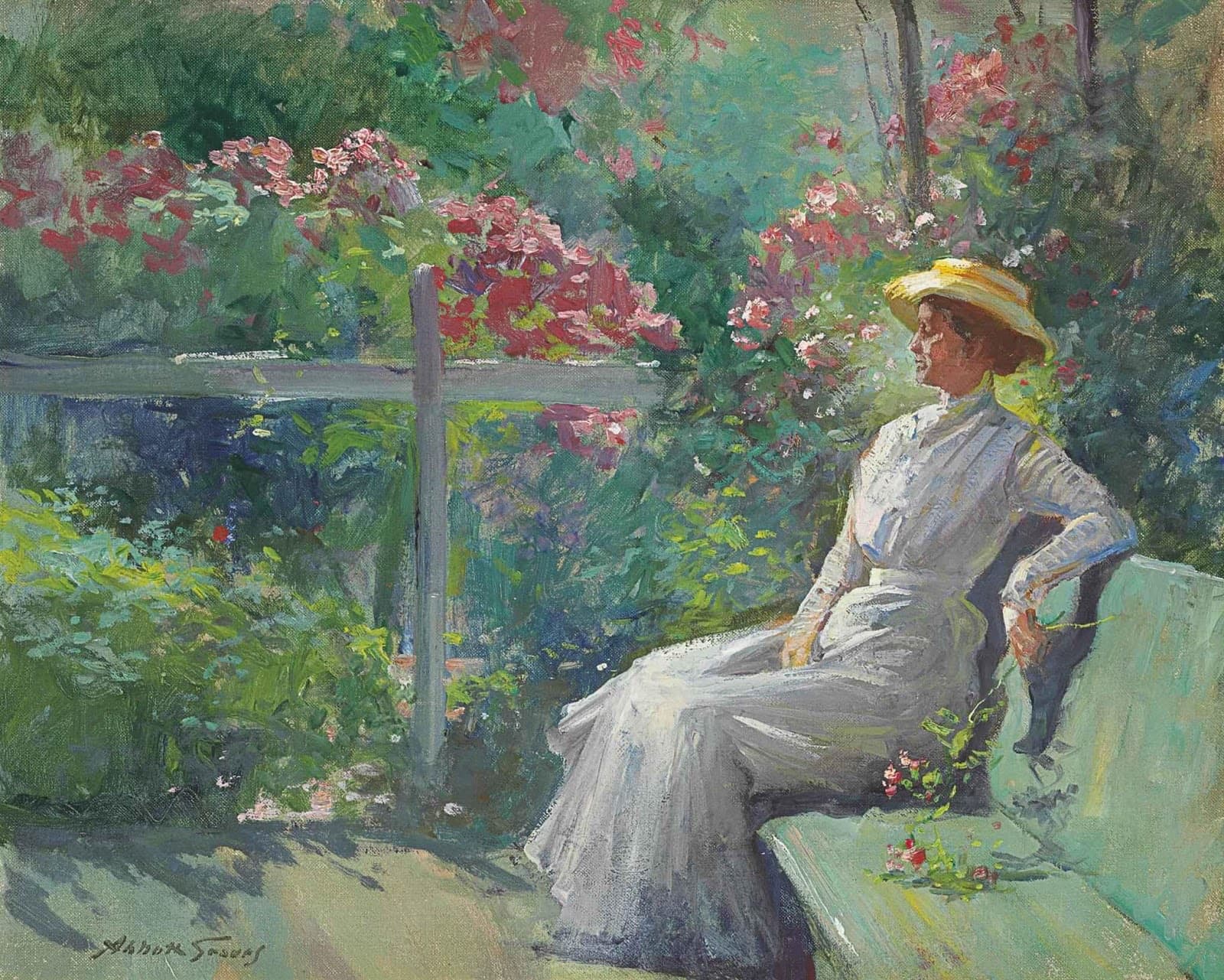
Graves's gardens are crowded, saturated and close. Instead of a distant view, he plants the viewer inside the flower bed: hollyhocks, phlox, roses and poppies rise to eye level, and paths or lawns appear only as a sliver. His brushwork is thick and broken, and he leaves small flicks of pure color (a red petal, a yellow stamen) standing on top of the green, a lesson he shared with the French Impressionists and with Hassam's garden pictures on Appledore Island.
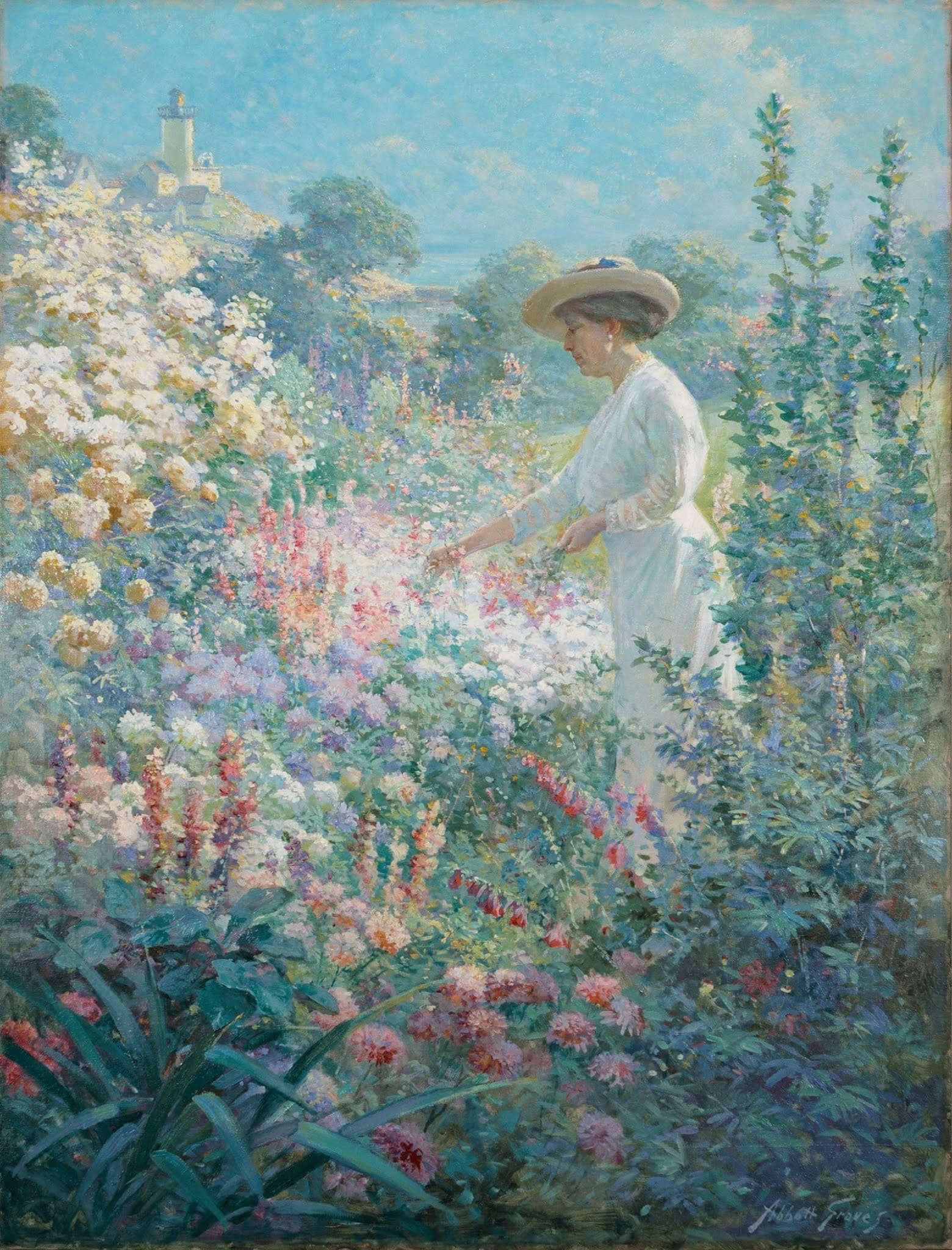
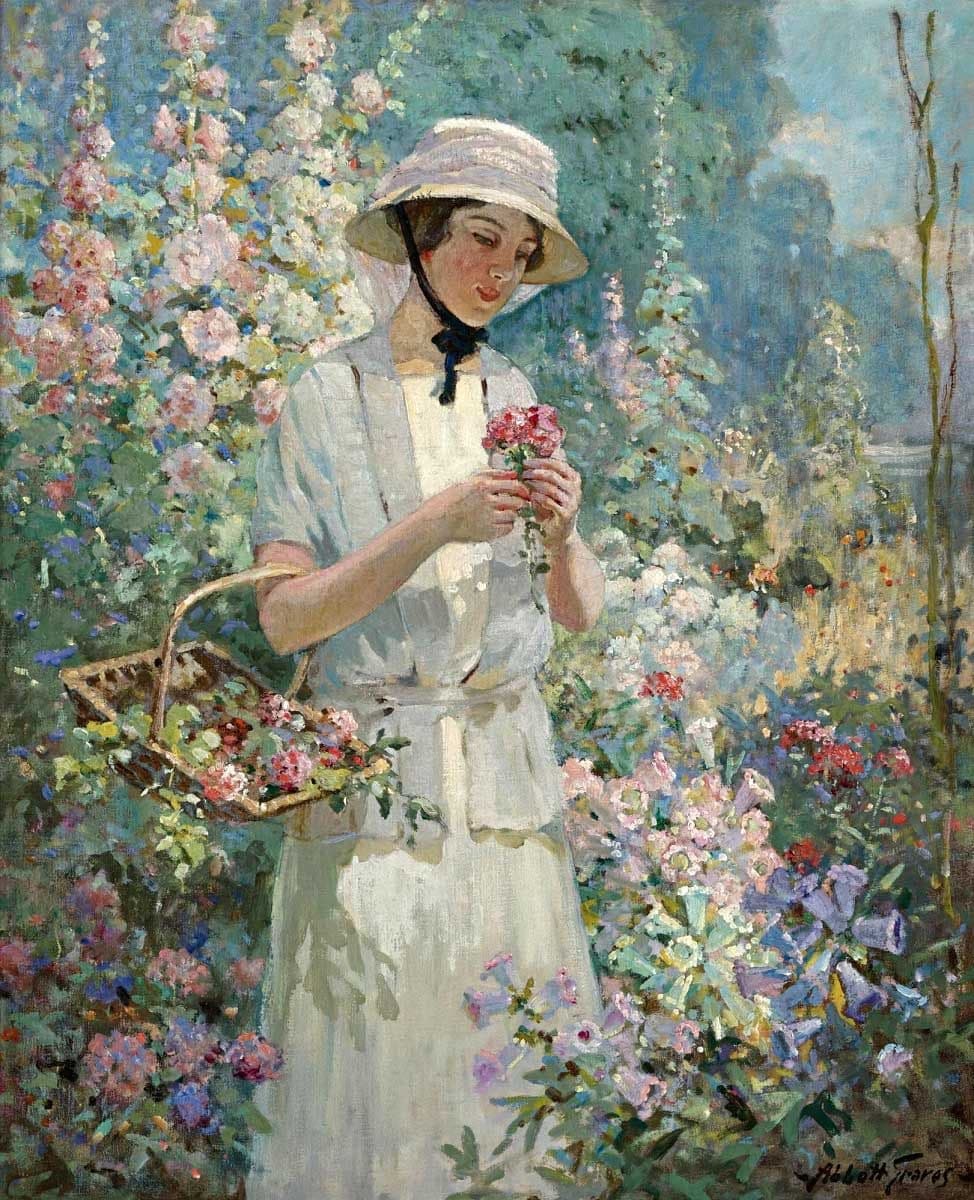
His training as a still-life painter shows in the flowers themselves. Even when the handling is loose, individual species are recognizable, which is not always true of Impressionist gardens. Light is usually high-summer and direct, with sharp, short shadows. Many pictures include a single woman in a white dress, used less as a portrait than as a cool, reflective shape that sets off the color around her.
Key works in the catalogue
- Lady in the Garden shows a woman in white and a straw hat resting on a green bench, hemmed in by roses and phlox. The bench is the only hard line in the picture.
- Garden at Finisterre, dated 1913, puts a woman in white among dense summer flowers, picking blooms, with a tower on a hill behind.
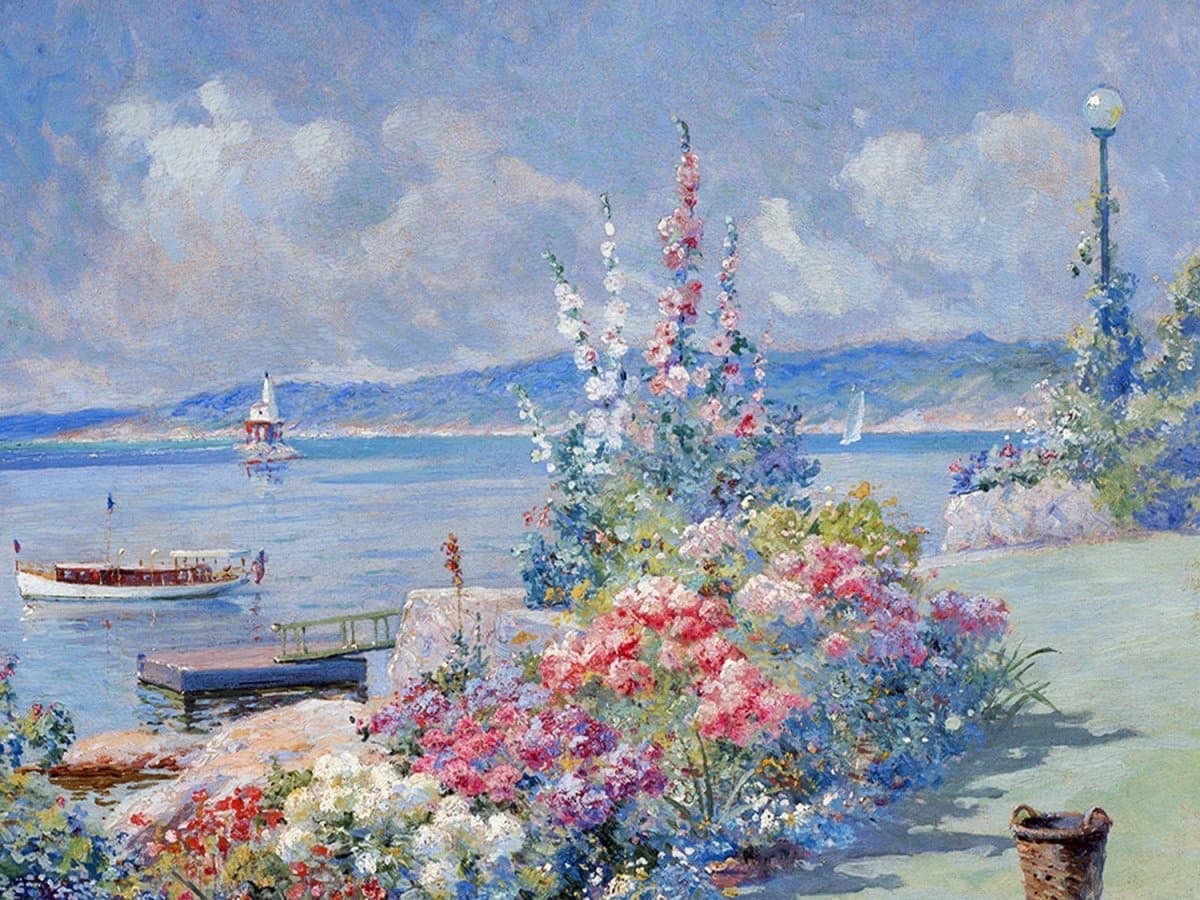
- Garden House, Gloucester looks over hollyhocks and phlox to the harbor at Gloucester, Massachusetts, a working fishing port that drew many artists.
- Woman with Flower Basket shows a woman carrying a basket of cut flowers, a theme Graves returned to across his career.
The garden as a subject
Graves belongs to a generation of American artists who turned the private flower garden into a major subject between the 1880s and the First World War. The trend had several sources: Claude Monet's garden at Giverny, which drew many American painters, the colonial revival in New England with its cottage-garden plantings, and a growing market for cheerful, domestic pictures among middle-class buyers. Graves's garden paintings, like Monet's Meadow at Giverny, treat cultivated nature as a place of light and leisure, though his compositions are tighter and more decorative.
For more of the tradition, see our Impressionism collection.
Reception and legacy
Graves was popular and commercially successful in his lifetime, and his genre scenes of Kennebunkport made him locally famous. After his death, American Impressionism fell out of critical favor, and he was remembered mostly in New England. Renewed interest in the movement since the 1970s has brought his gardens back to the market, where they sell steadily through dealers and auction houses.
Where to see his work
The Portland Museum of Art in Maine holds his work, and the Westmoreland Museum of American Art in Greensburg, Pennsylvania, lists him in its collection. Many of his best gardens are in private collections and surface through galleries specializing in American Impressionism.
Questions & answers
Who was Abbott Fuller Graves?
Abbott Fuller Graves (1859–1936) was an American Impressionist painter born in Weymouth, Massachusetts. He specialized in flower gardens and genre scenes of Kennebunkport, Maine, taught at Boston's Cowles Art School and was elected to the National Academy of Design in 1926.
What did Abbott Fuller Graves paint?
He is best known for close, sunlit views of flower gardens full of hollyhocks, phlox and roses, often with a woman in a white dress. He also painted Kennebunkport farmers, fishermen and sea captains, and earlier in his career he was a flower still-life painter.
Where can I see Abbott Fuller Graves's paintings?
The Portland Museum of Art in Maine holds his work, and some paintings are in other American museums. Many of his garden scenes are in private collections and appear regularly through galleries and auction houses that handle American Impressionism.
Was Abbott Fuller Graves an Impressionist?
Yes. He is classed as an American Impressionist. He studied in Paris and worked alongside Childe Hassam in Boston, and his broken brushwork, bright color and interest in outdoor light come from the Impressionist tradition.