Russian · Neoclassicism · Gothic Revival
Vasily Bazhenov
b. 1737 or 1738, Moscow (or Dolskoye, near Maloyaroslavets) — d. 13 August 1799, Saint Petersburg
Vasily Bazhenov (1737/38–1799) was a leading Russian architect of Catherine the Great's age, known for the unbuilt Kremlin Palace, the Gothic fantasy of Tsaritsyno and the Pashkov House in Moscow.
1 work in the collection
Works by Vasily Bazhenov
Vasily Ivanovich Bazhenov was one of the first Russian-born architects to rival the foreigners who dominated building in eighteenth-century Russia. With his colleague Matvei Kazakov he shaped the look of Enlightenment Moscow, yet his career is a story of grand projects cancelled, demolished or left unfinished.
Life in brief
Bazhenov was born in 1737 or 1738, probably in Moscow, the son of a church sexton. As a youth he worked unofficially in Dmitry Ukhtomsky's architectural team in the Kremlin, entered Moscow University in its first intake in 1755 and moved to the new Imperial Academy of Arts in Saint Petersburg in 1758. A scholarship took him to Paris, where he trained with Charles De Wailly, and on to Italy, where the academies of Rome, Florence and Bologna elected him a member.
Back in Russia, Catherine II asked him to design a new Kremlin Palace. His plan of 1767–68 was a vast Neoclassical complex that would have rebuilt much of the Kremlin around a great oval square. Ground was broken in 1773, and in 1775 the empress stopped the work. The same pattern followed at Tsaritsyno, the imperial estate south of Moscow, where he raised a palace ensemble in a red-brick and white-stone Gothic manner from the mid-1770s; in 1786 Catherine ordered the main palace pulled down and gave the project to Kazakov.
Bazhenov's ties to the Moscow Freemasons and to the heir, Grand Duke Paul, drew suspicion in the Novikov affair of 1792. When Paul became emperor in 1796 he brought Bazhenov to Saint Petersburg and made him vice-president of the Academy of Arts. He was involved in the design of Saint Michael's Castle, though how much of it is his remains disputed. He died in 1799, and the site of his grave is unknown.
Style
Bazhenov worked in two registers. One was a learned French-trained Neoclassicism, seen in the Pashkov House (completed around 1787), the white palace on a hill facing the Kremlin that is attributed to him by long tradition. The other was a playful “Russian Gothic”: pointed arches, pinnacles and lancet windows laid over buildings whose plans stayed classical or Orthodox.
Works in our catalogue
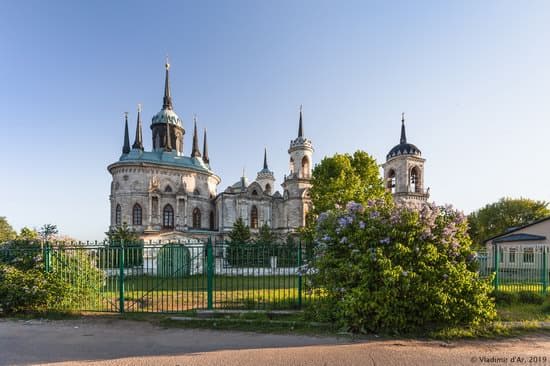
The second manner appears in the Church of the Vladimir Icon of the Mother of God at Bykovo (1788–89), built on the estate of Mikhail Izmailov, Moscow's governor and Bazhenov's superior. No document signs the church, but most historians give it, with the manor house, to Bazhenov; older claims for Bartolomeo Rastrelli are impossible, since Rastrelli died in 1771.
Where to see his work
In Moscow, the Pashkov House and the restored Tsaritsyno estate; outside the city, the church and manor at Bykovo. For the wider taste for medieval forms, see Gothic Art.
Questions & answers
What is Vasily Bazhenov famous for?
Bazhenov is known for the Kremlin Palace design of 1767–68 for Catherine the Great, which was begun and then abandoned, for the Gothic-style ensemble at Tsaritsyno near Moscow, and for the Pashkov House, the Neoclassical mansion facing the Kremlin attributed to him.
Did Bazhenov design the church at Bykovo?
Probably, but it is not documented. The Church of the Vladimir Icon of the Mother of God at Bykovo (1788–89) was built for Mikhail Izmailov, Bazhenov's patron and superior, and most historians attribute it to Bazhenov. Some writers suggest Matvei Kazakov or a local builder.
Why was Tsaritsyno palace demolished?
Catherine the Great inspected Bazhenov's main palace at Tsaritsyno in 1785 and ordered it pulled down in 1786. Her reasons are not fully known; dislike of the design and Bazhenov's links with Freemasons and her son Paul have both been suggested. Matvei Kazakov then took over the estate.