American · Neoclassicism
Thomas Ridgeway Gould
b. 5 November 1818, Boston, Massachusetts — d. 26 November 1881, Florence, Italy
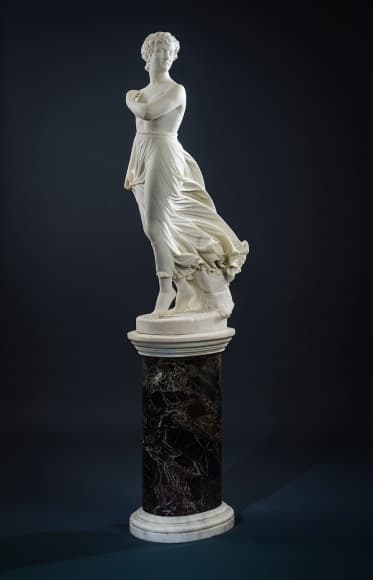
Thomas Ridgeway Gould (1818–1881) was an American Neoclassical sculptor from Boston who moved to Florence in 1868. He is known for West Wind, a striding marble personification, and the statue of King Kamehameha I in Hawaii.
1 work in the collection
Works by Thomas Ridgeway Gould
Thomas Ridgeway Gould was an American sculptor, born in Boston in 1818, who came to art late, after a first career in business, and made his best-known works in Florence. He belongs to the generation of American Neoclassical sculptors who settled in Italy for its marble, its skilled carvers and its classical models.
Life in brief
Gould worked for years in the dry-goods trade with his brother before beginning to study sculpture, around 1851, with the Connecticut artist Seth Wells Cheney. In 1863 he exhibited two large heads, of Christ and of Satan, at the Boston Athenæum. Losses during the Civil War cost him much of his fortune, and in 1868 he moved with his family to Florence, where he worked for the rest of his life. He died there in 1881 and was buried in Forest Hills Cemetery in Boston; his son completed some of his unfinished commissions.
Style
Gould worked in the smooth, idealized manner of Neoclassicism, but with an American taste for allegory and for public portrait statues. His figures are graceful and full of movement, with drapery used to suggest wind and motion.
Key works
West Wind, first modeled in 1870, is a young woman striding forward, her skirts blown back against her legs and trailing behind her, with a belt of stars that has been read as a personification of America and its westward course. To support the weight of the marble on such a light stance, Gould joined the flowing skirt to a rocky support behind her. In 1874 he was accused of copying Canova's Hebe, a charge shown to be groundless. The figure was shown at the Philadelphia Centennial Exposition of 1876, and Gould made seven replicas in two sizes; examples are in the St. Louis Mercantile Library, the Memorial Art Gallery of the University of Rochester and the Orlando Museum of Art.
His other major work is the bronze statue of Kamehameha I, the king who united the Hawaiian Islands. The original stands in Kapaʻau, North Kohala, on the island of Hawaii; a second cast stands in front of Aliʻiōlani Hale in Honolulu, and a replica is in the National Statuary Hall Collection in the U.S. Capitol.
Where to see his work
Besides the West Wind replicas and the Kamehameha statues, his statue of John Bridge stands on Cambridge Common, Massachusetts. Compare the Neoclassical marbles of Antonio Canova and Pietro Tenerani, and see Famous Sculptures.
Questions & answers
Who sculpted West Wind?
West Wind is by the American sculptor Thomas Ridgeway Gould, first modeled in Florence in 1870. He made seven marble replicas in two sizes; examples are in the St. Louis Mercantile Library, the Memorial Art Gallery in Rochester and the Orlando Museum of Art.
Who made the Kamehameha statue in Hawaii?
The famous bronze statue of King Kamehameha I was modeled by Thomas Ridgeway Gould in Florence. The original stands in Kapaʻau, North Kohala, a second cast is in Honolulu, and a replica is in the U.S. Capitol.
Why did Thomas Ridgeway Gould move to Italy?
After losing much of his fortune during the Civil War, Gould moved with his family to Florence in 1868, where marble, skilled carvers and classical models were readily available. He lived there until his death in 1881.