French · Art Nouveau · Art Deco
René Lalique
b. 6 April 1860, Aÿ, Marne, France — d. 1 May 1945, Paris, France
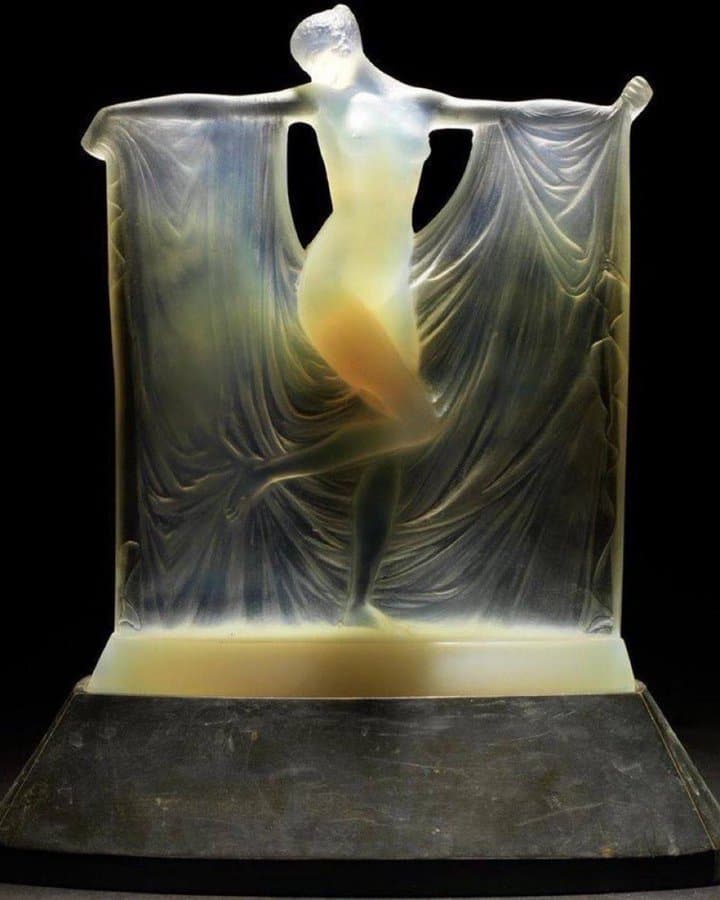
René Lalique (1860–1945) was a French jeweler and glassmaker, the leading Art Nouveau jewel designer of the 1890s and later the master of Art Deco glass, from perfume bottles and car mascots to opalescent figures like Suzanne.
1 work in the collection
Works by René Lalique
René Lalique was a French designer born in 1860 in Aÿ, in the Champagne region, who had two careers, each at the top of its field. Around 1900 he was the most celebrated jeweler of Art Nouveau; from the 1910s to the 1930s he became the defining glassmaker of Art Deco, producing molded glass in quantities that brought fine design into ordinary homes.
Life in brief
Lalique was apprenticed to a Paris jeweler at sixteen and studied in London before setting up as a designer for leading jewelry houses. In 1885 he took over his own workshop. His jewels, combining gold and enamel with unconventional materials such as horn, ivory, glass and semi-precious stones, caused a sensation at the Paris Exposition Universelle of 1900; the actress Sarah Bernhardt and the collector Calouste Gulbenkian were among his patrons. Around 1907 the perfumer François Coty asked him to design bottles, and glass gradually took over. In 1921 he opened a glassworks at Wingen-sur-Moder in Alsace. He died in Paris in 1945, and the firm continued under his son Marc and granddaughter Marie-Claude.
Style and technique
Lalique's glass is mostly mold-pressed or blown into molds, which allowed series production, then finished by hand with acid frosting, polishing and patinas. His signature is the contrast between clear and frosted surfaces and the use of opalescent glass that glows milky blue in reflected light and amber against the light. Subjects come from nature and the female figure: dragonflies, birds, fish, flowers and nymphs. He designed vases, lamps, car hood ornaments, architectural panels for the Orient Express carriages and glass for the ocean liner Normandie.
Suzanne
Suzanne (1925) is one of his best-known figures: a nude young woman in opalescent glass, arms raised and outstretched so that a drapery falls from them like wings. It is often said to have been named for his daughter Suzanne Lalique, herself a designer, who married Paul Haviland of the Limoges porcelain family. Lit from behind, the figure glows from within.
Where to see his work
The Musée Lalique in Wingen-sur-Moder, Alsace, and the Calouste Gulbenkian Museum in Lisbon, with its great collection of his jewelry, are the essential places; the Musée d'Orsay and the Musée des Arts Décoratifs in Paris also hold major pieces. See Famous Paintings of Women for more images of the female figure.
Questions & answers
What is René Lalique known for?
René Lalique is known first as the leading Art Nouveau jeweler of the 1890s and 1900s, and then as the great Art Deco glassmaker of the 1920s and 1930s, famous for molded frosted and opalescent glass vases, perfume bottles, car mascots and figures.
Who is Lalique's Suzanne?
Suzanne is a 1925 opalescent glass figure of a nude young woman holding out a falling drapery. It is commonly said to be named for Lalique's daughter Suzanne, a designer who married Paul Haviland.
Where can I see René Lalique's work?
The Musée Lalique in Wingen-sur-Moder, Alsace, and the Calouste Gulbenkian Museum in Lisbon have the most important collections. The Musée d'Orsay and Musée des Arts Décoratifs in Paris also display his jewelry and glass.