Russian · Academic art · Peredvizhniki
Konstantin Makovsky
b. 20 June 1839, Moscow, Russia — d. 30 September 1915, Petrograd, Russia
Konstantin Makovsky (1839–1915) was a Russian painter of lavish historical scenes, boyar weddings and society portraits. Once a rebel against the Academy and a member of the Wanderers, he became the most fashionable salon painter in imperial Russia.
1 work in the collection
Works by Konstantin Makovsky
Konstantin Yegorovich Makovsky was a Russian painter born in Moscow in 1839, best known for opulent scenes of old Muscovite life, crowded with brocades, jewels and painted wood, and for glamorous society portraits. He is usually counted among Russian academic painters, although he began his career as one of the young artists who rebelled against the Academy.
Life in brief
Makovsky came from an artistic family. His father, Yegor Makovsky, was an amateur artist and a founder of the Moscow School of Painting, Sculpture and Architecture, and his brothers Vladimir and Nikolai also became painters. He entered the Moscow school as a boy and moved on to the Imperial Academy of Arts in Saint Petersburg. In 1863 he was one of the fourteen students who walked out of the Academy rather than paint a set subject from Norse mythology, the so-called Revolt of the Fourteen. He later joined the Peredvizhniki, or Wanderers, the realist exhibiting society, but drifted away from them as his style became more decorative. He traveled in France, Italy and Egypt, enjoyed great commercial success, and died in Petrograd in 1915 after being injured in a street accident.
Style
Makovsky's mature pictures are theatrical and richly colored, with many figures and a delight in costume, metalwork and textiles. A Boyar Wedding Feast (1883), now at Hillwood Museum in Washington, D.C., and Beneath the Crown (1889) present an idealized seventeenth-century Russia. His portraits of fashionable women were in great demand, and critics who admired the Wanderers' social realism found him too sweet and too commercial.
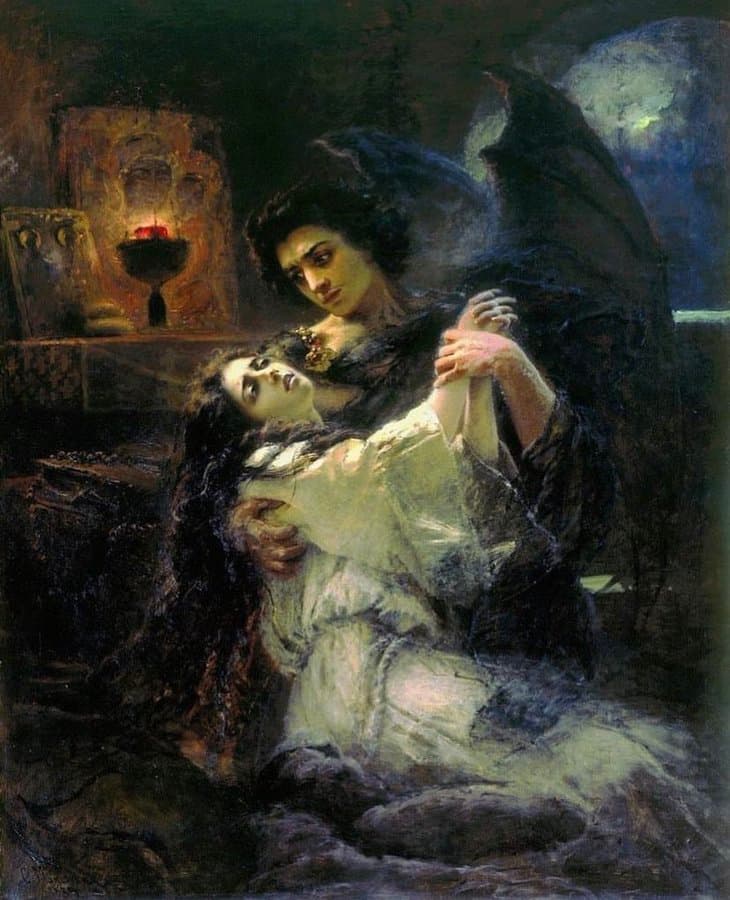
Tamara and Demon
Tamara and Demon (1889) illustrates Mikhail Lermontov's Romantic poem The Demon, in which a fallen angel, the spirit of exile, falls in love with the Georgian princess Tamara. Makovsky shows the meeting of the dark-winged youth and the girl near the end of her life. The poem was one of the most illustrated texts in Russian art; Mikhail Vrubel's demons answer the same story.
Where to see his work
The State Russian Museum in Saint Petersburg and the Tretyakov Gallery in Moscow hold many of his paintings, and Hillwood in Washington has A Boyar Wedding Feast. For more fallen angels see Fallen Angels in Art and Angels & Demons in Art.
Questions & answers
Who was Konstantin Makovsky?
Konstantin Makovsky (1839–1915) was a Russian painter known for lavish historical scenes such as A Boyar Wedding Feast and for society portraits. He took part in the 1863 Revolt of the Fourteen against the Academy and later exhibited with the Peredvizhniki.
What is Makovsky's Tamara and Demon about?
Painted in 1889, it illustrates Lermontov's poem The Demon, in which a fallen angel falls in love with the Georgian princess Tamara. The picture shows the demon and Tamara as her earthly life comes to an end.
Where is A Boyar Wedding Feast?
Makovsky's A Boyar Wedding Feast (1883) is at Hillwood Estate, Museum and Gardens in Washington, D.C., the former home of collector Marjorie Merriweather Post.