British · Gothic Revival · Victorian sculpture
John Thomas
b. 1813, Chalford, Gloucestershire — d. April 1862, London
John Thomas (1813–1862) was a British sculptor and architect who supervised the stone carving at the Palace of Westminster and worked on Buckingham Palace. His Lady Godiva (1861) is in Maidstone Museum.
1 work in the collection
Works by John Thomas
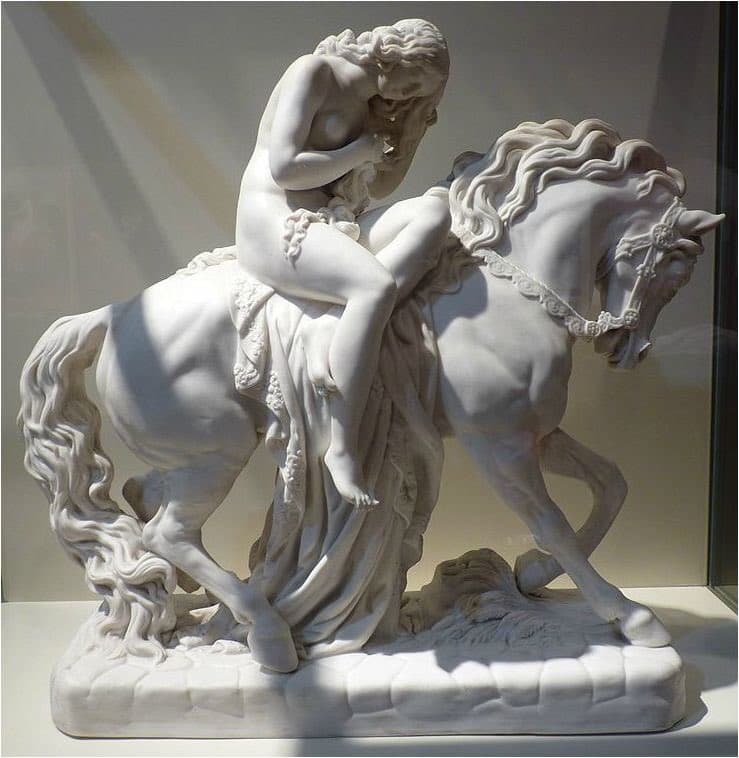
John Thomas was one of the busiest architectural sculptors of early Victorian Britain. As Superintendent of Stone Carving at the new Palace of Westminster, he was responsible for an army of carved kings, queens and ornament; in the gallery he is remembered for Lady Godiva (1861), now in Maidstone Museum & Bentlif Art Gallery.
Life
Thomas was born in 1813 in Chalford, Gloucestershire. Orphaned young, he was apprenticed to a stonemason, then went to Birmingham, where his elder brother William was an architect. There Charles Barry noticed him and employed him as a stone and wood carver on King Edward's Grammar School, Birmingham (since demolished), a building on which Barry worked with A. W. N. Pugin.
Barry then made him Superintendent of Stone Carving at the Palace of Westminster. Thomas supplied about sixty statues of English monarchs, including those in the niches of the Central Lobby. His last major work was a colossal statue of Shakespeare for the 1862 International Exhibition; a dispute over where it should stand is said to have hastened his death in April 1862. He is buried in Kensal Green Cemetery.
Work
Thomas moved easily between sculpture and architecture. His output included eight allegorical city figures for Euston station (1847), the four lions guarding the Britannia Bridge over the Menai Strait, the Atlas Fountain at Castle Howard, the statue of Sir Hugh Myddelton on Islington Green, carvings for Halifax Town Hall, and work at Buckingham Palace. As an architect he designed Headington Hill Hall in Oxford and Somerleyton Hall in Suffolk. His group Charity was shown at the Great Exhibition of 1851.
Lady Godiva
Lady Godiva shows the legendary countess riding naked through Coventry, head bowed and a hand to her face. It is one of the few works in which Thomas, otherwise a craftsman of public buildings, made an intimate gallery piece, and it was reproduced in Parian porcelain.
Where to see his work
The Palace of Westminster, Maidstone Museum and many British public buildings carry his carving. For context see famous sculptures and the architect Sir George Gilbert Scott, another leader of the Gothic Revival.
Questions & answers
Who sculpted the Lady Godiva statue in Maidstone Museum?
The Victorian sculptor John Thomas made Lady Godiva in 1861. The original, showing Godiva riding with head bowed, is in Maidstone Museum & Bentlif Art Gallery; reductions were produced in Parian porcelain.
What did John Thomas do at the Houses of Parliament?
Charles Barry appointed him Superintendent of Stone Carving at the Palace of Westminster. He was responsible for about sixty statues of English kings and queens, including those in the Central Lobby niches.
When did John Thomas die?
He died in London in April 1862, soon after a dispute over the placement of his colossal Shakespeare statue at the International Exhibition. He is buried in Kensal Green Cemetery.