French · Digital art · 3D art
Jean-Michel Bihorel
b. 1988, France
Jean-Michel Bihorel is a Paris-based French digital artist and CG supervisor who makes photorealistic 3D images, above all the Flower Figures series of porcelain-like bodies breaking into blossoms and Winter Sleep, the snowy mountain mistaken for Alaska's Sleeping Lady.
3 works in the collection
Works by Jean-Michel Bihorel
Jean-Michel Bihorel is a French computer-graphics artist based in Paris. By profession he works in the film and animation industry, as a look-development and lighting artist and CG supervisor at the Paris studio Mécanique Générale; on his own account he makes still images and short animations of figures and landscapes that look photographed but exist only as data. His two best-known projects are the Flower Figures, female bodies built from flowers, and Winter Sleep, a mountain in the shape of a sleeping woman that went viral in 2020.
Life and career
Bihorel has been making digitally generated images since 2008, after graduating from an animation school in France. His early professional work was in visual effects and fully computer-animated sequences for feature films and advertising, a production environment that, by his own account, sharpened his taste for detailed, photorealistic images. He is a co-founder of and mentor at Creative Seeds, a school for computer-animation students, and has taught online courses for the Gnomon Workshop, including classes on building complex organic assets with SpeedTree and Houdini.
He describes 2016 as the year his personal artistic practice really began: the point at which he felt he had both mastered the technical side of the medium and found subjects that mattered to him. He has said he is the child of two artists who worked in traditional media, and that he has always been attached to the beauty of material and gesture and to a certain figurative realism, even while working entirely on the computer. His stated aim is that the digital nature of his images should not be the first thing a viewer notices.
How his images are made
Bihorel works with the standard tools of high-end visual effects: 3D modeling, procedural systems that distribute thousands of elements according to rules, physically based shading and rendering. Accounts of the Flower Figures describe him starting from real dried flowers, photographed or scanned in 3D, which he then multiplied and arranged over a human form in Houdini and Maya before rendering. Procedural methods let him cover a body with blossoms, leaves or rock strata that follow its curves without placing each one by hand.
The result is an image with the material conviction of a photograph of a sculpture: crackled glaze, translucent petals, wind-packed snow. Lighting does much of the work. He usually isolates a single figure against darkness or an empty sky and lights it from one side, as a studio photographer would light a marble.
The Flower Figures
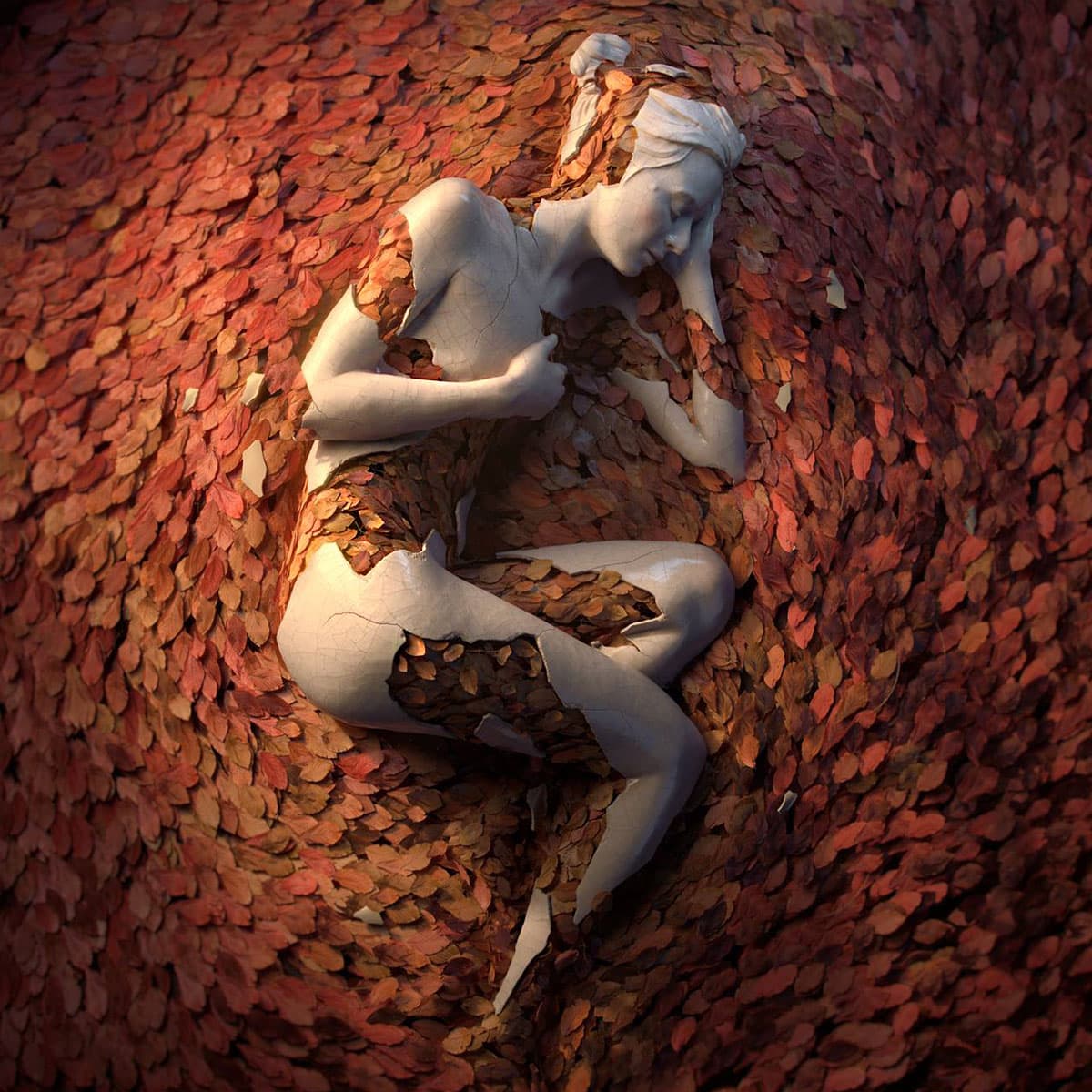
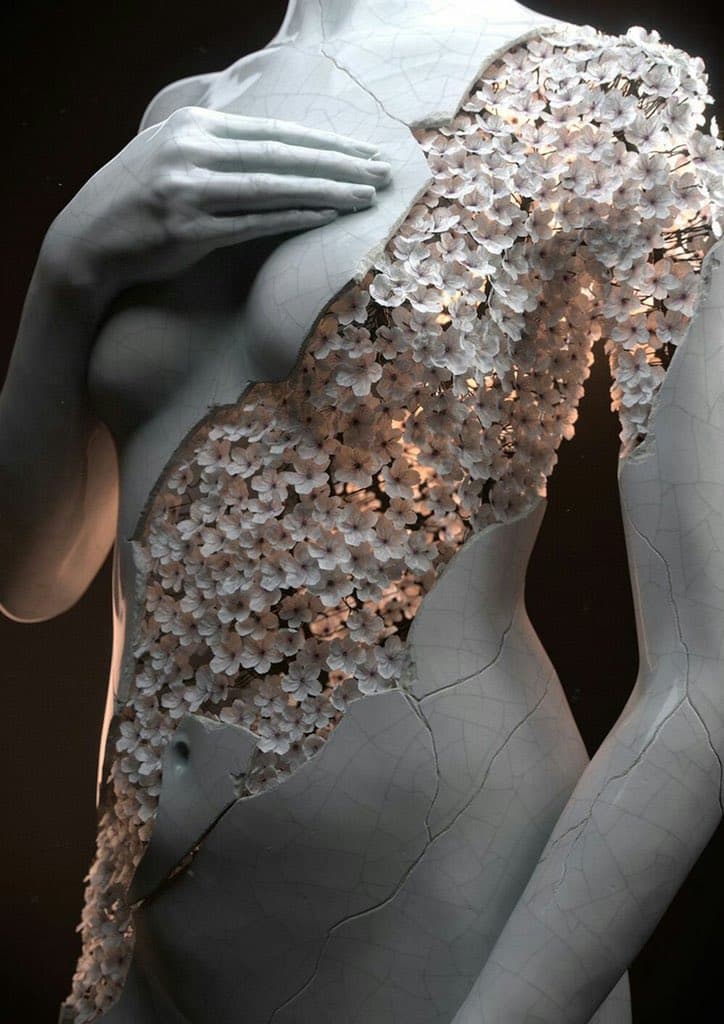
The Flower Figures series, begun in 2016, is a sequence of numbered images of female bodies made of, or breaking open into, flowers. Some show whole figures seated, kneeling or curled up; others close in on a torso. In Flower Figures Nº02 a cracked, porcelain-white torso splits along a diagonal fissure, and a mass of pale blossoms glows through the gap. In Flower Figures Nº04, subtitled Fall – Asleep, a white woman lies curled in a sea of red autumn leaves, her body breaking apart into the same leaves.
The series plays on an old idea: the body as a shell around something living, and the human figure dissolving back into nature. The cracked glaze recalls ceramic figurines and antique marbles; the flowers recall still life and the vanitas tradition, in which blossoms stand for beauty that will not last. It also has a wider ancestry in the metamorphoses of Ovid, where nymphs become trees and youths become flowers, and in Giuseppe Arcimboldo's heads composed of fruit and blossoms.
Winter Sleep and the Sleeping Lady
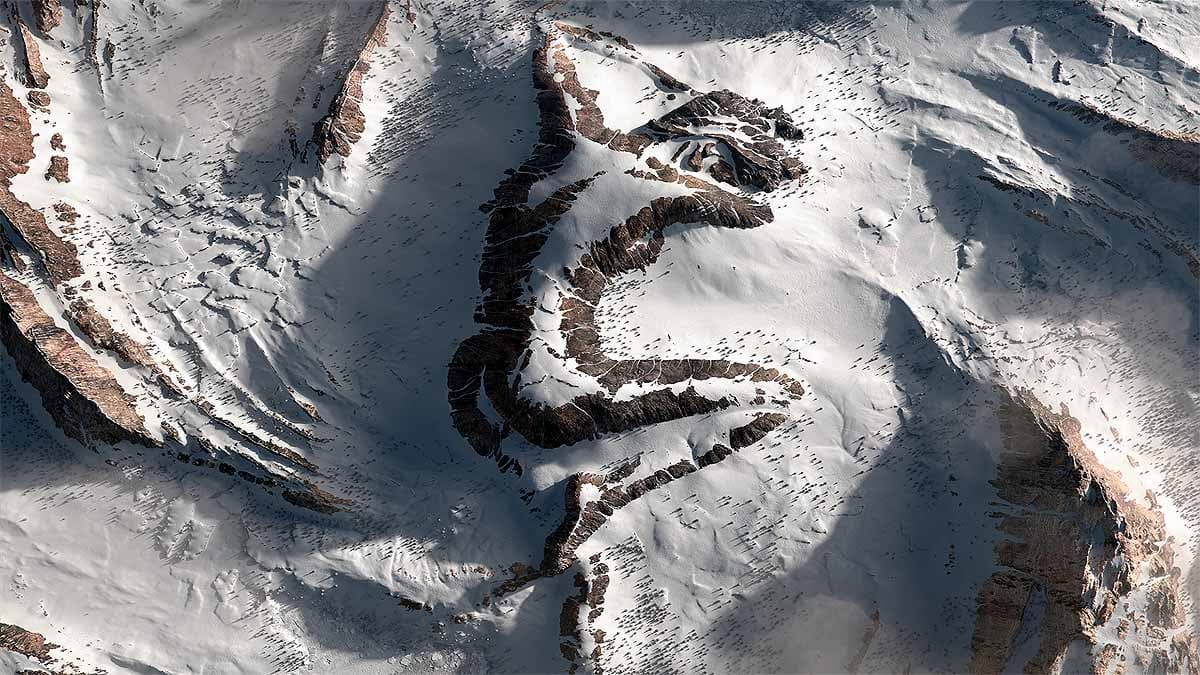
Winter Sleep (2020) is an aerial view of a snow-covered mountainside whose bare ridges of rock resolve into a woman lying asleep on her side. Bihorel published it on his portfolio under the title Winter Sleep. In mid-2020 it spread widely on Facebook with the claim that it was a photograph, taken from an aircraft, of the Sleeping Lady, the local name for Mount Susitna across Cook Inlet from Anchorage, Alaska. Fact-checkers traced it back to Bihorel, who confirmed that the image existed only in digital form; the real Mount Susitna looks nothing like it from above. The episode is a good measure of how photographic his work has become, and the picture still circulates without his name.
Other projects
Bihorel's portfolio also includes Peace and Tranquility to Mars, a set of quiet topographic landscapes on the red planet, and lighter character pieces such as This Means War, a battered robot with worn, paint-splattered limbs. Across them all runs the same interest in surfaces that look old, handled and physical.
Influence and context
Bihorel belongs to a generation of artists from the visual-effects industry who use production tools to make personal, gallery-style images, shared mainly online. His work circulates widely on design and art sites, and on social media it is often reposted without credit, sometimes as if it were real sculpture or photography. Within the catalogue, his flower bodies sit naturally beside Kate MacDowell's porcelain sculptures that open onto plants and animals, and beside other modern takes on the vanitas in Memento Mori & Vanitas.
Where to see his work
Bihorel's images are published on his own portfolio and social media accounts, where the numbered Flower Figures and the Winter Sleep images can be seen at full resolution. As digital works, they have no single physical location.
Questions & answers
Who is Jean-Michel Bihorel?
Jean-Michel Bihorel is a French digital artist based in Paris. He works as a look-development and lighting artist and CG supervisor in animation and visual effects, and makes personal 3D artworks such as the Flower Figures series and Winter Sleep.
Is the Sleeping Lady mountain photo real?
No. The viral image of a snowy mountain shaped like a sleeping woman is Winter Sleep, a 2020 digital artwork by Jean-Michel Bihorel. Fact-checkers confirmed it is computer-generated and not a photograph of Mount Susitna, Alaska's Sleeping Lady.
How does Bihorel make the Flower Figures?
He builds them as 3D digital sculptures. Accounts describe him scanning or photographing real dried flowers, then using procedural tools in software such as Houdini and Maya to multiply and arrange them over a female body before rendering a photorealistic image.
Are Jean-Michel Bihorel's sculptures real?
No. Despite looking like porcelain, marble and petals, the Flower Figures and his other works are computer-generated images. They have no physical original unless separately printed or fabricated.