French · Rococo
Jean-Honoré Fragonard
b. 5 April 1732, Grasse, France — d. 22 August 1806, Paris
Jean-Honoré Fragonard (1732–1806) was the French Rococo painter of The Swing, whose quick, sparkling brushwork and playful scenes of love defined the last flowering of eighteenth-century elegance.
1 work in the collection
Works by Jean-Honoré Fragonard
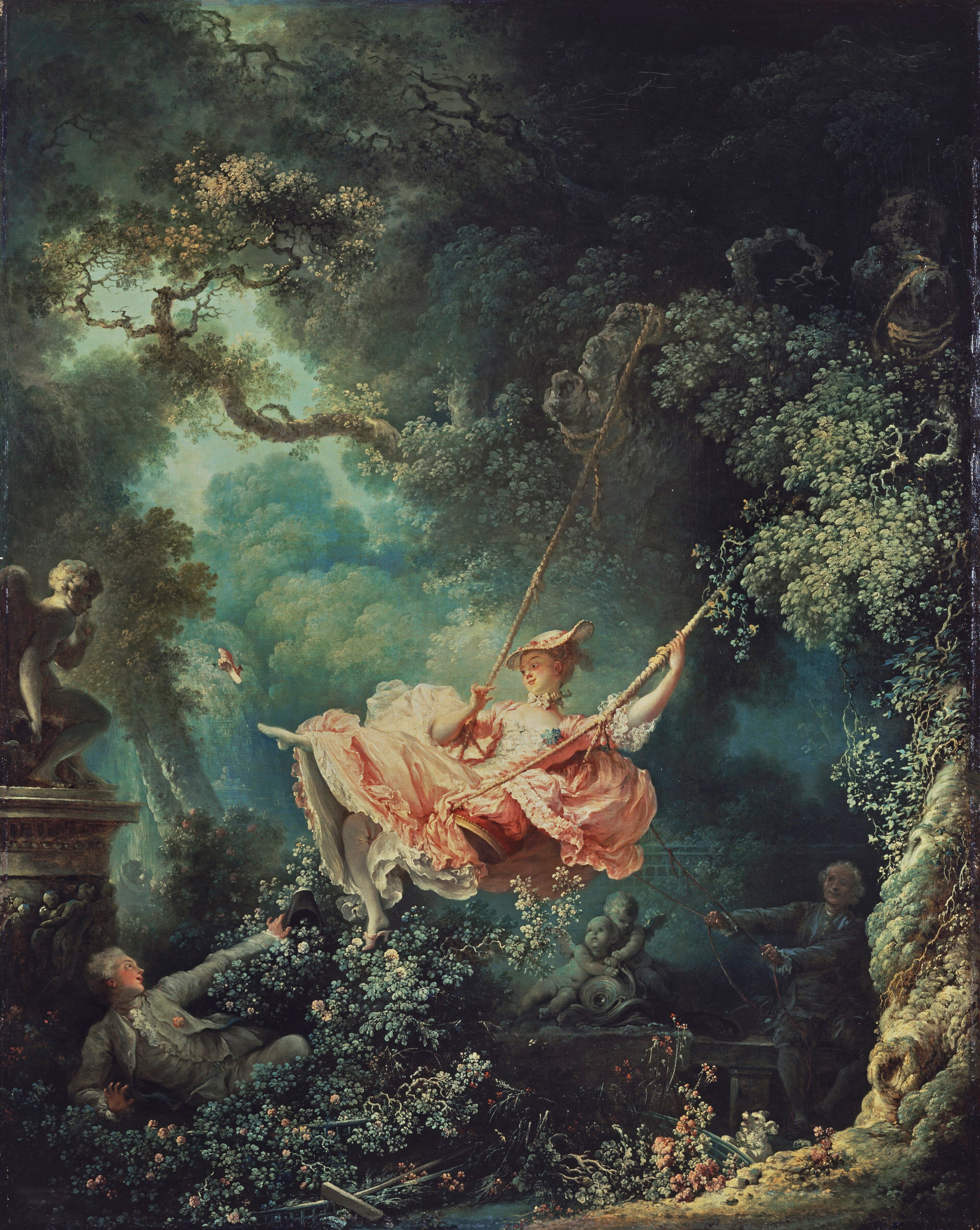
Jean-Honoré Fragonard was one of the last great painters of the French Rococo, a master of light-hearted love scenes, gardens and fluent, rapid brushwork. His most famous painting, The Swing (c. 1767), is in the Wallace Collection in London.
Life in brief
Fragonard was born in 1732 in Grasse, in Provence, and moved to Paris as a child. After a short spell with Jean-Siméon Chardin he trained with François Boucher, the leading decorative painter of the day, and in 1752 won the Prix de Rome. He spent 1756–61 at the French Academy in Rome, where he drew the gardens of the Villa d'Este at Tivoli alongside his friend Hubert Robert, studies of tall cypresses and fountains that shaped his later landscapes.
Back in Paris his large history painting Coresus Sacrifices Himself to Save Callirhoe (1765, Louvre) won him admission to the Royal Academy and the promise of an official career. He largely turned away from it, painting instead for private collectors, financiers and royal mistresses: small, intimate canvases of lovers, bathers, reading girls and children. In 1769 he married Marie-Anne Gérard, herself a miniature painter.
The Revolution destroyed his market. With the support of Jacques-Louis David he found work on the commission organizing the new national museum at the Louvre, but by his death in 1806 his style was long out of fashion.
Style
Fragonard painted fast. In his “fantasy figures” of around 1769, a series of costumed half-length portraits now mostly in the Louvre, the paint is laid on in thick, slashing strokes that look astonishingly modern; an old inscription on one claims it was painted in an hour. His palette is warm and bright, full of rose, gold and green. Love, flirtation and abandon are his subjects, but often tinged with irony.
The Swing
According to the memoirs of the playwright Charles Collé, a courtier first asked the painter Gabriel-François Doyen for a picture of his mistress on a swing pushed by a bishop, with himself placed to see her legs. Doyen declined and passed the commission to Fragonard. In the finished picture a young woman in a frothy pink dress kicks her slipper into the air above a hidden admirer, while an older man works the ropes in the shadows and a statue of Cupid raises a finger to its lips.
Where to see his work
The Louvre has the largest group; the Wallace Collection, the Frick Collection (The Progress of Love, painted for Madame du Barry) and the National Gallery of Art (Young Girl Reading) hold famous works. The Villa-Musée Fragonard is in Grasse. Explore Light Academia and Famous Paintings of Women.
Questions & answers
Where is The Swing by Fragonard?
The Swing (c. 1767) is in the Wallace Collection in London, a free national museum in Hertford House, Manchester Square. It was acquired by the 4th Marquess of Hertford in the nineteenth century and hangs in the museum's Rococo galleries alongside works by Watteau and Boucher.
What is the meaning of The Swing?
The Swing is a playful scene of flirtation and infidelity: a young woman swings high, kicking off a slipper, as her hidden lover gazes up her skirts while an unaware older man pushes her. Symbols such as the shushing Cupid and the flying shoe underline its erotic secrecy.
What art movement was Fragonard part of?
Fragonard was a leading painter of the Rococo, the light, ornamental and often amorous style of eighteenth-century France associated with Watteau and Boucher. He outlived the style, which fell out of favor with the rise of Neoclassicism and the Revolution.