German (worked in Basel and England) · Northern Renaissance
Hans Holbein the Younger
b. c. 1497–98, Augsburg — d. between 7 October and 29 November 1543, London
Hans Holbein the Younger (c. 1497–1543) was a German Renaissance painter and court artist to Henry VIII, famed for exact portraits such as The Ambassadors, with its hidden skull, and for his Dance of Death woodcuts.
1 work in the collection
Works by Hans Holbein the Younger
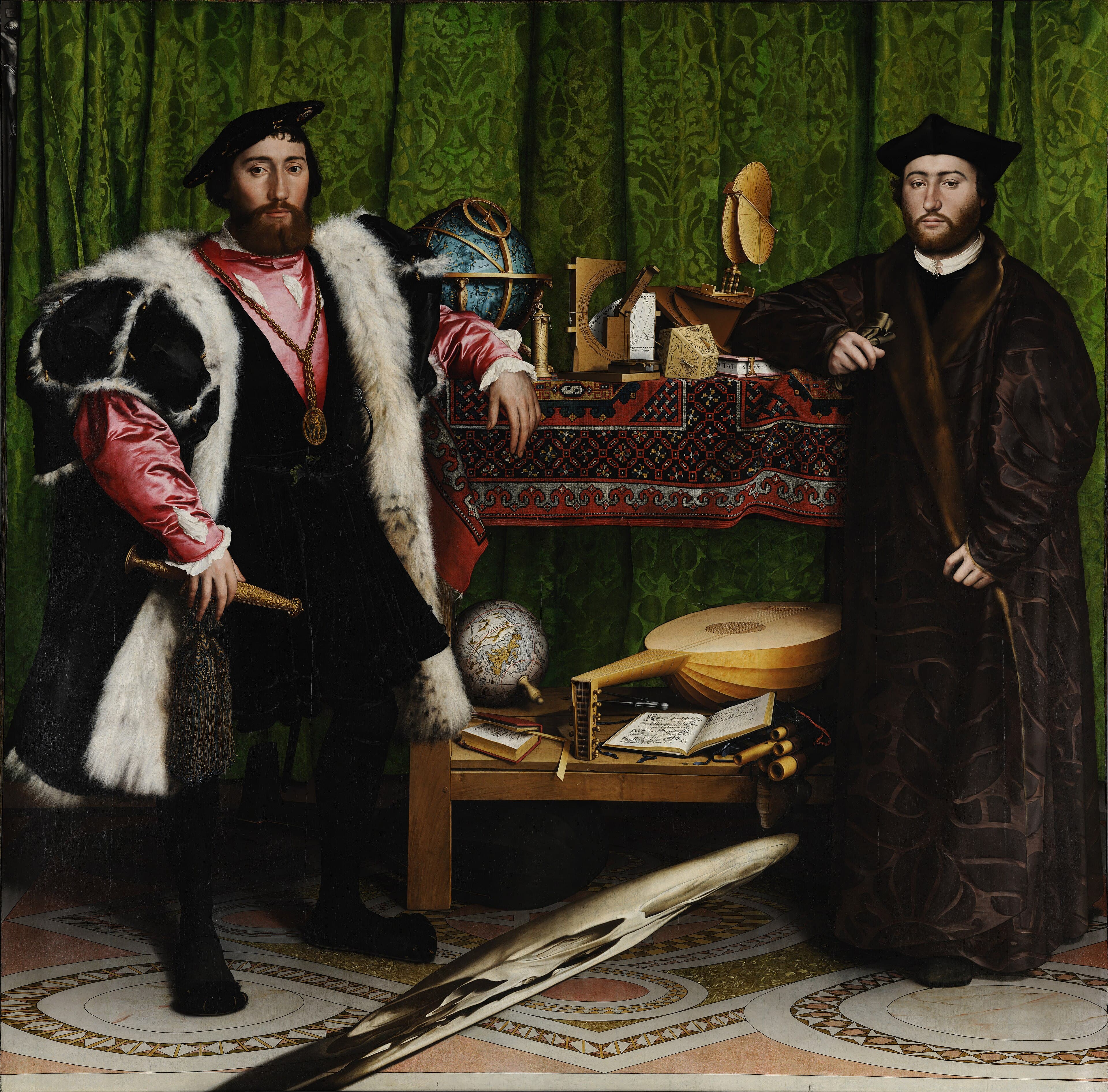
Hans Holbein the Younger was one of the finest portrait painters who ever lived, a German artist who worked in Basel and London and became painter to King Henry VIII. His most famous painting, The Ambassadors (1533), with its distorted skull floating across the floor, is in the National Gallery, London.
Life in brief
Holbein was born in Augsburg around 1497–98, the son of the painter Hans Holbein the Elder, who trained him. By 1515 he was in Basel, a center of printing and humanism, where he designed book illustrations and title pages, painted altarpieces and house façades, and portrayed the scholar Erasmus. His Dead Christ in the Tomb (1521–22, Kunstmuseum Basel), a life-size corpse laid out in a narrow box, is one of the starkest images of death in Western art. He also designed the Dance of Death woodcuts (c. 1523–26, published in 1538), in which a skeleton comes for pope, emperor, merchant and child alike.
The Reformation dried up religious commissions in Basel. With a letter from Erasmus he went to England in 1526, where he painted Sir Thomas More and his family, returned to Basel in 1528, and settled in London for good in 1532. By about 1536 he was working for Henry VIII. He painted the king, his courtiers and his prospective brides, including Christina of Denmark (1538, National Gallery) and Anne of Cleves (1539, Louvre), and the great Whitehall Palace mural of the Tudor dynasty, destroyed by fire in 1698. He died in London in 1543, probably of plague.
Style
Holbein's portraits are precise, cool and still. He made exact chalk drawings from life, many now in the Royal Collection at Windsor, and transferred them to panel, then rendered every fur, jewel and stitch with flawless finish. The sitters rarely smile, but their faces carry a strong sense of individual character.
The Ambassadors
The double portrait shows the French envoy Jean de Dinteville and his friend Georges de Selve, Bishop of Lavaur, standing beside a two-tiered table laden with globes, scientific instruments, books and a lute with a broken string. Across the floor slants a strange gray shape. Seen from the side, at a sharp angle, it resolves into a human skull: a memento mori hidden in plain sight. A small crucifix half-concealed by the curtain at the top left completes the meditation on death and faith.
Where to see his work
The National Gallery and the Royal Collection in Britain, the Kunstmuseum Basel, the Louvre, the Frick Collection in New York and the Thyssen-Bornemisza in Madrid hold key works. Explore Memento Mori and Vanitas, Danse Macabre and Renaissance Paintings.
Questions & answers
What is the skull in The Ambassadors?
The gray diagonal shape at the bottom of The Ambassadors is an anamorphic skull, painted in distorted perspective so that it only appears correctly when seen from the side at a steep angle. It is a memento mori, reminding viewers that death awaits even the most learned and powerful.
Where is The Ambassadors by Holbein?
The Ambassadors (1533) is in the National Gallery in London, which bought it in 1890. Painted in oil on oak panel, it measures about 207 by 210 cm, and it is usually displayed so that visitors can step to the side and see the skull resolve.
Was Holbein Henry VIII's court painter?
Yes. Holbein settled in England in 1532 and by about 1536 was working as the King's Painter. He created the famous image of Henry VIII standing with legs apart, known from the lost Whitehall mural, and painted many courtiers and royal brides.