German · Romanticism
Caspar David Friedrich
b. 5 September 1774, Greifswald, Swedish Pomerania — d. 7 May 1840, Dresden
Caspar David Friedrich (1774–1840) was the leading German Romantic landscape painter, famous for Wanderer above the Sea of Fog and for solitary figures seen from behind before mist, sea and moonlight.
1 work in the collection
Works by Caspar David Friedrich
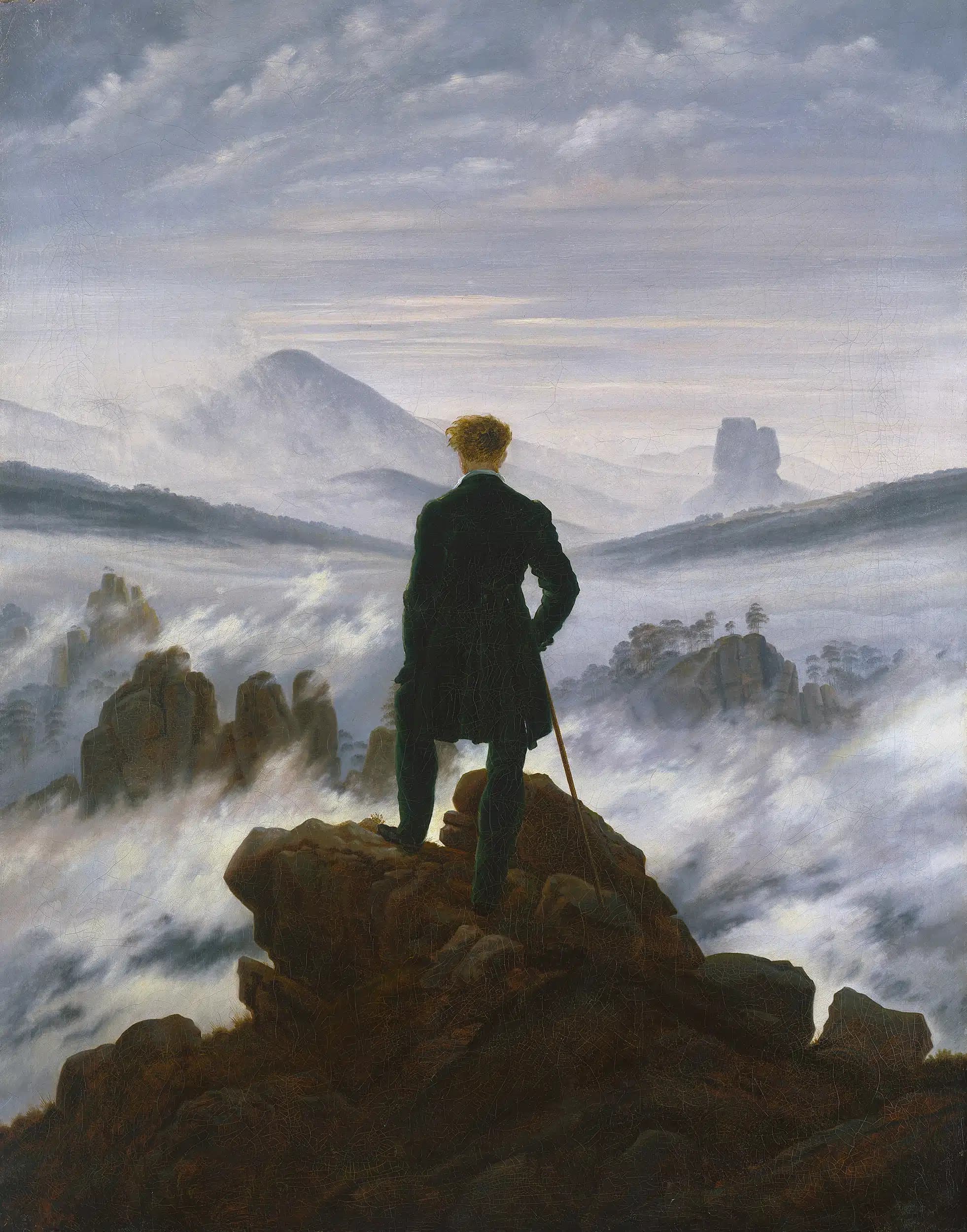
Caspar David Friedrich was the great painter of German Romanticism, whose quiet, symbolic landscapes turned mountains, coastlines and ruined abbeys into images of the soul. His best-known painting, Wanderer above the Sea of Fog (c. 1817), is in the Hamburger Kunsthalle.
Life in brief
Friedrich was born in 1774 in Greifswald, on the Baltic coast, then part of Swedish Pomerania. His childhood was marked by loss: his mother died when he was seven, and in 1787 his younger brother Johann Christoffer drowned after falling through ice, reportedly while trying to save him. He studied at the Copenhagen Academy from 1794 and in 1798 settled in Dresden, which remained his home. Trips to the island of Rügen, the Harz and the Riesengebirge supplied the motifs he combined in the studio.
His Cross in the Mountains (the Tetschen Altarpiece, 1808), a landscape used as an altarpiece, provoked a public quarrel, and in 1810 the Prussian crown prince bought The Monk by the Sea and The Abbey in the Oakwood. He married Caroline Bommer in 1818. A stroke in 1835 left him barely able to paint in oils, and by his death in 1840 he was largely forgotten. A Berlin exhibition in 1906 began his rediscovery.
Style
Friedrich built his pictures from drawn studies of real places, then arranged them into stark, symmetrical compositions. His signature device is the Rückenfigur, a figure seen from behind, standing in for the viewer as they face a landscape that seems too large to grasp. Light is cool and even, brushwork almost invisible, and the space often drops away from foreground to infinite distance with no middle ground.
Other key works include Chalk Cliffs on Rügen (1818, Museum Oskar Reinhart, Winterthur), Two Men Contemplating the Moon (1819–20, Dresden) and The Sea of Ice (1823–24, Hamburger Kunsthalle), a wreck crushed between upended slabs of ice.
Where to see his work
The Hamburger Kunsthalle, the Alte Nationalgalerie in Berlin and the Albertinum in Dresden hold the most important groups, celebrated in exhibitions for his 250th anniversary in 2024. Explore further in Romanticism and Dark Academia.
Questions & answers
What is Caspar David Friedrich's most famous painting?
His most famous painting is Wanderer above the Sea of Fog (c. 1817), showing a man in a dark coat, seen from behind, standing on a rocky summit above a sea of mist. It is in the Hamburger Kunsthalle in Hamburg, Germany.
Why does Friedrich paint people from behind?
The figure seen from behind, or Rückenfigur, invites the viewer to stand in the figure's place and share its contemplation of the landscape. Because the face is hidden, the scene becomes about the act of looking and about the individual's feeling before nature's vastness.
Where can I see Caspar David Friedrich's paintings?
The main collections are the Hamburger Kunsthalle (Wanderer above the Sea of Fog, The Sea of Ice), the Alte Nationalgalerie in Berlin (The Monk by the Sea, The Abbey in the Oakwood) and the Galerie Neue Meister in the Albertinum, Dresden.