Italian · Contemporary art
Graziano Locatelli
b. 1977, Italy
Graziano Locatelli (born 1977) is a self-taught Italian artist based in Milan who makes tile, concrete and mixed-media works about broken things, best known for walls of white tiles that crack open to reveal human figures.
1 work in the collection
Works by Graziano Locatelli
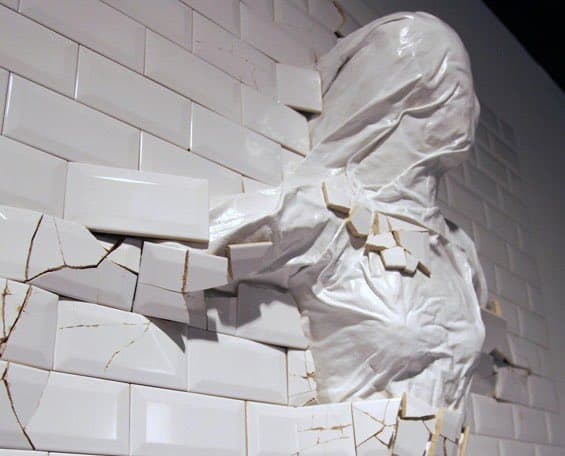
Graziano Locatelli is an Italian artist, born in 1977 and based in Milan, who makes sculpture and installations from tiles, cement, glue, metal plates, ceramics and broken glass. His signature works are walls of glossy white tiles that crack, bulge and shatter as if human figures were pushing through them. 1995 (detail) in our catalogue is one of these fractured pieces.
Life
Locatelli is self-taught. He grew up in the mountains near Bergamo, and he traces his subject to childhood: "During my chaotic childhood, I developed an intense and uncanny fascination towards broken objects," he has said, describing wrecked cars and ruined, abandoned mountain villages as his favorite sights. The attraction to things transformed by breaking became, in his words, the main theme of his work.
He began by experimenting with assembly techniques and humble, "poor" materials such as aluminum and broken glass, in the spirit of Italian Arte Povera, before arriving at the tile-and-cement works he is known for.
Style: the poetics of the crack
Locatelli's best-known works use the most anonymous surface in modern life: white ceramic subway tile, the kind that lines bathrooms, kitchens, hospitals and metro stations. Onto this clean grid he introduces damage. In some pieces a figure seems to burst out of the wall into the room, shards hanging off its shoulders. In others only hairline cracks run through the tiles, and the pattern of the cracks resolves, from a distance, into a human face. His series Returnature sets concrete against tile in a similar tension.
The effect is familiar and unsettling at once. Critics read the work as transferring the fragility of objects to the human body: the wall cracks the way a person breaks down, and the figure emerging from it may be escaping, or may be trapped. That double reading, release or collapse, gives the work its quiet drama. It also places Locatelli in a long line of artists for whom the ruin and the fragment are images of time and loss, from Romantic painters of ruins to contemporary artists such as Daniel Arsham, whose eroded casts treat the present as a future archaeological site.
1995 (detail)
The work in our catalogue, titled 1995 and shown here in detail, is a mixed-media piece of broken tiles, cement and other materials. Our legacy notes describe Locatelli's works as installed in everyday public spaces in Italy, but we have not been able to confirm where this piece is or when it was made; the title may refer to a year rather than the date of the work.
Where to see his work
Locatelli's work is shown through galleries and online platforms and is widely shared in design and art magazines. There are no museum holdings we can confirm. For related themes, see our guide to dark academia and death in art.
Questions & answers
Who is Graziano Locatelli?
Graziano Locatelli is a self-taught Italian artist born in 1977 and based in Milan. He makes tile, cement and mixed-media works about broken objects, especially white tiled walls that crack open to reveal human figures.
What materials does Graziano Locatelli use?
He works with ceramic tiles, cement, glue, metal plates, mosaics, aluminum and broken glass, often building white subway-tile walls that he cracks and shatters to suggest figures or faces.
Why does Locatelli make broken art?
He says that during a chaotic childhood near the mountains he became fascinated by broken objects, such as wrecked cars and ruined villages. Things transformed by breaking became the central theme of his work.