Belgian · Ligne claire · Franco-Belgian comics
Hergé (Georges Prosper Remi)
b. 22 May 1907, Etterbeek, Brussels — d. 3 March 1983, Woluwe-Saint-Lambert, Brussels
Hergé was the pen name of Georges Prosper Remi (1907–1983), the Belgian cartoonist who created Tintin in 1929. His clear-line drawing style and the 24 Adventures of Tintin made him one of the most influential comic artists of the 20th century.
1 work in the collection
Works by Hergé (Georges Prosper Remi)
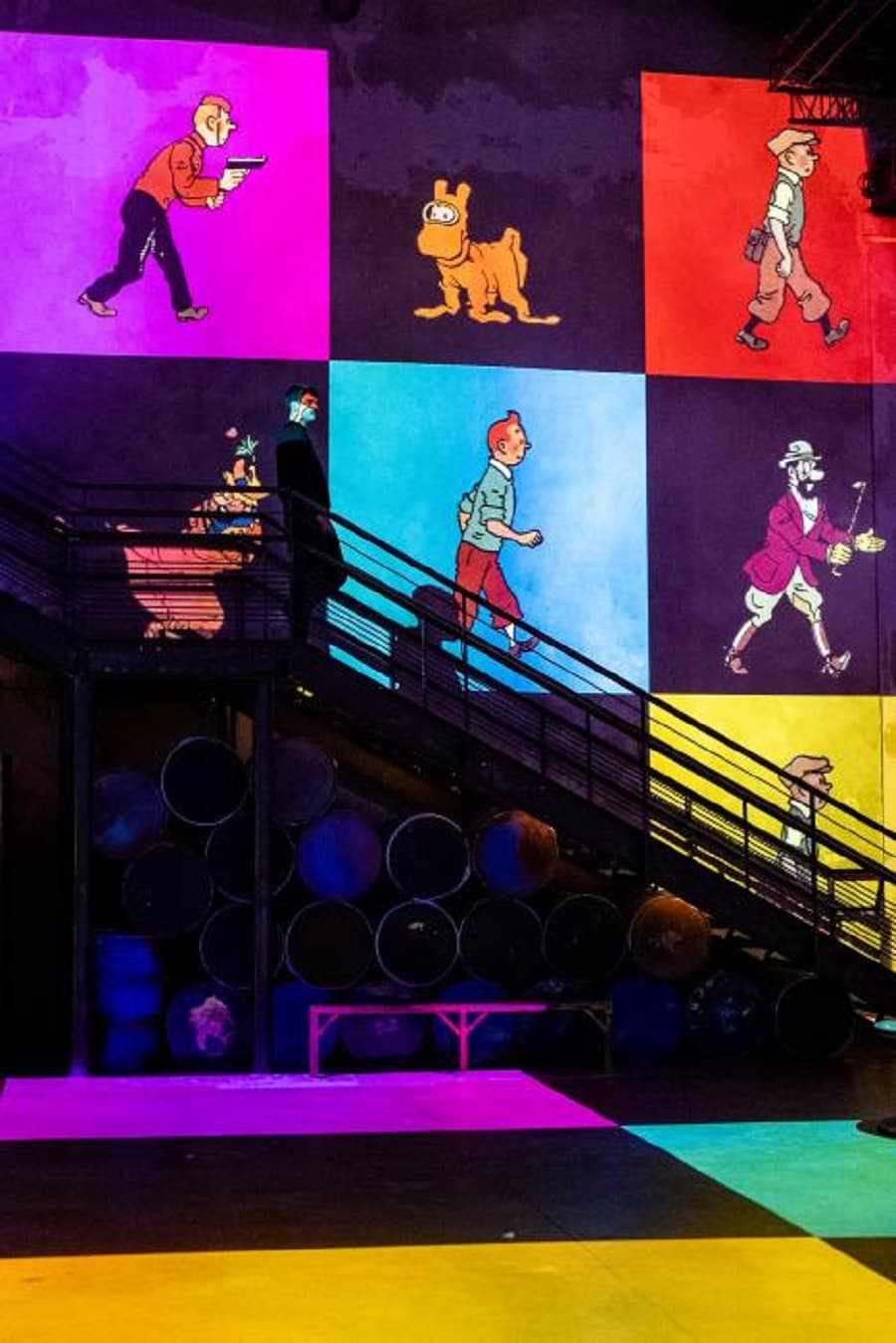
Hergé was the pen name of Georges Prosper Remi, a Belgian cartoonist born in Brussels in 1907 who created Tintin, the boy reporter with a quiff and a white fox terrier named Snowy. The Adventures of Tintin ran from 1929 until his death in 1983, have sold in the hundreds of millions in dozens of languages, and set the standard for European comics. The pen name comes from his initials reversed, R.G., pronounced in French "air-zhay." Our catalogue includes an immersive Tintin exhibition devoted to his world.
Life
Georges Remi was born on 22 May 1907 in Etterbeek, a district of Brussels, into a lower-middle-class family. He was a keen Boy Scout, and his first comic strip, Totor, appeared in a Scout magazine in 1926. Soon afterward he joined the Catholic daily Le Vingtième Siècle, whose director, Abbé Norbert Wallez, put him in charge of the paper's new youth supplement, Le Petit Vingtième.
There, on 10 January 1929, he launched Tintin au pays des Soviets (Tintin in the Land of the Soviets), a crude, anti-communist adventure reflecting the paper's politics. Its success was immediate, and Tintin went on to the Congo, America and beyond. A turning point came with The Blue Lotus (1934–35): Hergé met Zhang Chongren, a Chinese art student in Brussels, who taught him about China and Chinese brush painting and persuaded him to research his settings seriously. From then on, documentation became central to his method.
During the German occupation of Belgium, Hergé continued Tintin in Le Soir, a paper controlled by the occupiers. After the liberation he was briefly arrested and barred from publishing, an episode that has shadowed his reputation, along with the colonial and racial caricatures of his early albums, especially Tintin in the Congo. In 1946 the publisher Raymond Leblanc launched Tintin magazine with him, and in 1950 he founded Studios Hergé. Over the years collaborators such as Edgar P. Jacobs and Bob de Moor helped redraw the early albums in color and produce new ones. He died in Brussels on 3 March 1983, leaving Tintin and Alph-Art unfinished.
Style: the clear line
Hergé's drawing is defined by what the Dutch cartoonist Joost Swarte later named ligne claire, the "clear line": every contour drawn in a single, even black line, flat areas of color without hatching or heavy shadow, and figures and backgrounds given equal clarity. His characters are simplified, almost cartoon-round, while cars, planes, ships, buildings and costumes are drawn with near-documentary precision. The combination lets a reader take in a dense page instantly.
He was equally a master of storytelling: the pacing of a page, the cliffhanger at the bottom of the right-hand page, the slapstick timing of Captain Haddock, the Thom(p)son twins and Professor Calculus. Destination Moon and Explorers on the Moon (1953–54), with their carefully researched rocket, anticipated real spaceflight by fifteen years.
Key works
- The Blue Lotus (1936 album), his first fully researched story, set in China during the Japanese invasion.
- King Ottokar's Sceptre (1939), a thinly veiled satire of fascist expansion.
- The Secret of the Unicorn and Red Rackham's Treasure (1943–44), a two-part treasure hunt that introduced Marlinspike Hall.
- Destination Moon and Explorers on the Moon (1953–54).
- Tintin in Tibet (1960), written during a personal crisis, often considered his masterpiece.
- The Castafiore Emerald (1963), an experiment in an adventure where almost nothing happens.
Besides Tintin he created Quick & Flupke and Jo, Zette and Jocko.
Tintin as exhibition
Hergé's world has long since moved off the page and into museums. Major retrospectives have been held in Paris and Brussels, and in recent years his panels have been turned into immersive digital exhibitions, in which projected, animated scenes from the albums fill whole rooms: the rocket on its launch pad, the shark submarine, the streets of Shanghai from The Blue Lotus. These shows rely on the very qualities of the clear line, since flat color and clean contours enlarge to the scale of a wall without losing legibility.
Influence and where to see his work
Hergé's influence runs through European comics from Edgar P. Jacobs's Blake and Mortimer to Joost Swarte, Yves Chaland and many contemporary graphic novelists, as well as into film, notably Steven Spielberg's The Adventures of Tintin (2011). Andy Warhol made portraits of him, and his original pages now sell as fine art.
The Musée Hergé in Louvain-la-Neuve, Belgium, opened in 2009, holds original drawings and documents. His estate and rights are managed by Tintinimaginatio (formerly Moulinsart), which also licenses exhibitions. For more modern image-makers in our catalogue, see Norman Rockwell, another master of storytelling in a single picture.
Questions & answers
Who created Tintin?
Tintin was created by the Belgian cartoonist Hergé, the pen name of Georges Prosper Remi (1907–1983). The first story, Tintin in the Land of the Soviets, began in the youth supplement Le Petit Vingtième on 10 January 1929.
Why is he called Hergé?
The name comes from his initials reversed: R.G. for Remi Georges. Pronounced in French, 'R.G.' sounds like 'Hergé.'
What is the ligne claire style?
Ligne claire, or 'clear line,' is the style associated with Hergé: even, unbroken black outlines, flat colors and little or no hatching, with characters and backgrounds drawn equally clearly. The term was coined by Joost Swarte in 1977.
Where can I see Hergé's original drawings?
The Musée Hergé in Louvain-la-Neuve, Belgium, opened in 2009, holds original drawings, documents and objects from his career. Exhibitions are also organized by his rights holder, Tintinimaginatio.