Italian (Venetian) · Rococo · Late Baroque
Antonio Corradini
b. 1688, Venice — d. 12 August 1752, Naples
Antonio Corradini (1688–1752) was a Venetian sculptor famous for 'veiled' marble figures, above all Modesty (La Pudicizia, 1752) in Naples' Cappella Sansevero, where thin carved cloth seems to cling to the body beneath.
1 work in the collection
Works by Antonio Corradini
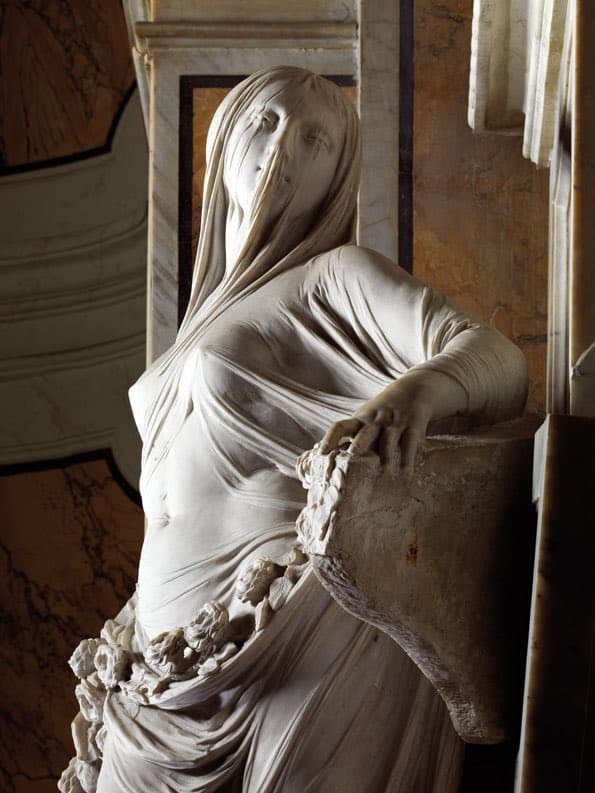
Antonio Corradini (1688–1752) was a Venetian Rococo sculptor who became famous across Europe for one illusion: a woman's body seen through a transparent veil, carved from a single block of marble. His last and most celebrated example, Modesty (also catalogued as La Pudicizia), stands in the Cappella Sansevero in Naples.
Life in brief
Corradini was born in Venice to a modest family; his father was a sail-maker. As a teenager he was apprenticed to the sculptor Antonio Tarsia, and later married his master's daughter. His early career was Venetian, but his reputation spread to the courts of northern Europe. He worked for Augustus the Strong in Dresden, and from around 1730 spent about a decade in Vienna as court sculptor to the Holy Roman Emperor Charles VI. In the 1740s he moved to Rome, where he carved The Vestal Tuccia (Palazzo Barberini), and finally to Naples, where he died in 1752.
The veiled figures
Corradini returned again and again to veiled women: Veiled Faith in Venice, a veiled bust often called Puritas, and the Roman Tuccia. The trick lies in carving the folds very shallow where the cloth touches the body, so the forms underneath (nose, lips, breasts) read through, while deeper folds fall loose at the edges.
Modesty in the Cappella Sansevero
In Naples, Prince Raimondo di Sangro commissioned Modesty as the tomb monument to his mother, Cecilia Gaetani dell'Aquila d'Aragona, who died young. The veiled woman leans on a broken tablet, and an oak tree grows behind her. Corradini finished it in 1752, the year he died. He had also prepared a model for a veiled dead Christ for the same chapel; the commission passed to Giuseppe Sanmartino, whose Veiled Christ (1753) became even more famous. For more marble illusions, see Famous Sculptures.
Where to see his work
The Cappella Sansevero in Naples, Ca' Rezzonico in Venice, the Palazzo Barberini in Rome and the Louvre all hold veiled figures by him.
Questions & answers
Who sculpted the veiled woman in the Cappella Sansevero?
The veiled figure of Modesty (La Pudicizia) in the Cappella Sansevero, Naples, is by the Venetian sculptor Antonio Corradini, completed in 1752. It is the tomb monument of Cecilia Gaetani, mother of Prince Raimondo di Sangro, who commissioned the chapel's sculpture.
How did Corradini carve a transparent veil in marble?
He carved the veil as a very thin layer of shallow folds that hug the body's forms, so the features beneath show through, while deeper folds hang free at the edges. The whole figure, veil included, is cut from one block of marble.
Did Corradini make the Veiled Christ?
No. Corradini made a model for a veiled Christ for the Cappella Sansevero but died in 1752. The marble Veiled Christ was carved in 1753 by the Neapolitan sculptor Giuseppe Sanmartino.