American · Genre painting · American historical painting
Jennie Augusta Brownscombe
b. 10 December 1850, Wyalusing, Pennsylvania — d. 5 August 1936, Bronxville, New York
Jennie Augusta Brownscombe (1850–1936) was an American painter and illustrator of colonial and Revolutionary history, best known for The First Thanksgiving at Plymouth (1914), and a founding member of the Art Students League of New York.
1 work in the collection
Works by Jennie Augusta Brownscombe
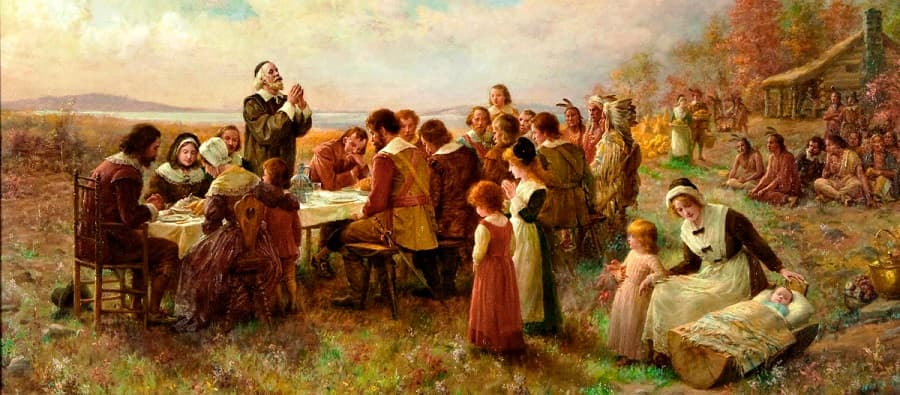
Jennie Augusta Brownscombe was an American painter, illustrator and etcher whose sentimental scenes of colonial and Revolutionary America were reproduced so widely on prints, calendars and greeting cards that her images shaped how several generations pictured the nation's past. Her best-known painting is The First Thanksgiving at Plymouth (1914), in the Pilgrim Hall Museum in Plymouth, Massachusetts.
Life in brief
Brownscombe was born in 1850 in Wyalusing, a small town in northern Pennsylvania, and was the only child of a farming family. She moved to New York to study at the Cooper Union School of Design for Women and the National Academy of Design, and in 1875 she was among the founding members of the Art Students League of New York, where she later also taught. In the early 1880s she studied in Paris under the genre painter Henry Mosler, and she spent many winters in Rome. She supported herself throughout her career by her work, selling reproduction rights to more than a hundred paintings to publishers, an unusual degree of independence for a woman artist of her time. She died in Bronxville, New York, in 1936.
Style and subjects
Her paintings are carefully drawn, brightly lit and full of costume detail: Pilgrims in dark wool and white collars, colonial brides, Washington and his officers. They belong to the Colonial Revival, the late nineteenth-century enthusiasm for early American life that also filled houses with reproduction furniture. Brownscombe painted history as domestic drama, often centered on women and children, and was more concerned with warmth and legibility than with historical accuracy.
The First Thanksgiving
In The First Thanksgiving at Plymouth a long table is set outdoors before the log houses of the colony; the Pilgrims bow their heads in prayer while Wampanoag men sit or stand at the edge of the gathering. The picture fixed a popular image of the 1621 harvest feast, though historians note that its costumes, setting and seating owe more to 1914 than to 1621. It sits naturally beside Norman Rockwell's later Thanksgiving image, Freedom from Want.
Where to see her work
The Pilgrim Hall Museum in Plymouth holds The First Thanksgiving; other paintings are in American public collections and historical societies, and her work is often found on period prints and calendars.
Questions & answers
Who painted The First Thanksgiving?
The well-known 1914 painting The First Thanksgiving at Plymouth is by the American artist Jennie Augusta Brownscombe. It hangs in the Pilgrim Hall Museum in Plymouth, Massachusetts.
Who was Jennie Augusta Brownscombe?
Jennie Augusta Brownscombe (1850–1936) was an American painter and illustrator from Pennsylvania who specialized in colonial and Revolutionary scenes. She was a founding member of the Art Students League of New York and sold reproduction rights to more than a hundred paintings.
Is The First Thanksgiving painting historically accurate?
Not in its details. Brownscombe painted it in 1914 in the spirit of the Colonial Revival, and historians point out that the clothing, buildings and arrangement of Pilgrims and Wampanoag reflect early twentieth-century ideas rather than evidence about the 1621 feast.